





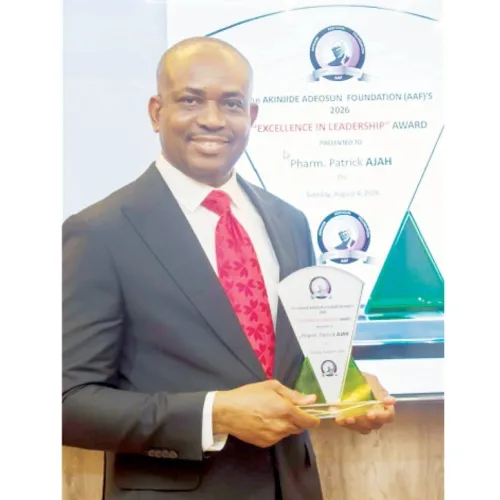
After receiving the Excellence in Leadership award from the Akinjide Adeosun Foundation (AAF), the Managing Director/CEO of May & Baker Nigeria Plc, Pharm Patrick Ajah, in this interview with CHIMA NWOKOJI, reveals his leadership style, hinged on the principle of “Leave no colleague behind.” He also delves into recent developments in Nigeria’s pharmaceutical industry and warns that If companies keep collapsing, the country will not be making meaningful progress. Excerpts:
You are being recognised for your leadership role as the Managing Director of May & Baker Nigeria, what is your assessment of leadership, especially as it relates to Nigeria today?
I appreciate the recognition being given to May & Baker by the Akinjide Adeosun Foundation (AAF). The company is a significant part of why this platform has been offered to me. It is not about friendship. All of us are challenged by the situation of the country today. Nigeria has faced major challenges before, but each time there is a need to point to the kind of leaders the country needs.
Leadership is the fact that a set of people have agreed on a destination and chosen somebody they believe can lead them there. If you cannot lead people to achieve an objective, there is no point in calling you a leader. In organisations like this, and many others where I have worked, leadership positions are not handed out casually. You go through proper screening. It is merit-based. Before I took this position, they asked searching questions going back to my university days. The reason is simple: they do not want us to mislead people.
When you step into the position, you see the essence of that. People are looking up to you and depending on you. The greatest part of leadership is understanding that it is not about you or what you can get for yourself. It is about how you lead people to the goal. For me, that is the most important part of leadership.
I know we need to achieve numbers and make profit, but if the people working with you are not fulfilled, the money your shareholders take will not erase the memory that you had opportunities to impact them and failed. That is why one of my key principles is “Leave no colleague behind.” As we try to achieve results, leave no colleague behind.
What challenges are facing the pharmaceutical sector in Nigeria as we speak?
The pharmaceutical sector has faced serious headwinds. When we left school, things were almost fun. You finished school, completed service, and got a job with the multinationals. I remember when GSK gave a colleague a brand-new Toyota Hiace. He drove it to the university and we all admired it. That was when I knew I wanted to be in this field. He taught me quite a bit.
Things were much better then, but they have changed significantly. Most of those companies we were proud of have either collapsed or left the country. It is more challenging now because we Nigerians are not going anywhere. Whatever challenges exist in the country, we face them. These companies have options. The moment the returns are no longer attractive, they pack their bags and leave. Many have done exactly that.
Power, infrastructure and related issues remain major problems. The next big challenge we are seeing is people. Most of our pharmacists are leaving the country, so finding good people to hold positions has become difficult. These are things the leaders of the country need to know. If companies keep collapsing, the country is not going anywhere. Companies like ours need to be encouraged to continue. I am proud that despite all these challenges, we are hiring people instead of losing them.
Power is a clear example. Before 2023, our monthly spend on power for the factory was about ₦65 million. Now, it is between ₦160 million and ₦175 million every month. We use gas, which is denominated in dollars. How many companies can afford that? By God’s grace, as our leaders keep listening, one day they will create a more enabling environment. Look at the road outside our facility. You pay so much tax, yet the road remains in that condition. They pass this same road to come and collect money from us, and every year, we are forced to pay for parking outside on a road they have not fixed.
Having identified brain drain in the pharmaceutical sector as a key challenge, what are some of the measures you think could be done to mitigate that? Can you profess some solutions to help retain pharmacists?
On brain drain and retaining pharmacists, I would say it is difficult, especially with this young generation. There are many schools of pharmacy producing more graduates. As a company, we offer opportunities for pharmacy students to visit our facility every year. We have been doing that for quite awhile with Professor Ahmed Mora, Pro-Chancellor and Chairman of Council at Egbinidion University and we are extending it to other interested schools. We want to show them the beautiful side of the profession. Some of those who visited two years ago are now doing their internship with us. One of them said the visit convinced him to go into manufacturing — an area most people previously avoided. When they see what is possible, they realise it is not just the glamorous picture that is painted. There are still places where people can be fulfilled.
We also try to offer leading wages — pay a little better than the average — and find other ways to make the environment attractive so that we lose fewer people.
Government has been encouraging local pharmaceutical manufacturing to reduce dependence on imports, what is your assessment? Has there been a reduction in importation of foreign drugs?
It has helped, largely because of the intention and effort of most of the local companies, rather than government alone. Last year, after a lot of push, we got the Executive Order granting duty waiver on locally produced products. That is a benefit, though some of my colleagues say it is only about five per cent of what you pay. Still, it is something. If we had started acting seriously more than 10 years ago when we began talking about it, the situation would be much better today. Now that many multinationals have left, we are not yet fully covering the spaces they vacated. The number of local manufacturers under PMG-MAN is now almost 200, and that will help. Locally produced products will be cheaper and will reduce the problem of fakes because local companies are monitored by NAFDAC. If someone fakes your product, it is easier to detect than when the manufacturer is outside the country. Before, the ratio was roughly 70 percent imported and 30 percent local. I believe we are now around 40 percent locally produced and still improving. For some key products, the situation is even better because of NAFDAC’s policies. Government policies remain very important in encouraging local manufacturing. By key products I mean those that people depend on for survival — antihypertensives, antidiabetics, antimalarials, paracetamol and similar essential medicines. When prices of these rise, many poor people simply drop out of treatment. All products are important, but especially those that most people need.
ALSO READ: Tinubu suspends three perm secs as another fake agency uncovered
How do you combat counterfeit drugs?
As local manufacturers, we have an advantage. Companies like ours have salespeople across the country. Most pharmacies know our people. When there is a challenge, they often call us first and say, “We notice this does not look right.” If the company is outside the country, it is much harder for them to detect fakes, especially now that many multinationals are no longer on ground. NAFDAC’s efforts have also helped, but Nigeria is very large, so it is difficult to fight everything. The more local manufacturers we have, the better we can address the problem because people are on the ground with networks across the country. Most people who were importing medicines into Nigeria in the past were not pharmacists. Pharmacists will not risk their licences. NAFDAC is now doing more of the independent market surveillance we used to push for — picking products from the market and testing them. That discourages sharp practices. When people are properly motivated, they do their work efficiently.
What is your experience in sourcing foreign exchange before and after unification of multiple FX regimes?
It was crazy. At some points between 2023 and 2025, about 65 percent of our time was spent looking for forex and managing it. The bigger problem was not just the high rate but the constant fluctuation. It made planning almost impossible because you would have to change prices almost every month. For companies like ours, that is very difficult. We tried to benchmark quarterly. Despite the fact that the rate is still high, the relative stability in the last one year has made things a lot easier because you can predict If it comes down further, it will be even better for the common man. This year I do not think we have done any price increase. Sometimes when my people want to raise prices, I look at the ordinary Nigerian who will buy our products and say we should hold a little longer.
Did May & Baker benefit from the 2020-2021 N100 billion CBN intervention fund for manufacturers. Is that the best way to help the sector?
The COVID relief fund was useful and we accessed it. Much of it was targeted at expansion and machinery, rather than just working capital, and it came at single-digit interest rates. It helped us make investments that would have been too risky otherwise. We opened a herbal factory at our facility in Ota to encourage products made from natural sources in Nigeria. We commercialised a sickle-cell product researched by NIPRD. Almost 100 per cent of that product is local; only the capsule shell is imported. We also have Roveda, a bitter-leaf capsule developed from research by a professor in Benin. With that fund we could make these long-term investments. No serious company will borrow at 33 percent to invest in a factory that will take at least five years to start breaking even. Most of us currently operate with gross margins in the range of 35–40 percent. The fact that CBN has stopped such interventions is not helpful. We are not yet where we need to be. The Bank of Industry was also helpful at some point, but for more than a year now they have not done much. They need to do more to encourage local manufacturing.
What is your assessment of the company and its future outlook?
Because we are a publicly quoted company, our results are out there. In the last one month I have received a barrage of interest after our half-year results were published. BusinessDay ranked May & Baker best in terms of profit margin among the pharmaceutical companies. I have had not fewer than 10 companies from America and Europe wanting to explore partnerships.
People want to come back and invest. Europe is a bit stagnant and America has its issues. If you are looking at Africa, Nigeria is the place. South Africa currently has challenges, so this is an opportunity for Nigeria. Sometimes when you give the true picture — power, insecurity, infrastructure — some of them pause. But those who have done business here before understand that Nigerians always find a way. In the last five years we have quadrupled our revenue. I have challenged my team that in the next three years we will double from where we are now, and they believe it is possible. Other local companies like Fidson are also doing well. The gap left by the multinationals has not yet been fully filled. Can it be filled in the next 10 years? It is possible if we keep making progress. One of our core values is faith in God. Things people think cannot be done can be done by Nigerians.
How does your sales team navigate insecurity challenges across the country?
Even with the security and infrastructure challenges, progress is possible, but we must work on fixing those things. There are parts of the country where we do not allow our representatives to go, especially at the peak of insecurity. A conducive environment is what people need to make investments. I hope that in the next couple of years we can address these issues. The Nigeria we have is not yet the Nigeria we expect.
Recently, there have been complaints about the effectiveness of antimalarial drugs?
I do not think there is something fundamentally wrong with the antimalarial drugs from reputable companies. We all remember that we used to use chloroquine. Because people did not always abide by the recommended dosage, resistance developed and chloroquine was eventually suspended. The artemisinin-based combinations that are now standard were validated as better. We will need to keep monitoring for any emerging resistance. These combinations may not act as fast as chloroquine used to, but chloroquine had serious side effects. Another combination exists but is less used because of side effects. When treating malaria, people often fail to rest as advised. Malaria comes with fever and other symptoms. The drug is working, but it takes time — that is why the course is three days. When doctors see that a patient is not improving quickly enough, they may add injections because they act faster. For now, I do not believe we have a widespread resistance problem. Sometimes people simply need more rest and proper management of the accompanying symptoms.
So many cough syrups have been discontinued, what exactly is the problem?
Most cough syrups containing certain agents that were being abused have been suspended. We also remember the challenges Emzor faced. We still have one product that we can no longer produce because of the restricted agents in it.
How do you handle human capital, especially in the area of team work and succession planning?
People are very important. Recently, the General Manager, Sales and Marketing, left. Finding a replacement has been challenging, but we eventually got someone who will resume in September. In the meantime, I appointed our Head of Audit and Compliance — who is very passionate about the numbers and sends people to audit and identify gaps — to chair the sales operations meetings. He is doing a fantastic job. The team makes it happen. We all share the same objective. In the last five years the economy has been tough, but our board meetings are much better because when you do the right work, the board mostly has congratulations for you. The team is critical.
Comments
Start the conversation about this story.