





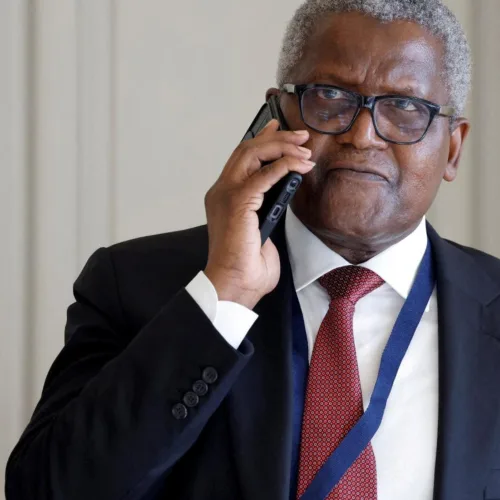
Aliko Dangote, founder and chief executive officer of the Dangote Group.
Africa’s richest man could not find a single ship to transport just 1,000 tonnes of his cement from Nigeria to nearby Ghana. He now wants to buy his own.
Dangote Industries Limited, the largest industrial conglomerate in West Africa headed by billionaire Aliko Dangote, said it is planning to acquire vessels capable of carrying its industrial products to regional markets, where it currently relies on tax-heavy road networks.
“We are moving forward towards getting our own ships in order to do this business,” Sada Ladan-Baki, head of international trade export at Dangote Cement, said Tuesday at a seminar on non-oil exports.
The company began exporting cement 16 years ago and has now attained 50 million metric tons of annual production capacity. By June this year, the Group had produced 1.1 billion MT of fertiliser, almost equalling the entire production for 2025 that contributed over eight percent of non-oil exports in the period.
But it has not perfected logistics. To constantly meet the demands of its buyers in the Economic Region of West African States (ECOWAS) and parts of Central Africa like Cameroon, the group set up assembly plants that churned out 7,000 trucks needed for road deliveries. That has proven costly.
“If we are going to export our cement from here to Ghana, we have to pay Value Added Tax (VAT) of 18 percent in Benin. We pay in Togo. We pay another 18 percent if we are going to Ivory Coast. So by the time [the trucks] get to these places, the taxes these countries charge us has already made us dead on arrival. How can Nigerian companies become competitive with all these barriers? Ladan-Baki said.
The company’s silver bullet is seaborne trade. The only problem is that it cannot find the ships.
“As of today…you cannot get a ship that will take your goods from here to Ghana. None. And that is for 1,000 metric tons, what the small traders and the business people can do,” Ladan-Baki said.
Since Nigeria’s National Shipping Line collapsed in 1995 after 36 years as a state-owned enterprise, the country has struggled to regain control of its waterways, losing almost all of the $6 billion in freight earnings generated annually to foreign shippers.
Read also: Inside Nigeria’s $6bn freight market where local investors are missing
Large companies have naturally committed to filling the gap themselves rather than waiting for help to come. In 2022, BUA Group, owned by billionaire Abdul Samad Rabiu, took delivery of two vessels purchased for sugar exports to West Africa. The company said the vessels would berth at its port/terminal in Rivers and increase export capacity while reducing operating costs.
Dangote Group itself owns dedicated port terminals at Onne and Apapa ports and, to solve capacity gaps, built a jetty at Lekki in Lagos to accommodate the ships that will move the products of its $20 billion refinery plant.
Its latest project will need extra support. Ladan-Baki called for the activation of Nigeria’s 23-year-old idle $700m Cabotage Vessel Financing Fund (CVFF) designed to finance the building and acquisition of ships for Nigerians.
The government opened up a portal for applications in January this year, promising disbursement in 90 days. Seven months later, shipowners are still waiting for their first disbursement.
Read also: Nigeria’s $700m maritime rescue fund caught in approval maze
Ladan-Baki said commercial banks, together with institutions such as Afreximbank, should take a leading role in financing vessel acquisitions and developing Nigeria’s shipping capacity to enable it to play a bigger role in the African Continental Free Trade Area (AfCFTA).
“We can only succeed if our two hands are clapping. We will only be happy if the country is self-sustaining in terms of shipping,” he said.


Bethel Olujobi reports on trade and maritime business for BusinessDay with prior experience reporting on migration, labour, and tech. He holds a Bachelor's degree in Mass Communication from the University of Jos, and is certified by the FT, Reuters and Google. Drawing from his experience working with other respected news providers, he presents a nuanced and informed perspective on the complexities of critical matters. He is based in Lagos, Nigeria and occasionally commutes to Abuja.
Comments
Start the conversation about this story.