





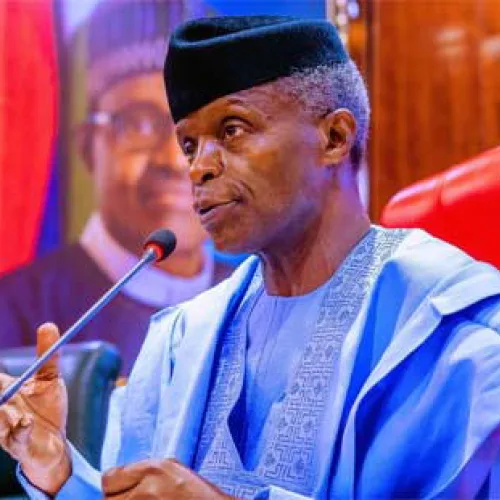
Former Vice-President Yemi Osinbajo says Nigeria must embrace Open and Distance Learning (ODL) to meet the growing demand for university education.
Osinbajo spoke on Tuesday at the University of Lagos’s Distance Learning Institute’s (DLI) Fifth International Colloquium in Lagos.
The colloquium had the theme: “Reimagining Open Distance Learning Ecosystem: Technology, Policy and Institutional Priorities”.
Osinbajo said that more than 2.2 million young Nigerians sought university admission annually, while the country’s tertiary education system historically admitted only about 25 per cent.
He said Nigeria’s population could approach 250 million by 2036, with annual university applicants potentially rising to 2.7 million or exceeding three million.
According to him, conventional universities cannot provide enough lecture theatres, laboratories, hospitals and physical campuses to accommodate the projected demand.
He described ODL as a national necessity rather than an alternative to conventional university education.
Osinbajo said technology, particularly Artificial Intelligence (AI) could enable institutions to combine mass access with personalised learning.
He said that with such an arrangement, thousands of students would have access to AI tutors capable of explaining concepts, testing understanding, translating materials and providing personalised feedback.
Osinbajo said that professionals would increasingly need to acquire new skills as technology would transform sectors including law, accounting, banking and engineering.
He stressed that technology should remain a tool for human development, adding that its value would lie in expanding human capabilities and opportunities.
Osinbajo urged stakeholders to develop practical policies on technology, lecturer training, assessment and AI to prepare Nigeria’s higher education system for future demands.
He said that distance learning could eventually become the principal means through which Nigeria would fulfil its promise of university education to millions of citizens.
The former vice-president commended UNILAG’s DLI for pioneering role in distance learning, and urged it to help to shape the sector.
Earlier, the Vice-Chancellor of UNILAG, Prof. Folasade Ogunsola, said that ODL was critical to expanding access amid Nigeria’s growing youth population.
Ogunsola said Nigeria had about 89 million youths aged between 15 years and 30 years.
She said the traditional university model could no longer adequately cater for the country’s growing demand for higher education.
According to her, ODL model provided opportunities for workers, persons with disabilities and people living far from university campuses to access flexible higher education.
Ogunsola said that UNILAG no longer indicated distance learning on certificates, reflecting its position that ODL graduates should enjoy equal recognition with conventional graduates.
She said that ODL should move beyond content delivery to connected learning, improved engagement, personalised education and stronger learning outcomes.
The vice-chancellor said that AI could support personalised learning, immediate feedback, content development, assessment and early identification of struggling students.
She emphasised the need to ensure academic integrity, data privacy and intellectual property while applying ODL model, saying that algorithmic bias and digital inequality were challenges.
Ogunsola urged stakeholders to develop policies supporting innovation while protecting academic standards, equity and the integrity of qualifications.
She also called for institutional strategies that would make ODL an integral part of universities’ core operations.
Prof. Risikat Dauda, Director of UNILAG’s DLI ,said that ODL was becoming central to expanding access, closing skills gaps and preparing citizens for a changing labour market
Dauda said that Nigeria’s ODL ecosystem still faced challenges including inadequate broadband, high data costs, digital literacy gaps and concerns about employers’ perception of ODL qualifications.
She urged stakeholders to ensure that recommendations from the colloquium would translate into institutional strategies, regulatory guidelines and national policies.
Dauda said Nigeria could not afford to allow valuable ideas from the colloquium to remain in a communique.
She described the future of ODL as flexible, lifelong and increasingly technology-driven, while stressing the need to preserve its human purpose.
The colloquium featured Osinbajo as Chairman, while Emeritus Prof. Stephen Brown delivered the keynote address.
Participants included academics and policymakers from Nigeria, Ghana, United Kingdom and other countries.
The post Distance learning now national necessity not alternative – Osinbajo appeared first on Vanguard News.
Comments
Start the conversation about this story.