





…N3trillion aid in 31 months
When Nigeria’s electricity regulator dissolved the board of Kaduna Electricity Distribution Company on Aug. 10, it cited a company that owed more than it could pay and had no plan to close the gap.
Nine months of market data analysed by BusinessDay showed Kaduna DisCos weren’t outliers, as Nigeria’s electricity distribution companies are drowning in debt while the federal treasury bleeds billions of naira to keep the lights on for consumers who still can’t get reliable power.
In Africa’s most populous country, the power tariff is built on a model in which customers with reliable service pay a premium rate, and that premium is supposed to subsidise cheaper power for everyone billed lower down the ladder.
In practice, that cross-subsidy barely exists. Government, not premium customers, is the one closing the gap, and it is closing most of it for nearly every distribution company in the country.
“The design assumes Band A customers are carrying Band E,” said Timothy Agbaje, an analyst at Electron Intelligence, an independent research firm and intelligence platform that tracks Nigeria’s power sector. “What we found is that nobody’s customers are carrying anybody. It’s government, almost everywhere, almost all the time.”
Data from Nigerian Bulk Electricity Trading (NBET) Plc and Nigerian Electricity Regulatory Commission (NERC) market obligation data showed that only two of Nigeria’s eleven DisCos—Eko and Ikeja, both in Lagos — keep government subsidy dependence below 53 per cent, at 51.5 per cent and 52.3 per cent, respectively.
The other nine range from 53.6 percent in Abuja to 82.6 percent in Yola. Even in Lagos, where dependence is lowest, the government is still covering roughly half the wholesale power bill.
Nigeria’s top-tier customers pay N225 per kilowatt-hour. Customers on the lowest tariff pay N32.26, about a sixth of that.
No DisCo’s blended tariff gets even 55 percent of the way from the bottom of that range to the top. Kano, Abuja and Eko collect the most per kilowatt-hour on average, near N129; Benin, Kaduna and Ibadan collect the least, under N98.
Read also: Nigeria turns back to petrol imports as local supply falls
Even Kano, the country’s strongest performer, recovers just over half the distance between the cheapest tariff and the premium one.
“There’s a premium tier on paper, and there’s a market that doesn’t run on it,” said David Oni, also of Electron Intelligence. “That distinction matters because it tells you the subsidy isn’t a top-up anymore. It’s the base case.”
The federal government subsidy dependence across the market stood at 18.7 per cent in 2022. It reached 62.6 percent in 2024, eased slightly to 57.4 percent in 2025, still triple what it started.
BusinessDay’s findings showed Nigeria spent N3.14 trillion on electricity subsidies between June 2023 and December 2025 to shield consumers from the impact of electricity tariff increases.
The government said the subsidy helped cushion consumers from the impact of higher electricity tariffs amid reforms in the power sector.
The subsidy bill stood at N177 billion in 2023 before rising by more than 740 percent to N1.48 trillion in 2024. As of December 2025, the subsidy expenditure stood at N1.47 trillion, representing a 1.14 percent decline from the previous year.
Electron Intelligence’s data ties that climb to a weakening naira rather than any policy decision to expand support.
NBET’s invoices to DisCos are pegged to dollar-denominated generation and gas costs; when the currency slides, those invoices rise in naira terms regardless of what’s happening on the ground, and the government absorbs the difference rather than passing it to customers.
“If the cross-subsidy were actually funding itself, dependence would move with how many premium customers a DisCo has, and it would hold roughly steady,” Oni said. “Instead, it moves with the exchange rate. That’s the tell.”
Collection is the other half of the story
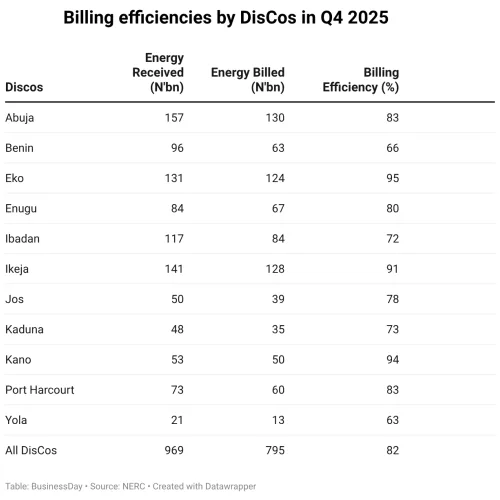
Eko and Ikeja also post the country’s best collection efficiency, at 87.9 percent each. Jos and Kaduna sit at the other end, recovering less than half of what they bill, 46.1 percent and 45.7 percent — with subsidy dependence at 61.0 percent and 66.4 percent.
The mechanics are unforgiving: a DisCo’s obligation to NBET is set by what it bills, not what it actually collects. Bill $170 million and collect $75 million, and the $95 million shortfall doesn’t disappear; it falls to the government to cover, regardless of whether the gap came from a below-cost tariff structure or from customers who were billed and simply never paid.
“Kaduna is what happens when both problems hit at once,” said Joseph Ibeh of Electron Intelligence. “A weak customer mix limits what you can bill in the first place. Poor collection then cuts into what little you did bill. Neither one offsets the other — they compound.”
Kaduna’s cash collected per kilowatt-hour came to $0.031, just $0.007 above the $0.024 floor charged to the country’s lowest-paying, least-reliable customers.
Benin, by contrast, had a weak customer mix too, but strong collection kept its cash-per-kWh at $0.055 — 2.3 times the floor rate, versus Kaduna’s 1.3 times.
“In practical terms, Kaduna was earning almost the same per unit of power as it would have if every customer in its territory was billed at the cheapest tariff on the ladder,” Ibeh said. “That leaves no buffer. Not for a bad quarter, not for a currency move, not for anything. That’s the position NERC’s order describes.”
Yola presents a variation on the pattern. Its collection efficiency, 63.6 percent, is middling, better than Kaduna’s or Jos’s.
But its subsidy dependence, 82.6 percent, is the highest in the country, because its revenue base is simply too small: $42.3 million billed against Kaduna’s $90.1 million, with distribution losses high enough that little of what it bills comes from premium-rate customers at all.
Read also: Oil prices slip as markets await new Iran sanctions
“Yola shows you collection isn’t the whole answer,” Agbaje said. “Some DisCos don’t have enough customers who can pay a cost-reflective rate to begin with. You can collect on every invoice you send and still be structurally short.”
Last Thursday, the House of Representatives Public Accounts Committee ordered 11 electricity Distribution Companies (Discos) to appear before it over a combined debt of N2.6 trillion owed to the federation.
According to the Senate Committee, Abuja Disco owes N330.4 billion, Eko Disco N231 billion, Benin Disco N233.2 billion, Enugu Disco N258.3 billion, Ibadan Disco N325.7 billion, and Ikeja Disco N310 billion,
Others are Jos Disco N161.7 billion, Kaduna Disco N277.7 billion, Kano Disco N211.7 billion, Port Harcourt Disco N239.7 billion, while Yola Disco is indebted to the tune of N107.4 billion.
What comes next
Electron Intelligence’s analysts are watching three things: whether that audit happens, whether the 2027 phase-out comes paired with a tariff increase, and whether NERC applies the treatment it gave Kaduna to other DisCos. Jos and Yola carry the next-weakest combination of collection efficiency and subsidy dependence, making both candidates.
“A board dissolution can address a commercial failure,” he said. “It can’t add megawatts to the line or secure a transmission tower under threat. Whether the regulator’s next move draws that distinction will say more about what NERC can actually fix than the intervention itself.”
Nigeria’s electricity market is structured around 11 distribution companies (DisCos), each assigned to specific states, with Lagos being the only state served by two separate companies.
The Benin Electricity Distribution Company (BEDC) supplies electricity to Delta, Edo, Ekiti, and Ondo states, while the Kaduna Electricity Distribution Company (KEDC) covers Kaduna, Kebbi, Sokoto, and Zamfara.
Kano Electricity Distribution Company (KEDC) is responsible for Kano, Katsina, and Jigawa states, whereas the Yola Electricity Distribution Company (YEDC) handles Adamawa, Borno, Taraba, and Yobe. The Jos Electricity Distribution Company (JEDC) supplies Bauchi, Benue, Gombe, and Plateau states.
In the central region, the Abuja Electricity Distribution Company (AEDC) covers the Federal Capital Territory alongside Kogi, Nasarawa, and Niger states.
The Ibadan Electricity Distribution Company (IBEDC) oversees Kwara, Ogun, Osun, and Oyo states.
Lagos is split between the Ikeja Electricity Distribution Company (IEDC) and the Eko Electricity Distribution Company (EKEDC).
The Port Harcourt Electricity Distribution Company (PHEDC) serves Akwa Ibom, Bayelsa, Cross River, and Rivers states.
In the South-east, the Enugu Electricity Distribution Company (EEDC) supplies Abia, Anambra, Ebonyi, Enugu, and Imo states.


Dipo Oladehinde is a skilled energy analyst with experience across Nigeria's energy sector alongside relevant know-how about Nigeria’s macro economy. He provides a blend of market intelligence, financial analysis, industry insight, micro and macro-level analysis of a wide range of local and international issues as well as informed technical rudiments for policy-making and private directions.
Comments
Start the conversation about this story.