





By Olusegun Odunewu
For thousands of Nigerians who travel between Lagos, Ogun and Oyo states daily, the Lagos-Ibadan Expressway has increasingly become more than a major transport corridor. It has become a source of anxiety, uncertainty and, in many instances, a graveyard.
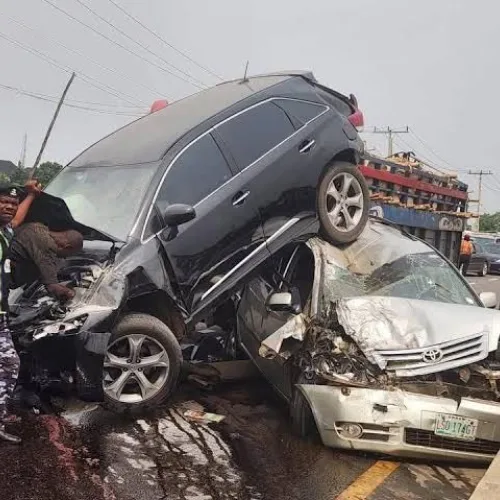
The latest tragedy occurred on Monday, August 24, 2026, when seven people were killed and two others injured in a multiple-vehicle crash at Kara, Ibafo, along the Lagos-Ibadan Expressway.
The Federal Road Safety Corps (FRSC), Ogun State Command, said the crash, which occurred at about 12:03 a.m., involved a white HOWO CNG/CIMC ENRIC truck, a white Mack trailer and a Mitsubishi Canter. The agency identified speed violation as the probable cause, although investigations are continuing.
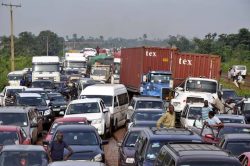
The latest incident has once again raised concerns about the safety of one of Nigeria’s most strategic highways and the devastating consequences of accidents that frequently result not only in loss of lives and property, but also in hours of traffic gridlock and massive losses in productivity.
A Road That Never Seems to Escape Crashes
The August 24 tragedy came barely a month after another fatal multiple crash at the notorious Kara Bridge axis.
On July 24, 2026, a collision involving five articulated trucks and a Toyota Sienna occurred around 12:05 a.m. on the outbound carriageway towards Ibadan. The FRSC attributed the initial crash to speed violation and loss of control.
While rescue operations were ongoing, another crash occurred on the inbound carriageway, involving a Mazda commercial bus whose driver reportedly suffered serious injuries following brake failure.
READ ALSO; Overturned trailer causes severe gridlock on Lagos-Ibadan Expressway, motorists turn to bush paths
The incidents left one person dead and two injured, while hundreds of motorists were trapped in traffic. The resulting gridlock stretched beyond Otedola Bridge and affected adjoining roads, with economic activities also disrupted.
The Kara Bridge incident was particularly significant because it demonstrated how quickly a single accident on the expressway can become a wider transportation crisis.
Once a trailer or tanker crashes, emergency responders must secure the scene, rescue victims, remove damaged vehicles and sometimes deal with fire or spilled cargo. During that period, thousands of vehicles can be trapped behind the obstruction.
Six Dead, Ten Hours Lost
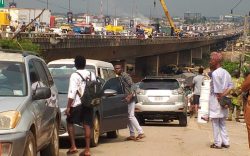
Another major incident occurred in June 2026 at the Ibadan Toll Gate section of the expressway.
A multiple-vehicle crash involving tankers, articulated trucks and cars claimed six lives and triggered a traffic lockdown that left hundreds of motorists and passengers stranded for more than 10 hours.
The crash occurred near Eleja Bridge around the Guru Maharaji area of Ibadan and affected traffic in both directions. Preliminary findings by the Oyo State Fire Service suggested that brake failure may have contributed to the incident.
For commuters, the damage from such incidents cannot simply be measured by the number of people killed or injured.
A worker who should spend eight hours at work may spend several additional hours sitting helplessly in traffic. A businessman travelling to Lagos for an appointment may miss the meeting.
A student may miss an examination. A patient travelling for medical treatment may arrive late. Perishable goods may be damaged, while transport operators burn thousands of naira worth of fuel without moving significant distances.
In other words, every major crash creates a secondary crisis of wasted time, fuel, productivity and economic opportunity.
The Numbers Paint a Grim Picture
The frequency of crashes is reflected in official road safety data.
A Federal Road Safety Corps report obtained by PUNCH showed that 175 crashes were recorded on the Lagos-Ibadan Expressway between January and March 2025, involving 1,271 people.
Of those involved, 73 died while 393 sustained injuries. January recorded 21 deaths, February 30 and March 22.
The figures are disturbing because the Lagos-Ibadan Expressway is not merely a regional road.
The 127.6-kilometre corridor connects Lagos, Nigeria’s commercial capital, with Ogun and Oyo states and provides a major link to several parts of the country.
READ ALSO; Darkness returns to Longbridge as vandals remove 168 Solar streetlights on Lagos-Ibadan Expressway
A major disruption on the highway therefore has implications for national logistics, interstate commerce, passenger movement and supply chains.
A 2025 report described the highway as Nigeria’s deadliest, citing 645 deaths and 3,964 injuries from 1,557 crashes recorded over a 27-month period. Experts interviewed in that report pointed to factors including overspeeding, vehicle maintenance challenges and the need for stronger safety measures.
When an Accident Becomes a Traffic Disaster
Perhaps the most troubling aspect of the Lagos-Ibadan Expressway crisis is the chain reaction that follows a crash.
An accident may initially involve two or three vehicles and a handful of victims. But once the vehicles become obstacles on the carriageway, the incident can affect tens of thousands of road users.
The July Kara Bridge crash provided a clear example.
Traffic was reported to have backed up towards Otedola Bridge and beyond, while adjoining routes were also affected. Some commuters reportedly abandoned vehicles and trekked, while others sought commercial motorcycles to escape the congestion.
A similar situation occurred in June when a tanker collision caused a traffic lockdown lasting more than 10 hours.
This means the true cost of an accident is substantially larger than the immediate casualty figure.
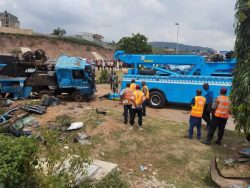
There is the direct cost of lives lost, medical treatment and damaged vehicles. Then there is the invisible economic cost: lost working hours, missed appointments, delayed deliveries, wasted fuel, increased transport fares and additional pressure on alternative roads.
Road Condition, Driver Behaviour and Vehicle Safety
The causes of crashes on the expressway are not always the same. In recent incidents, authorities have cited speed violation, loss of control, brake failure and tyre bursts.
In April 2026, for instance, a Toyota Hiace bus crash near Christopher University on the Mowe section killed four people and injured eight others. The FRSC attributed the crash to a tyre burst combined with excessive speed.
This raises questions about the condition of commercial vehicles, particularly articulated trucks, trailers, tankers and interstate buses that use the highway extensively.
FRSC officials have repeatedly urged drivers to avoid excessive speed, maintain safe following distances and remain vigilant, particularly at night when poor visibility and fatigue can increase the risk of crashes.
But experts and road safety advocates argue that blaming drivers alone will not solve the problem.
The GO FORTE Foundation, in a January 2026 intervention, identified a section around the Mobil Filling Station and Otedola Estate access as a recurring accident hotspot. The group said the downward slope creates a “natural acceleration zone” for heavy vehicles and called for a technical audit and permanent engineering solutions.
READ ALSO; One killed, two injured as multiple crashes snarl traffic on Lagos-Ibadan Expressway [VIDEO]
Its recommendations included speed-calming measures, heavy-vehicle lane management, escape ramps, improved signage and lighting, gradient re-engineering and stronger enforcement of vehicle weight regulations.
Such recommendations point to a broader truth: road safety requires a combination of responsible driving, vehicle roadworthiness, effective enforcement, good engineering and rapid emergency response.
The Problem of Emergency Response
Another critical issue is how quickly accident scenes are cleared.
Every minute a crashed truck, trailer or tanker remains across a carriageway increases the possibility of a longer traffic queue.
The FRSC’s response to the August 24 crash at Ibafo was relatively quick. The agency said its Ibafo Outpost received the report at about 4:04 a.m. and arrived at the scene approximately five minutes later.
However, rapid arrival does not necessarily mean rapid clearance.
Large articulated vehicles require specialised recovery equipment, while tanker fires and hazardous cargo create additional complications.
In a June 2025 tanker fire, commuters were stranded for hours after a fuel-laden tanker overturned and caught fire. Reports at the time highlighted concerns about emergency coordination and the difficulty of quickly removing obstructions from the highway.
This is why emergency response on the corridor needs to be treated as a permanent infrastructure requirement rather than an ad-hoc operation.
Strategically positioned heavy-duty tow trucks, ambulances, fire engines and traffic management teams could substantially reduce the time between a crash and restoration of normal traffic.
The Kara Bridge Warning
The recurring incidents around Kara should also be treated as a warning.
In July 2026, the Federal Government put on hold planned reconstruction of a failed expansion joint on Kara Bridge after repair activities had earlier been announced.
The FRSC had described the intervention as critical to safety and warned that reducing the carriageway during repairs would create congestion. Officials had also appealed to organisations whose operations permit remote work to allow employees to work from home in order to reduce traffic pressure during the repair period.
Earlier in February, FRSC Lagos Sector Commander Kehinde Hamzat explained that some damaged sections of the road were forcing motorists to dodge bad portions and, in the process, collide with other vehicles.
He said the agency had decided to address two expansion joints at a time rather than repeatedly subject motorists to disruptions at separate locations.
The implication is clear: road maintenance itself must be carefully planned so that the cure does not create another safety and congestion crisis.
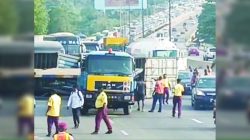
Beyond Blame: What Should Be Done?
The recurring crashes demand a coordinated response involving the Federal Ministry of Works, FRSC, police authorities, LASTMA, state governments, emergency agencies, transport unions and road users.
A National Economic Corridor Cannot Remain a Perpetual Emergency Zone
The Lagos-Ibadan Expressway is too important to Nigeria’s economy to be treated as an ordinary road.
It carries commuters, traders, manufacturers, farmers, logistics operators, fuel tankers, interstate buses and heavy-duty trucks. When it stops functioning, a substantial part of Nigeria’s economic activity is affected.
The experience of motorists over the years illustrates the human cost.
In 2026, motorists have repeatedly reported hours-long delays associated with repairs and accidents. In one January account, a driver said a journey from Mowe to Berger that could ordinarily take 45 minutes to one hour could stretch into hours because of congestion around the repair area.
Comments
Start the conversation about this story.