






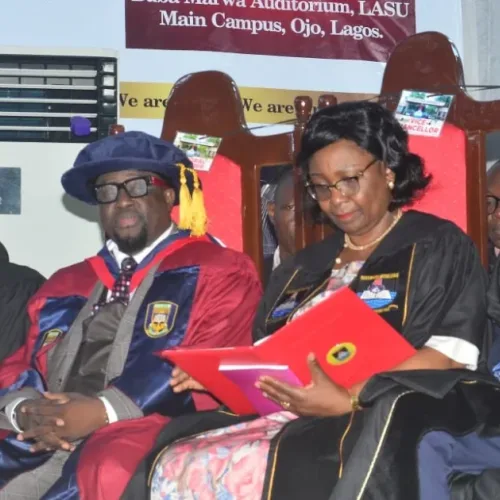
Prof. Enikuomehin (middle) and LASU VC, Prof. Olatunji-Bello.
A professor of Computer Science at Lagos State University, Prof. Oluwatoyin Enikuomehin, has warned that Artificial Intelligence is fundamentally reshaping how people think, remember, and make decisions, urging Nigeria to urgently enact a National AI Act before the technology outpaces governance.
Enikuomehin gave the warning on Tuesday while delivering the university’s 127th Inaugural Lecture titled, “Thinking Machines and the Future of Thinking: Cyberphysicalism, the Transformation of Human Thought and the Emergence of an Artificial Intelligence Driven Algorithmic Society.”
The don argued that the real question is no longer whether machines are intelligent but what AI is doing to human cognition as people increasingly “think with machines.”
“This morning, like many of us, the first thing I reached for was not a book but my phone. Before I was fully awake, I had checked messages, glanced at updates, responded to prompts and asked questions that required answers,” he said.
“In those few minutes, something subtle but important had already happened. I had begun my day not by thinking alone, but by thinking with a machine.”
He warned, however, that AI has become a far more powerful extension of human thinking, making governance an urgent necessity.
To prevent biased, opaque and potentially harmful AI systems, the professor unveiled what he called the AI Governance Stack—a seven-layer framework designed to ensure accountable deployment of AI.
The framework covers infrastructure security, data governance, algorithmic accountability, explainability, ethical oversight, regulatory compliance and societal impact assessment.
“AI governance is a layered problem. Failure at any layer propagates upward and undermines the layers above it,” Enikuomehin said.
“A system with perfect ethical oversight but weak data governance will still produce biased outputs.”
“Nigeria requires a comprehensive legislative framework that is architecturally precise, specifying what governance mechanisms are required at each layer of the Governance Stack,” he said.
He also proposed creating an independent National AI Research and Governance Council to assess the social impact of AI, advise government on policy, and represent Nigeria in international AI governance forums.
Beyond legislation, Enikuomehin warned that inadequate digital infrastructure could widen existing inequalities.
He called for universal broadband access, affordable digital devices and reliable electricity to ensure AI becomes an equaliser rather than a divider.
“Without universal broadband, affordable device access and reliable electricity, AI will deepen the inequalities it promises to address,” he warned.
Addressing individuals, Enikuomehin urged Nigerians to embrace AI without abandoning independent thinking.
“Our memories are stored in the cloud, our decisions are influenced by algorithms, and our knowledge is increasingly co-created with machines,” he said.
“Success will depend not on competing with machines but on developing the uniquely human capacities that enable meaningful collaboration with them.”
He urged citizens to question and verify AI-generated outputs, practice ethical discernment and protect their digital identities.
“In a cyberphysical world, your data is your cognitive shadow. Digital privacy is not merely a technical concern. It is a dimension of human dignity.”
Speaking, the Vice-Chancellor of Lagos State University, Prof. Ibiyemi Olatunji-Bello, described Enikuomehin’s presentation as “a very stimulating lecture” with “no dull moment,” saying it offered profound insights into the evolution of human thought in the age of Artificial Intelligence.
“It was a very stimulating lecture. There was no dull moment. The lecture explored the evolution from human thinking to machine thinking, showing how AI, augmented and cyber-physical systems are reshaping human cognition and creating a new algorithmic society,” she said.
Olatunji-Bello also announced that Enikuomehin would become the first inaugural lecturer to receive the university’s newly introduced commemorative certificate for inaugural lecturers.
“As an honour, you are the very first inaugural lecturer who will be given a commemorative certificate. You have been officially welcomed into the Senate and the Body of Professors,” she added.
Comments
Start the conversation about this story.