





The newly elected President of the Petroleum and Natural Gas Senior Staff Association of Nigeria (PENGASSAN), Comrade Bosun Olabiyi-Agoro, has promised to tackle the practice of prolonged contract staffing and casualisation in the oil and gas industry, declaring that workers who have remained on the same job for years can no longer be treated as temporary employees.
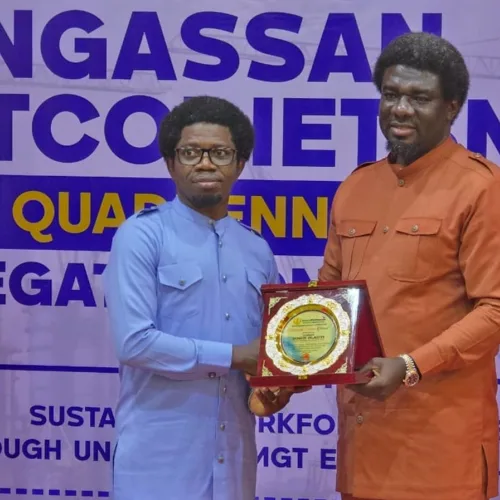
Olabiyi-Agoro made the declaration, in Abuja, while delivering his acceptance speech as the new president of PENGASSAN at its first Quadrennial National Delegate Conference, held at the International Conference Centre.
He said while PENGASSAN was not opposed to contract staffing as a legitimate employment arrangement, the practice should not be used to exploit, marginalise or deny workers their rights.
“We are not averse to contract staffing, but it must be practised the way it is done everywhere in the world,” the new PENGASSAN president said.
ALSO READ: NOPPMAN lifts suspension on onion exports to Ghana
“A job that someone has been doing for over two years, five years, 10 years, even 20 years or more cannot be categorised as temporary position anymore.”
He described prolonged contract staffing and casualisation as a “menace” in the oil and gas sector, warning that the practice is increasingly becoming a workplace health and safety concern.
“This is becoming a health and safety matter in our various locations and offices and we will interrogate this matter with every resource available to us,” he declared.
Olabiyi-Agoro, further warned that the use of contract staffing to “molest workers, to cause marginalisation and save cost” should no longer be allowed to continue.
The new PENGASSAN administration is assuming office against the backdrop of major changes in the oil and gas industry, including divestments, business reorganisation, automation and the global energy transition.
Against this background, the new president placed job protection at the centre of his agenda, assuring members that no PENGASSAN worker would be left behind.
“In this era of divestments, business reorganisation, automation, and energy transition, no PENGASSAN member will be left behind,” he said.
He said the union would negotiate just-transition agreements, retraining and redeployment whenever changes in the industry threaten workers’ employment.
“Safety, welfare, and dignity will remain non-negotiable,” he added.
Olabiyi-Agoro also expressed optimism over increasing recruitment activities by some companies in the sector, saying the trend should continue as activities in the oil and gas industry increase.
He pledged to defend collective bargaining agreements and strengthen industrial relations between workers and employers, stressing that agreements reached with management must be respected and implemented.
“Agreements signed must be agreements kept,” he declared.
The PENGASSAN president said his administration would work with management as partners rather than enemies, but would not compromise on workers’ rights.
“Where there is fairness, we will collaborate. Where there is injustice, we will resist — peacefully, lawfully, and powerfully,” he said.
He also promised timely communication and adherence to the principle of “no surprises” in industrial relations, while assuring employers that the union would negotiate in good faith and keep its side of agreements.
Beyond job protection and industrial relations, Olabiyi-Agoro outlined five cardinal areas that would guide his administration: protection of jobs and membership drive; defence of collective bargaining agreements and stronger industrial relations; training, women empowerment, staff welfare and stakeholder management; building a stronger and united PENGASSAN; and improving the association’s image.
He pledged increased investment in digital skills, leadership training and mentorship, while promising greater participation of women and young professionals in decision-making.
“The future of oil, gas, and renewables must have PENGASSAN fingerprints on it,” he said.
Olabiyi-Agoro also pledged to maintain constructive engagement with government and industry management, stressing that PENGASSAN was not opposed to investment or business development.
“We are not anti-business. We are pro-Nigeria,” he said.
“We want production up, investment in, and Nigerian content protected. But that can only happen when workers are respected and treated fairly.”
He called for early engagement among government, employers and the union to resolve industrial disputes before they degenerate into crises.
The new president assured PENGASSAN members that the association’s national leadership would remain responsive to workplace challenges.
“If your branch is hurting, PENGASSAN HQ will feel it. If your company is cheating you, PENGASSAN will fight it,” he declared.
He said the new leadership would build on the foundation laid by Osifo, stressing that the task ahead was about service rather than personal ambition.
Olabiyi-Agoro, emerged alongside other national officers elected at the conference, succeeding Osifo, who served as PENGASSAN president from 2020 to 2026. His election marks a leadership transition for the association as the oil and gas industry navigates employment restructuring, divestments, technological changes and the energy transition.
Comments
Start the conversation about this story.