





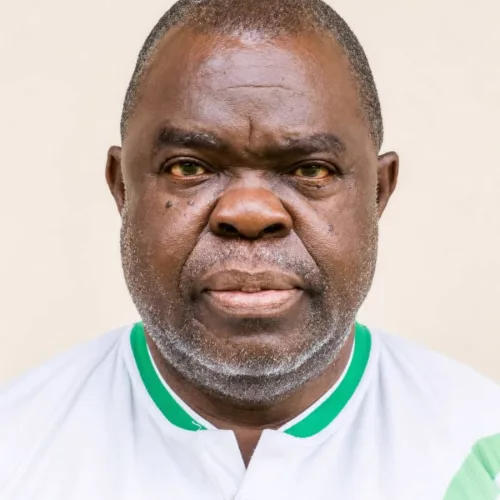
A university lecturer, Professor Emmanuel Olukemi Rotimi, has been appointed to the Policy Advisory Committee of the Presidential Working Group on the National Policing Bill.
Rotimi, a distinguished historian at Obafemi Awolowo University, Ile-Ife, Osun State, brings one of Nigeria’s foremost scholars of police history into the ongoing effort to design the legal and institutional framework for a new policing system in the country.
The proposed legislation is expected to provide the operational foundation for a dual structure comprising a Federal Police Service and State Police Services.
The Presidential Working Group, chaired by the Chief of Staff to the President, Femi Gbajabiamila, is working under a seven-week timetable to produce an implementation-ready draft of the Bill for submission to the Federal Ministry of Justice.
The Policy Advisory Committee is chaired by retired Justice Mohammed Abdullahi Liman and is responsible for providing policy direction, issuing drafting instructions and validating the content of the proposed legislation.
Rotimi’s selection is particularly significant because his academic career has been devoted largely to understanding the evolution, organisation and challenges of policing in Nigeria.
A professor in OAU’s Department of History, his areas of specialisation include Nigeria’s colonial and postcolonial history as well as the history of the police and policing in the country.
His engagement with the subject began at the postgraduate level. His master’s thesis examined the Native Administration Police Forces of Western Nigeria between 1905 and 1951, while his doctoral research traced the history of Native Administration Police Forces across Nigeria from 1900 to 1970.
He is also working on a three-volume history of policing in Nigeria covering the period from 1900 to 1983.
One of his best-known works, The Police in a Federal State: The Nigerian Experience, published in 2001, provides an extensive account of the origins, development, organisation and eventual abolition of the Native Authority and Local Government police forces.
The study has remained relevant to the continuing national debate over the ownership, control and accountability of policing in a federal system.
Rotimi has consistently argued that the current debate should be understood within Nigeria’s own historical experience of decentralised policing.
During a media interview in 2025, he explained that the proposed reform represented a return to federalist principles of policing that existed before military rule, when local police institutions operated alongside the centrally controlled Nigeria Police Force.
He has also stressed that the success of any decentralised policing arrangement will depend on transparent funding, effective training, public accountability and safeguards against political abuse.
These concerns are central to the work of the Presidential Working Group, which is expected to address national standards, state readiness, inspections, complaints procedures, firearms control, data sharing, federal intervention and institutional oversight.
Meanwhile, Obafemi Awolowo University has congratulated Rotimi on the appointment, describing it as a well-deserved national recognition of his scholarship and sustained contribution to discussions on policing and security reform.
His membership of the committee offers an opportunity to bring historical knowledge into the design of contemporary public policy.
As Nigeria considers one of the most consequential changes to its policing structure since the abolition of local police forces under military rule, Rotimi’s research is expected to help policymakers draw lessons from the achievements, failures and institutional weaknesses of earlier policing arrangements.
Please follow and like us:
Comments
Start the conversation about this story.