





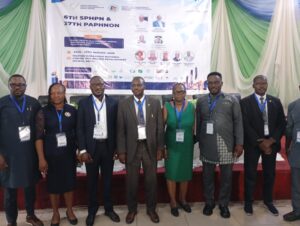
THE Society of Public Health Professionals of Nigeria (SPHPN), in collaboration with the Professional Association of Public Health Nurses of Nigeria (PAPHNON), commenced its joint scientific conference in Abuja Tuesday with calls for collaboration.
Prof. Hakeem Babatunde Fawehinmi, Special Guest of Honour and Chairman of the conference, made the call in his welcome address, urging professionals to tackle emerging health challenges through stronger collaboration.
Fawehinmi said the gathering represented more than a meeting of professionals, describing it as a convergence of ideas, experiences, disciplines, cultures and aspirations united by the goal of improving health.
He said delegates from Nigeria, Cameroon and other countries underscored the importance of collaboration, professional solidarity and knowledge exchange in advancing public health and strengthening responses to emerging challenges across Africa.
According to him, the conference brings together nurses, public health physicians, environmental health experts, pharmacists, veterinary public health professionals, trainees and other specialists working to protect and improve community health.
“Public health does not belong to one profession alone.
“The health of our people is shaped by human behaviour, healthcare systems, the environment, animals, medicines, food, water, sanitation, social conditions and many other interconnected factors,” he said.
Fawehinmi identified emerging and re-emerging infectious diseases, antimicrobial resistance, climate change, non-communicable diseases, maternal and child health challenges, food safety, zoonotic diseases, health inequalities and pressures on health systems as requiring innovative solutions.
He expressed hope that the conference would go beyond academic presentations by providing a platform where research findings could be translated into policy and practical solutions developed for communities.
The special guest of honour urged participants to strengthen cross-border partnerships, particularly with professionals from Cameroon and other participating countries, to share experiences and develop joint responses to public health challenges.
He encouraged trainees and younger professionals to engage experts, ask questions, present ideas and build professional networks, emphasising that such interactions would strengthen their professional development and contributions to public health.
He emphasised that the future of public health depended on a new generation of competent, ethical, innovative and collaborative professionals capable of responding effectively to changing health challenges across communities.
Fawehinmi commended speakers, facilitators, sponsors, partners, exhibitors, volunteers and members of the organising committees for their contributions, urging participants to embrace collaboration as the foundation of effective public health practice.
Also speaking, the National President of SPHPN, Prof. Stephen Abah, called for urgent action to build a future-ready public health workforce and advance health sovereignty across Africa.
Abah said the conference themed, “Public Health in a Changing World: Innovation, Equity and Global Health Security,” was timely, given rapidly evolving health threats, declining external funding and emerging technologies reshaping health systems.
He described public health as “the invisible infrastructure of a nation,” saying it was critical to child survival, food security, investor confidence and national resilience amid growing health and socioeconomic pressures.
The SPHPN president said the Africa Health Security and Sovereignty Agenda, endorsed by African Union Heads of State in February 2026, represented a shift toward greater self-reliance in addressing Africa’s health challenges.
He identified stronger African participation in global health governance, institutionalised pandemic preparedness, domestic health financing, digital transformation, data sovereignty and local manufacturing of health products as key priorities for continental health security.
“Health sovereignty does not mean isolation. It means that African countries must have the capacity to define and lead their health priorities, own critical capabilities, and participate as strong partners in regional and global health cooperation,” Abah said.
He described the public health workforce as “the engine of transformation” and urged SPHPN and PAPHNON to strengthen professional competence, promote evidence-informed practice and prepare health workers for digital transformation.
Abah challenged delegates to move the conference “from dialogue to decisions, from decisions to implementation, and from implementation to measurable health gains,” urging them to make clear commitments for action afterward.
“We must challenge ourselves to make Abuja 2026 different. The success of this conference cannot be measured simply by the number of papers presented. It must be measured by what we commit to do afterwards,” he said.
He called for stronger collaboration among government, academia, professional associations, development partners and communities to deliver practical, scalable and sustainable health solutions that can produce measurable improvements in public health outcomes.
The SPHPN president acknowledged contributions from past leaders, including Prof. Michael Asuzu and Prof. Obehie Okojie, as well as current Board of Trustees Chairman, Prof. Oyewale Tomori, for their service.
He reaffirmed SPHPN’s commitment to professional excellence, research, advocacy and workforce development, while providing platforms for public health professionals to contribute meaningfully to national and global policy discussions.
The News Agency of Nigeria (NAN) reports that the conference, the 6th SPHPN and 37th PAPHNON Joint Scientific Conference, has attracted more than 5,000 multidisciplinary public health professionals from Nigeria’s 36 states, Federal Capital Territory, Cameroon and other countries.(NAN)
M.P
Tags: collaborative action Conference

Comments
Start the conversation about this story.