





Women entrepreneurs across low- and middle-income countries are developing solutions to some of the world’s most urgent healthcare and food-security challenges. Yet many struggle to turn promising ideas into scalable businesses because they lack equitable access to funding, networks, mentorship, market opportunities, and the resources needed to become investor-ready. Bayer Foundation is addressing these structural gaps through targeted support for women innovators, particularly those working in underserved communities.
Women-led ventures remain significantly underfunded, while entrepreneurs tackling problems such as limited healthcare access, food loss and water scarcity often operate in markets where conventional investment is difficult to secure. In the Middle East and North Africa (MENA), for example, women-led ventures received just 1.2 percent of venture capital in 2021. Across Africa, more than half the population—about 615 million people—lack access to the healthcare they need, while an estimated 22 percent of annual food production is lost, worth nearly $92 billion. These challenges create an urgent need not only for innovation, but for financing models that can reach founders working outside traditional investment ecosystems.
Bayer Foundation, through its sixth Women Entrepreneurs Award, implemented with the Impact Hub Network, is providing 15 women entrepreneurs with €25,000 each, alongside mentorship, networks and a six-month accelerator focused on investor readiness. The programme is designed to help founders move beyond recognition to the next stage: strengthening their businesses, connecting with potential investors and partners, and scaling solutions that address critical health and food-security gaps. Since its launch in 2021, the initiative has expanded from sub-Saharan Africa to lower- and middle-income countries across Africa, Latin America and Asia, supporting 70 women leaders to date. Its 2026 cycle attracted 1,172 applications.
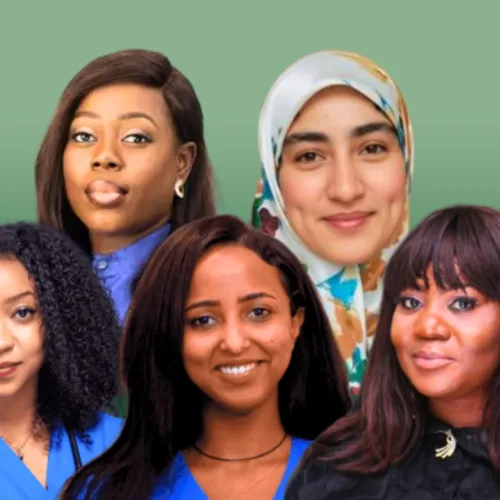
The need for this targeted approach is reflected in the work of the five African awardees from Kenya, Ethiopia, Nigeria and Morocco.
Omowunmi Emmanuel-Ogah, Nigeria
Drawing on her early experience in the pharmaceutical industry, Omowunmi set out to address a fundamental gap in healthcare delivery: the barrier to essential medications. During her time on the vaccine team at GlaxoSmithKline, she witnessed firsthand how effective vaccines often failed to reach the people who needed them most due to systemic breakdowns.
The onset of the COVID-19 pandemic further exposed these vulnerabilities. Facing a surge of emergency patient needs, her team realised that operating solely as a traditional pharmacy was no longer enough.
This prompted a strategic pivot in 2021, transforming the enterprise from a standard pharmacy into an integrated healthcare hub. Today, the organisation operates as an expanded network of pharmacies, diagnostic laboratories, and immunisation centres accredited by the National Primary Health Care Development Agency (NPHCDA), expanding community access to life-saving vaccines and diagnostic care.
“I wanted to build something to ensure that access to medication was possible. We stopped being just a pharmacy and became an integrated hub,” one of the two awardees from Nigeria said during a virtual briefing.
Alice Muhuhu, Kenya
Alice Muhuhu, a medical doctor and the founder of Aurora Health Systems, traces the genesis of her work back to the frontline struggles of the pandemic. “It was inspired by my experience during COVID-19,” she reflects, remembering her time in a public hospital where she witnessed firsthand how severely resource constraints affected patient outcomes.
Driven by that experience, she and her team at Aurora Health Systems set out to bridge the gap in specialised care. “We are building AI-powered cardiac diagnostic technology designed to bring early diagnosis closer to patients,” Alice explains.
Her focus is squarely on rural and underserved communities, where access to advanced specialist equipment and cardiologists remains severely limited.
Aurora Health Systems in Kenya has built AI-powered, offline-capable ECG devices that detect more than 50 cardiac conditions in low-resource clinics, bringing accurate diagnosis to patients who would otherwise have no access to it.
For Alice, the mission extends beyond medical innovation. It is about shifting the narrative of technological leadership on the continent.
“We believe Africa has the potential to build world-class technology,” she emphasises. “We should not only consume innovation, but we can create it.”
Beamlak Alemayehu, Ethiopia
Beamlak’s solution highlights a transformative shift in Ethiopia’s healthcare landscape, driven by a mission to deliver the right treatment at precisely the right time. By combining direct medication delivery with clinical care, the initiative has already reached over 100,000 people across the city while extending vital access to doctors for patients in Ethiopia’s rural regions.
Addressing the harsh reality on the ground, where patients often have to travel up to 20 kilometres just to find medical care, only to face gruelling wait times of up to five hours, Medanit’s team introduced an efficient booking system. This digital bridge narrows the distance barrier, eliminates critical delays, and ensures that life-saving care reaches those who need it most.
“As a healthcare professional and entrepreneur, my mission is to save lives by saving time. Every milestone we achieve brings us closer to a future where every Ethiopian can access trusted healthcare quickly, regardless of where they live or their financial situation,” Alemayehu said.
Funmilayo Ishola, Nigeria
Funmilayo Ishola founded Dehydrator Hub after recognising a critical flaw in Nigeria’s food system: 40 to 50 percent of produce is lost between farms and major markets, severely limiting the country’s ability to meet export standards.
Initially launched in 2019 to procure food-processing machinery, the business adapted in 2022 when high costs made equipment ownership unattainable for many clients. In response to customer demand, Ishola pivoted to a “food processing as a service” model, creating solar-powered processing hubs where local farmers, exporters, and women can bring raw produce to be transformed into high-value, export-ready ingredients.
Having successfully completed its first pilot, Dehydrator Hub is now targeting a nationwide scale, with the ultimate goal of establishing a processing hub in every local government area across Nigeria to eliminate post-harvest waste and revolutionise the food system.
Sokayna Bellam, Morocco
In Morocco, Sokayna Bellam’s Jodoor is using hydroponic farming to cut water use by 80 percent, offering a model built for climate-stressed farmland across the region.
Jodoor set out to bring the right technology to the right people and the right land. The company began by adapting hydroponic systems to Moroccan conditions, testing them in real operating environments, and developing a model that brings together production, technical support, market access, and financing.
“Compared to conventional farming, our systems reduce water consumption by up to 90 percent, saving approximately 230 litres of water per kilogram of produce. We also lower carbon emissions by around 0.12 kg of CO2 per kilogram and eliminate the use of chemical pesticides, resulting in 100 percent residue-free crops. These improvements are critical in regions like Morocco, where agriculture is heavily constrained by water scarcity and climate stress,” she explained.
Today, Jodoor is more than an ag-tech company. It is an effort to rethink how agriculture can be financed, operated, and scaled in regions facing growing water stress.
Closing the gap
Together, these ventures illustrate the gap Bayer Foundation is seeking to close: not a shortage of ideas among women entrepreneurs, but a shortage of the capital, connections and institutional support required to turn those ideas into sustainable, scalable solutions.
By pairing direct financial support with mentorship, networks and investor-readiness training, the foundation is attempting to address several barriers at once. Its model recognises that for women innovators in underserved markets, a grant alone may not be enough. Access to the right networks, business expertise and pathways to further investment can be just as important in determining whether an innovation remains a promising pilot or becomes a solution capable of reaching millions.
The broader objective aligns with Bayer Foundation’s ambition of advancing social innovation and science toward “Health for All and Hunger for None.” By directing resources toward women building solutions in healthcare and food security, the foundation is betting that closing the financing and opportunity gap for female entrepreneurs can also help close some of the wider development gaps facing underserved communities.


Comments
Start the conversation about this story.