





For two days, on August 18 and 19, 2026, the Lagos State Health Management Agency (LASHMA) brought journalists into the heart of one of the most consequential health-policy conversations in Lagos: how to make health insurance understood, trusted and accessible to millions of residents.
Held at the LASHMA office in Alausa, the capacity-building programme on the Lagos State Health Scheme (LSHS) and the Mandatory Social Health Insurance Programme, popularly known as ILERA EKO, was more than a routine media engagement. It was an attempt to close the gap between policy and public understanding and to place journalists at the centre of that effort.
The message running through the training was clear: a health insurance policy can only achieve its purpose when people understand what it offers, how it works, who is covered, what they are entitled to and where to turn when something goes wrong.
That responsibility, LASHMA officials repeatedly told the journalists, cannot be separated from the work of the media.
The Permanent Secretary, Lagos State Health Management Agency, Dr. Emmanuella Zamba, in her keynote address, described journalists as critical partners in advancing health insurance awareness, transparency and accountability.
She recalled that in October 2025, she attended a National Media Dialogue organised by the International Society of Media in Public Health (ISMPH) in Abuja, where she committed to prioritising the capacity building of journalists when she returned to Lagos.
The programme, she said, was the fulfilment of that commitment.
It was not LASHMA’s first such intervention. Zamba disclosed that in February 2026, the Agency, in collaboration with ISMPH, trained 56 journalists in the first batch. Those journalists, including their family members and dependants, were also given one year of free health insurance coverage courtesy of LASHMA.
The emphasis on the media was deliberate. For a policy as broad and consequential as mandatory health insurance, public acceptance cannot be achieved by government announcements alone. It requires continuous explanation, clarification and scrutiny.
As Zamba put it, policies do not guarantee success by themselves. Their effectiveness depends on understanding, cooperation and participation. She urged journalists to use the knowledge acquired during the training to promote factual reporting, constructive criticism, public trust and accurate feedback.
A policy that covers every Lagos resident
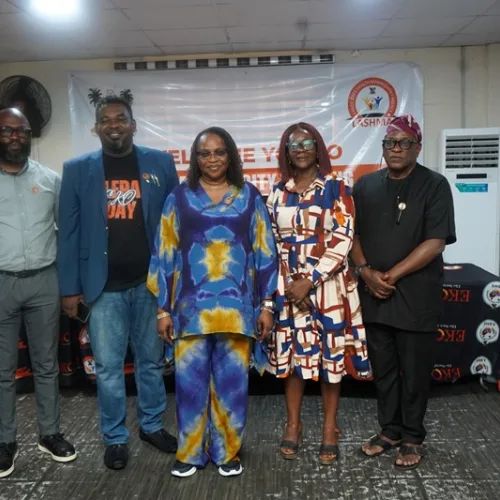
 Zamba, speaking at the event
The starting point of the training was the policy itself. On July 16, 2024, Governor Babajide Olusola Sanwo-Olu signed Executive Order No. EO/BOS/01 of 2024, making enrolment in the Social Health Insurance Scheme compulsory for residents and workers in Lagos State.
The order applies to residents irrespective of their state of origin or nationality. ILERA EKO is the platform through which residents access the coverage.
The significance of the policy became clearer as the sessions progressed. In a city as large and economically diverse as Lagos, a medical emergency can quickly become a financial crisis when healthcare costs have to be paid entirely out of pocket.
The ILERA EKO model seeks to change that equation by pooling resources through premiums and an Equity Fund and moving healthcare financing away from unpredictable fee-for-service payments towards a structured, prepaid system.
Adesegun Ogundeji, Coordinating Director, Ministry of Information and Strategy, who delivered the welcome address, stressed that the policy was not simply about compliance.
Ogundeji, who was represented by Kayode Sutton, Director, Public Affairs, Ministry of Information and Strategy, explained that with applicable premiums of ₦15,000 for an individual, ₦55,000 for a family of four and ₦80,000 for a family of six, enrollees can access a broad range of services. These include consultations, specialist care, dental and eye care, selected surgeries, treatment of common illnesses such as malaria and typhoid, management of hypertension and diabetes, emergency services, childhood healthcare, medical tests and prescribed drugs.
But the policy’s reach extends beyond those who can readily afford premiums.
One per cent of the Consolidated Revenue Fund has been dedicated as an Equity Fund for vulnerable residents. According to Zamba’s keynote, the fund was increased from ₦1 billion to ₦3 billion and approved as a one-line charge by the Governor.
The training presentation on Executive Order implementation provided another measure of the programme’s vulnerable-population intervention. The Eko Social Health Alliance (EKOSHA), the LASHMA arm responsible for vulnerable coverage, had supported the enrolment of 367,259 vulnerable residents from 2022 to June 2026, including identification, eligibility verification and post-enrolment support.
From awareness to enforcement
The journalists were also taken through the mechanics of enforcing the Executive Order.
Dr. Nifesimi Akinnagbe, presented the Executive Order Implementation Updates, explaining that enforcement activities formally commenced in 2026 and were being implemented in phases.
The first phase targets Ministries, Departments and Agencies, while subsequent phases cover the informal and formal sectors.
The informal-sector phase is designed to drive compliance among both organised and unstructured informal-sector residents, as well as vulnerable residents within communities. The formal-sector phase requires private HMOs to provide social-health-insurance-compliant plans to clients or facilitate ILERA EKO enrolment for small and medium-sized enterprises.
The figures presented showed that implementation was already underway.
Following a baseline compliance assessment across MDAs from February 16 to 27, 2026, the Enforcement Team commenced a follow-up assessment on May 4. The findings recorded 63 fully compliant MDAs, 71 partially compliant MDAs and no non-compliant MDA.
Healthcare facilities are also central to enforcement. The presentation stated that facilities are required to request proof of enrolment from patients accessing care and enrol uninsured patients into ILERA EKO at the point of service.
Across three Facility Compliance Readiness Assessment phases, 382 ILERA EKO healthcare providers were assessed-107 public facilities and 275 private facilities.
The assessment goes beyond simply checking whether a facility knows about the Executive Order. Facilities are expected to have enrolment desks, trained personnel, vulnerable-desk officers, relevant information for patients, complaint-resolution procedures and processes for ensuring access to care during evenings, weekends and public holidays.
This detail was particularly important for journalists because it moved the discussion away from policy language and into the everyday experience of the patient.
When the emergency comes
 Zamba and others at the event
Perhaps one of the most important distinctions highlighted during the training concerned emergencies.
Under Section 6 of the Executive Order, a healthcare facility must stabilise a patient in a life-threatening emergency without demanding proof of health-insurance enrolment. After stabilisation, however, the patient is required to provide proof of enrolment or register under the Lagos State Health Scheme through LASHMA or an NHIA-accredited private provider in order to access continued medical services.
The LASHMA-AID Emergency Services Programme, launched on December 16, 2025, was presented as part of Lagos State’s effort to strengthen emergency healthcare delivery.
The scorecard presented to the journalists showed 71 patients reached between March and August 2026, 57 survivors or patients in care, 41 ambulance dispatches and 13 mortalities. It also recorded 57 vulnerable people covered, 14 enrollees, 50 cases handled in state/general facilities and 21 in private facilities. The cases included trauma and road traffic accidents, medical emergencies, surgical, obstetric and neonatal cases.
The figures gave journalists something more substantial than policy promises: a basis for examining what the programme is doing, where it is working and where questions remain.
What exactly does ILERA EKO offer?
Rotimi Olatunji, Head, Business Development, took the journalists through the ILERA EKO brands and products.
The portfolio includes the Standard Jaara Plan, Standard Jaara Plus Plan, Seniors Plan, School Plan, Higher Institution Plan, Diaspora Plans-Waka Well Plan and Home Konnect Plan, as well as bespoke plans.
ILERA EKO is not designed as a one-size-fits-all programme. The Standard, Standard Jaara and Jaara Plus plans serve the general working population, while specialised offerings cater to seniors and students. Diaspora Konnect is designed for residents abroad to cover relatives back home, while Waka Well is designed for visitors and holiday makers.
The benefits also go well beyond routine consultations.
The materials listed primary and preventive care, maternal and child health, hospital and surgical care, antenatal care, safe delivery including vaginal and Caesarean sections, postnatal care, immunisation, treatment of childhood illnesses, inpatient admission, surgeries and emergency services.
They also include essential laboratory investigations, X-rays, ultrasound, ECG, physiotherapy and dental care, as well as coverage for renal dialysis, cancer management and eye care, including prescription glasses.
Olatunji’s presentation further highlighted features such as no age limits, limited waiting periods, no global financial limit, flexible payment options, access to public and private hospitals as primary care providers and coverage provisions for dependants above 23 years.
For journalists, these details matter because the quality of reporting on health insurance depends heavily on the ability to distinguish what the scheme actually covers from assumptions, hearsay and outdated information.
The patient’s journey matters too
 Zamba and others at the event
Michael Lanre Green, Head, Client/Customer Services, brought the discussion closer to the patient’s actual experience.
His presentation, titled Understanding the ILERA EKO Customer Journey: From Enrollment to Care Access, Experience & Accountability, focused on what happens after a resident becomes an enrollee.
ILERA EKO is designed to protect residents from catastrophic health expenditure, guarantee access to quality and affordable healthcare and promote equity, shared responsibility and system accountability.
The pathway begins with choosing a plan and selecting a Primary Care Provider (PCP), which serves as the enrollee’s first point of contact for non-emergency care.
Where specialised treatment is required, the referral network is activated, taking the patient to a higher-level public or private facility. In an emergency, the PCP contacts the LASHMA-AID line for referral through an ambulance service to a higher-level or specialised hospital after stabilisation.
But the training did not portray the patient journey as flawless or beyond scrutiny.
Green explained practical situations in which enrollees may need to change providers, including a change of residence, persistent poor service quality, distance or accessibility challenges, facility closure or de-accreditation, or medical needs requiring a more suitable provider.
Journalists were also given guidance on how enrollees should respond to poor staff attitude, excessive waiting time, delayed referrals or denial of service: document what happened, report through official channels and follow up.
That message reinforced perhaps the most important lesson of the two-day programme: health insurance is not merely a card or a premium. It is a relationship between the enrollee, healthcare provider, insurer and the wider health system.
The cooperative dimension
Another session introduced the journalists to ILERA N’ TIWA [Alausa] Cooperative & Multipurpose Society Ltd. (ITCMS), presented by Olatunji.
The initiative, launched in December 2024 and operational from March 2025, was described as a financial-inclusion and social-health-insurance aggregation initiative of LASHMA. Its objective includes accelerating enrolment through flexible payment options and cooperative membership while addressing payment defaults associated with earlier instalment-based premium arrangements.
ITCMS combines health-insurance access with a social-welfare and economic-support model. Its stated benefits include access to the Standard Jaara plan, loans after six months of active membership, emergency loans, referral cash rewards, access to food banks, periodic promotions, travel and tour rewards, preventive health programmes, accrued dividends on savings and access to Lagos State Government welfare initiatives.
The cooperative’s contribution structure was also presented: Bronze, Silver, Gold and Diamond categories, with different minimum monthly contributions for individuals and families.
The facilitator stated that ITCMS is duly registered and regulated by the Lagos State Government through the Ministry of Commerce and Cooperatives and has a quarterly steering committee drawn from ILERA EKO customers. Members can also aspire to positions through elections.
Taking the message to the grassroots
The training also showed that LASHMA’s implementation strategy is not confined to offices and hospitals.
The Agency has commenced structured outreach across the 57 LGAs/LCDAs to sensitise Local Government Chairmen, stakeholders and community members about the Executive Order.
The engagement includes encouraging chairmen to nominate Ilera Eko Ilera Ibile Officers, sponsor vulnerable residents, pay premiums for non-oracle staff and revamp primary healthcare centres to achieve 24-hour status or establish referral frameworks.
The presentation listed engagements involving Alimosho, Ikeja, Kosofe, Agboyi-Ketu, Odi-Olowo/Ojuwoye, Ojokoro, Mushin, Ifelodun, Oto-Awori, Amuwo-Odofin, Mosan-Okunola, Ikorodu Central, Ikorodu North, Ikorodu West, Imota, Lagos Mainland, Apapa-Iganmu, Epe, Lekki, Ikosi-Ejirin and Eredo, among others.
The Agency has also used radio and media engagement as part of the awareness campaign. Since December 2024, LASHMA said it had hosted seven editions of its Quarterly Media Parley.
The Executive Order implementation presentation also listed ILERA-EKO programmes on Bond FM 92.9, Lagos Traffic Radio 96.1 FM, Faaji FM 106.5, WASH 94.9 FM and JORDAN FM 105.5. In 2025, U-Bee Media Network, owned by Adebayo Salami, popularly known as “Oga Bello,” produced multilingual social health insurance content in English, Yoruba and Pidgin.
The journalist as bridge and watchdog
By the close of the two-day engagement, the larger purpose of the training had become difficult to miss.
Lagos has a mandatory health insurance policy. LASHMA has an implementation structure. There are premiums, plans, benefit packages, referral pathways, enforcement mechanisms, an Equity Fund, emergency interventions, vulnerable-coverage programmes, grassroots engagement and a growing network of healthcare providers.
But none of those mechanisms can function effectively if residents do not understand them.
That is where journalism comes in.
Ogundeji reminded participants that their role goes beyond reporting events. Journalists shape public understanding and influence the choices people make. Accurate, balanced and consistent reporting, he said, can help residents understand the importance of health insurance, the benefits of ILERA EKO and how to access available services.
Zamba made a similar appeal in her keynote, urging journalists to regard the engagement as a partnership with the health sector, one that allows for factual reporting, constructive criticism, public trust and accurate feedback.
It is a partnership with an important caveat: partnership does not mean surrendering the watchdog role.
If a patient is denied a service that should be covered, the journalist must be able to ask why. If a facility fails to follow the referral pathway, that deserves scrutiny. If residents remain unaware of their entitlements, the media must ask what is missing in the communication chain. And where LASHMA succeeds, those achievements also deserve to be documented.
The training therefore placed information and accountability on the same continuum.
For the journalists who gathered in Alausa on August 18 and 19, the assignment after the training is perhaps more demanding than simply writing about another government programme.
It is to translate policy into language people can understand without losing accuracy; to explain benefits without turning reportage into publicity; to question implementation without distorting facts; to amplify the voices of patients while demanding accountability from institutions; and ultimately to help Lagos residents understand a health system that is intended to protect them before illness becomes a financial catastrophe.
That may be the most important lesson of the LASHMA training.
Health insurance may be designed in policy documents and administered through institutions, but its real test is what happens when an ordinary Lagos resident falls ill.
And between that resident and the policy is a bridge that must be built carefully. That bridge is journalism.
Comments
Start the conversation about this story.