





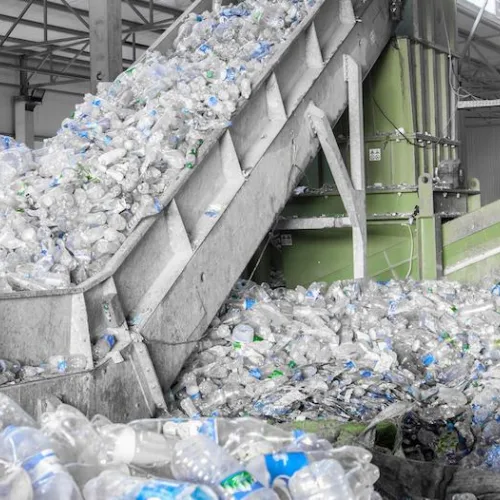
Environmental engineers have projected that Nigeria could generate N100 billion in revenue from waste recycling by 2030, while creating more than 250,000 jobs within the period.
The experts said the projected revenue and job opportunities could be achieved if Nigeria transitions from a linear economy to a circular economy.
They noted that embracing a circular economy could also help the country mitigate the effects of climate change and promote sustainable development.
The experts spoke at the 9th memorial public lecture organised by the Nigerian Institution of Environmental Engineers (NIEE) in honour of the late Engineer Samuel Fadahunsi in Benin City.
The lecture was themed, “Engineering Climate Resilience and Circular Economy Solutions for Sustainable Development in Nigeria.”
Those who spoke at the event included Jacob Ehiorobo of the Department of Civil Engineering, University of Benin (UNIBEN), who delivered the guest lecture; Emmanuel Oluwadare Akpaja of the Department of Plant Biology and Biotechnology, Faculty of Life Sciences, UNIBEN; Caius Ikem Umekesiobi, National Chairman of NIEE; and Ali Alimasuya Rabiu, President of the Nigerian Society of Engineers (NSE).
The speakers said a circular economy, which promotes waste reduction, recycling and efficient use of resources, could reduce the carbon intensity of industrial processes, supply chains and consumer behaviour when integrated with climate mitigation measures.
Delivering his lecture, Ehiorobo called for increased investment in waste recycling facilities, including the establishment of recycling factories across the country.
He said research had projected that Nigeria’s waste recycling market could reach N100 billion by 2030 and create more than 250,000 jobs.
Ehiorobo said available statistics showed that Nigeria generates more than 32 million tonnes of solid waste annually, with food waste and plastics accounting for a significant portion.
He also cited a recent European Commission estimate that a transition to a circular economy could generate €600 billion in annual economic gains for the European Union’s manufacturing sector alone.
According to him, the circular economy is a concept promoted by the European Union and several national governments, including the UK, Canada, France, Sweden, Japan and China, as well as businesses across the world.
Read also: Nigeria must move beyond monthly cleanups to control its rodent crisis
Ehiorobo added that China was reportedly the first country in the world to adopt a law on the circular economy in 2008.
He explained that a circular economy is a system in which materials are reused and recycled rather than discarded, while climate action involves measures aimed at reducing greenhouse gas emissions and slowing global warming.
He identified the creation of new industries and employment opportunities in recycling, repair, remanufacturing and sustainable agriculture as some of the economic benefits of adopting a circular economy.
“Adopting circular economy principles can spur innovation, encouraging the development of technologies that extend the life cycle of products and materials.
For example, investing in sustainable building materials or energy-efficient technologies could reduce Nigeria’s reliance on imported goods while supporting local production and innovation.
“Digital platforms that connect consumers with service providers for product repair or resale are another avenue for circular economy innovation, facilitating a shift towards sustainable consumption patterns.
“The circular economy will help in addressing key challenges like resource depletion, waste management and economic resilience, unlike the traditional linear economy (take-make-dispose).
“A circular economy is regarded as an approach to economic growth that is aligned with sustainable environmental and economic development,” he said.
However, Ehiorobo said Nigeria must develop strong policy frameworks and provide institutional support to fully harness the benefits of a circular economy.
He said policies that encourage recycling, proper waste management and sustainable resource utilisation could promote a circular economy mindset among industries and communities.
He also called for partnerships among international organisations, private sector players and local governments to provide the funding and technical expertise required to implement circular economy practices on a wider scale.
“In order to develop an effective circular economy and climate action for sustainable development in Nigeria, there is a need for collaboration among the different agencies involved in climate action and mitigation in effective disaster risk response and disaster risk reduction for the country,” he added.
In his keynote address entitled, “Valorization of Mushrooms in Environmental Engineering: Advancing Circular Economy, Climate Action and Sustainable Development in Nigeria,” Akpaja said mushrooms could provide economic opportunities beyond their health benefits.
He described mushroom production as a potential source of revenue generation and an area that could contribute to the development of sustainable economic practices.
In his remarks, Rabiu, President of the Nigerian Society of Engineers, who was represented by Evukowhiroro Ojegba, commended NIEE for sustaining the annual memorial lecture in honour of late Engineer Samuel Fadahunsi.
Earlier, Umekesiobi, National Chairman of NIEE, described the late Fadahunsi as “a visionary, a builder, and a man who believed that engineering must serve humanity and the environment.”
Umekesiobi said the theme of the lecture was timely, noting that the circular economy offered Nigerians a new pathway where waste could be transformed into wealth, pollution could be designed out, products could remain in use for longer periods, and natural systems could be regenerated.
Speaking on behalf of the Fadahunsi family, Folake Olumogba expressed appreciation to members of NIEE for keeping the memory of their late father alive through the annual memorial lecture.


Comments
Start the conversation about this story.