





…Backs Doro’s Reform Drive
The First Lady of the Federal Republic of Nigeria, Senator Oluremi Tinubu, has unveiled the $1 billion Renewed HOPE Social Protection Programme, describing the reform initiatives being advanced by the Minister of Humanitarian Affairs and Poverty Reduction, Dr Bernard M. Doro, as capable of transforming Nigeria’s humanitarian response from temporary assistance to sustainable pathways towards resilience, self-reliance and prosperity.
Speaking at the unveiling at the Aso Villa Banquet Hall, Abuja, on Wednesday, the First Lady said the initiatives reflect the commitment of the administration of President Bola Ahmed Tinubu to strengthening Nigeria’s social protection architecture and improving the lives of vulnerable individuals, families and communities.
The First Lady commended the direction of the reforms and reiterated the importance of interventions that enable vulnerable Nigerians to progress beyond immediate assistance towards dignified and sustainable livelihoods
She noted that while the Federal Government continues to implement far-reaching economic reforms to lay the foundation for sustainable growth and shared prosperity, many Nigerian families still require protection and support.
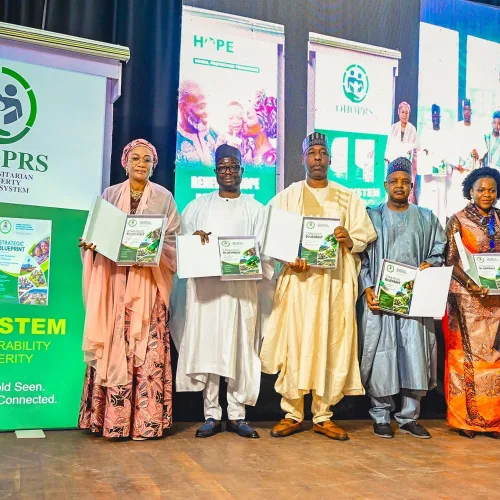
The event featured the launch of the Federal Government Emergency Shock-Responsive Cash Transfer Programme, targeting 7.6 million of the most vulnerable households nationwide; the One Humanitarian One Poverty Response System (OHOPRS); the Federal Ministry of Humanitarian Affairs and Poverty Reduction Ministerial Blueprint; and Humanity First Magazine.
Presenting the reform architecture, Dr Doro said Nigeria’s challenge has not necessarily been a lack of humanitarian and poverty reduction interventions, but the fragmentation of programmes, beneficiary registers and delivery systems across institutions and different levels of government.
According to him, this has created a situation where some people may benefit from several interventions while equally vulnerable Nigerians receive none.
“Programmes are not talking to one another. You will find that one person benefits from several programmes, while another person does not benefit from any. The system we have practised over time has therefore failed to answer one fundamental question: What happens to the household after receiving the interventions?”
Dr Doro said OHOPRS is designed to address this challenge by providing an integrated national framework connecting humanitarian response, social protection, poverty reduction and economic inclusion around the household.
The system is intended to strengthen coordination among Federal, State and Local Governments, development partners and other intervention actors, improve visibility of who has received support, reduce duplication and enable vulnerable households to be followed through a structured pathway towards recovery and self-reliance.
“This is the strategic shift and philosophy behind the work we have undertaken over the last eight to nine months: from palliatives to pathways, from reactive relief to anticipatory protection, from programme-centred interventions to household-centred interventions, and from fragmented efforts to a unified response.”
The Minister said the reform will be supported by stronger data and registries, digital delivery systems, sustainable financing, institutional coordination, accountability, transparency and real-time intelligence.
He explained that the Emergency Shock-Responsive Cash Transfer Programme will provide timely support to households affected by economic, environmental and other shocks, while the Ministerial Blueprint provides a roadmap for translating the humanitarian and poverty reduction priorities of President Tinubu’s Renewed Hope Agenda into coordinated and measurable action.
Dr Doro stressed that the ultimate objective is not merely to increase the number of interventions but to ensure that assistance produces measurable improvement in people’s lives.
“The question must go beyond how many people received assistance. We must know whether the household recovered, whether it became more resilient and whether it is progressing towards self-reliance and prosperity.”
In his goodwill message, Governor Babagana Zulum of Borno State, who spoke on behalf of the governors, emphasised the importance of ensuring that the new approach works across all levels of government and reaches Nigerians directly at the grassroots.
He called for collaboration beyond political affiliations, noting that vulnerable Nigerians require the collective commitment of Federal, State and Local Governments.
The Operations Manager at the World Bank, Taimur Samad representative described the unveiling as a landmark transition from an emergency and predominantly reactive approach towards the development of a more systematic social protection system.
The representative reaffirmed the World Bank Group’s partnership with the Federal Government and stressed the importance of integrating programmes across Federal and State levels to strengthen poverty reduction and social protection outcomes.
The European Union Ambassador to Nigeria and ECOWAS, Gautier Mignot, also described the unveiling as the beginning of a new chapter in the evolution of Nigeria’s social protection architecture, welcoming the growing integration of humanitarian assistance, social protection and sustainable development within a coordinated national framework.
The representative underscored Nigeria’s wider importance to the continent, noting that progress in Nigeria has implications beyond its borders.
The unveiling marks a significant milestone in the Federal Government’s effort to build a social protection system in which interventions are increasingly coordinated around the needs of households, with a clear progression from vulnerability to protection, resilience, economic inclusion and prosperity.
Please follow and like us:
Comments
Start the conversation about this story.