





The race was over in less than nine seconds.
On August 25, a Chinese humanoid robot called Tiangong Ultra completed the 100-metre sprint in 8.86 seconds at the World Humanoid Robot Games in Beijing, beating the 9.58-second human world record set by Usain Bolt in 2009.
The robot did not merely win a race against other machines but it crossed a symbolic line in the development of humanoid robotics.
It crashed into a padded barrier, a contradiction that may be the most important thing to understand about the future of humanoid robots.
They are becoming remarkably capable but they are not yet ready to replace humans.
Beijing turns robotics into a competitive sport
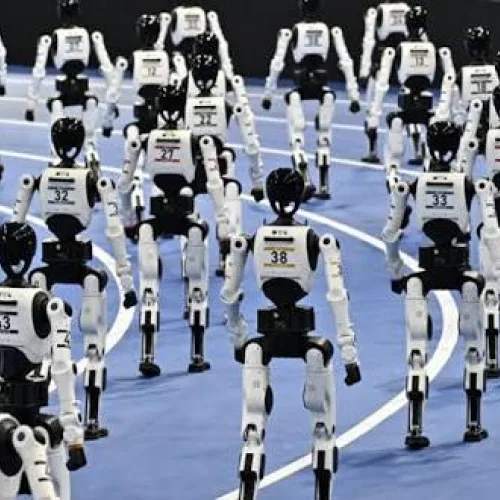
The second World Humanoid Robot Games in Beijing brought together more than 2,000 robots from 666 teams competing across 51 disciplines.
The machines are not only running but they are playing football, table tennis and basketball, dancing and taking part in tasks designed to mimic real-world work, including industrial and service activities.
China is effectively creating a testing ground where companies can measure robots against one another in controlled but demanding environments and the results are already moving quickly.
Tiangong Ultra’s 8.86-second sprint improved on its previous 9.39-second record. Other robots have also surpassed Bolt’s human record, while one robot reached a 2.88-metre high jump.
The more revealing part of the Beijing games is that organisers are testing robots on practical tasks.
This year’s competitions include industrial activities and challenges involving dexterity and manipulation areas that are much closer to the problems businesses actually want robots to solve.
The future of humanoid robots will not be determined by how quickly they can run but it will be determined by whether they can reliably do useful work.
Impressive demonstrations to useful machines
A humanoid robot that can identify a package, pick it up without damaging it, navigate a crowded warehouse, place it in the correct location and repeat the process for eight hours is commercially valuable.
A useful care robot would need to recognise objects, understand instructions, navigate unpredictable environments and interact safely with people.
This is why the next phase of robotics is about embodied intelligence which is giving AI the ability to perceive the physical world and act within it and not just generate an answer.
China wants to be ready when the moment arrives
Beijing’s robot games also reveal something about China’s broader technology strategy. China is treating humanoid robotics as a strategic industrial sector and not as a laboratory experiment.
The country’s government has identified robotics as an important part of advanced manufacturing while companies are investing heavily in the hardware, sensors, motors and AI systems required to make humanoids commercially useful.
China delivered more than 40,000 humanoid robots in the first half of 2026 and accounted for an estimated 97 percent of global humanoid robot market share, Reuters reported.
The numbers should be treated carefully because the market is still young and definitions vary, but the broader direction for this is that China is trying to build an ecosystem around humanoid robots before the technology fully matures.
This approach resembles its earlier push into electric vehicles, batteries and other manufacturing technologies.
The most viral images from the Beijing games may not be the robots crossing the finish line but the ones falling over.
Some robots struggled with coordination, while others crashed after completing their runs. In some cases, machines needed to be carried away after failing to stop properly.
These are evidence of the enormous engineering problem ahead and not evidence that humanoid robotics has failed
The most important competition may not be happening on the track but it is happening in factories, warehouses, hospitals, hotels and other workplaces.
In April, humanoid robots competing in Beijing’s half-marathon had already shown improvement over the previous year. The winning robot in 2025 took two hours and 40 minutes, while in 2026 several robotic competitors were able to beat the human race winner by more than 10 minutes.
The progression illustrates how quickly hardware and software can improve when companies have a real-world environment in which to test them.
What this means for workers
The rise of humanoid robots does not necessarily mean that humans will suddenly become redundant but most likely, the nature of work will change.
Robots are attractive for tasks that are repetitive, dangerous, physically demanding or difficult to staff.
Humans may move toward jobs requiring judgement, creativity, communication, leadership and complex decision-making but there is another possibility of humans and robots working together.
Get Newsletter Updates
Enjoying our column?
Subscribe to our specialised **Tech Pulse** feed to receive fresh reports and analyses directly in your inbox.


Folake Balogun is a technology journalist covering Africa’s digital economy, with a focus on startups, fintechs, venture capital, artificial intelligence, and emerging technologies. Her work explores the intersection of technology, business, and society, highlighting how innovation is reshaping industries and everyday life across Africa and global markets. She translates complex trends into insightful and impactful stories for a wider audience.
Comments
Start the conversation about this story.