





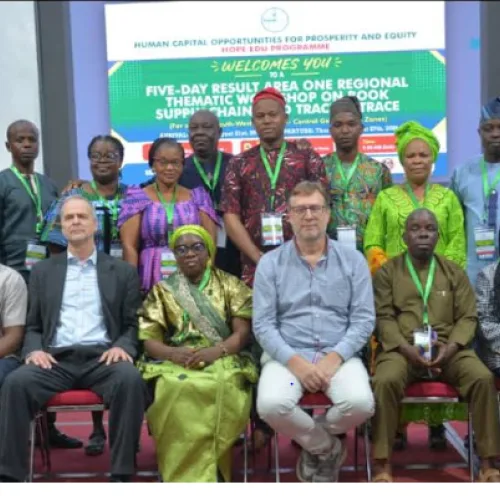
The federal government, through the Hope Education Programme (HOPE-EDU), the Office of the Minister of Education, in collaboration with the Universal Basic Education Board (UBEC) has commenced capacity-building for SUBEB directors and other stakeholders across the Southwest and North-Central regions.
The workshop, according to Aisha Garba, the executive secretary at UBEC, is part of efforts by the federal government to strengthen education management and improve learning outcomes in the country.
Garba, speaking at the training workshop held recently in Lagos with the theme: “Strengthening Foundations: Implementing the Structured Pedagogy Package,” emphasised that education remains the cornerstone of national development.
“The federal government, in partnership with the World Bank, is fully committed to ensuring that the HOPE‑EDU Programme delivers qualitative outcomes. Your presence here today demonstrates a shared dedication to the future of the Nigerian child,” she said.
Besides, she highlighted that since the programme became effective in February 2026, implementation has focused on establishing the institutional arrangements, technical, and operational foundations required to achieve the Programme Development Objective (PDO) and Year 1 Results.
“With the support of the World Bank team, as well as commissioned technical experts and consultants, we have worked closely with states to lay the groundwork for reforms that this workshop will now help translate into action.
“The focus of this workshop, the book supply chain and track-and-trace system, sits at the very heart of RA1’s promise to learners: that teaching and learning materials procured and financed through this Programme will achieve a 1:1 pupil–book ratio in literacy and numeracy, and that these books will reach classrooms intact and on time,” Garba said.
The Human Capital Opportunities for Prosperity and Equality (HOPE-EDU) Programme is a federal government initiative supported by the World Bank to strengthen foundational learning through improved systems, institutional capacity and technical support.
It is against this backdrop that HOPE-EDU, under Results Area 1 (RA1), is convening a series of Thematic Regional Workshops on Structured Pedagogy Package (SPP) Guidance and the Book Supply Chain and Track-and-Trace (BSC/TnT) System to strengthen the capacity of Federal and State officers to support effective implementation.
According to UBEC, “The workshops are designed to translate the programme’s objectives into practical support for states, equipping relevant federal and state officials with the knowledge, tools and systems required to strengthen implementation.
“The workshops will provide an opportunity to demonstrate the federal government’s commitment to strengthening foundational learning, improving the quality and availability of teaching and learning materials, and building transparent and accountable systems for education service delivery.”
Hence, the commission, through the office of the minister of education ensures that the engagement goes beyond a technical workshop, but is positioned as an important step in translating HOPE-EDU’s investments and objectives into practical improvements at state and school levels, ultimately contributing to better teaching and learning outcomes for Nigerian children.
The workshops will be implemented in three phases: Lagos (Phase 1), Uyo (Phase 2), and Kano (Phase 3), covering all six geopolitical zones.
The Lagos phase had two workshops: the SPP Guidance Workshop, which focused on effective implementation of the structured pedagogy package and targeted academic services, teacher professional development (TPD), and M&E officers.
Besides, it includes the BSC/TnT Workshop, which focuses on strengthening systems for the procurement, warehousing, distribution, and tracking of teaching and learning materials. It targets procurement, academic services, M&E, and EMIS/ICT officers.
Some of the objectives include building the capacity of state academic services, teacher professional development (TPD), and monitoring and evaluation (M&E) officers to implement the structured pedagogy package effectively, among others.
It is expected that at the end of these workshops, participating states will be able to strengthen SPP rollout plans and implementation capacity, and have improved readiness to meet DLI 1 and DLI 2 evidence requirements.
Moreover, they are expected to have a better understanding of TLM specifications, procurement and distribution requirements, improved capacity to use the BSC/TnT platform, and clearer accountability arrangements for the management and tracking of teaching and learning materials.
Following the Lagos workshops, the programme will proceed to Uyo for the South-East and South-South states and then to Kano for the North-West and North-East states.
The three phases are designed to provide states across all six geopolitical zones with the technical guidance, institutional support and tools required for effective implementation of RA1.


Charles Ogwo is a proactive journalist, driving education, and business innovations for over 10 years. He leads initiatives leveraging tech to enhance storytelling and build topnotch performing team. Charles is passionate about harnessing technology to inform, engage and empower communities.
Comments
Start the conversation about this story.