





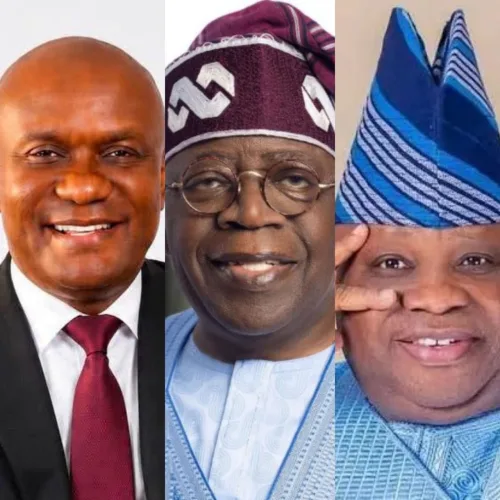
Former Speaker of the Abia State House of Assembly and APC House of Representatives candidate for Ikwuano/Umuahia Federal Constituency, Rt. Hon. Chinedum Enyinnaya Orji, has said the recent Osun State governorship election proved that the Independent National Electoral Commission (INEC) can conduct free and fair polls, while President Bola Ahmed Tinubu’s transparency reforms are taking hold and redefining Nigerian democracy.
In an article titled “Transparency, Trust, and Transformation: Why INEC’s Credibility and Tinubu’s Reforms Are Redefining Nigerian Democracy,” Orji argued that transparency is the oxygen of true democracy, enabling free elections, economic growth, and citizens’ ability to hold leaders to account.
“Transparency is the oxygen of true democracy. Without it, elections become rituals, policies become decrees, and public trust erodes. With it, citizens can see the process, judge the outcomes, and believe that their votes and their taxes actually matter,” Orji wrote.
The former Speaker said President Tinubu’s commitment to openness is a governing philosophy anchored on the belief that legitimacy comes from process, not pronouncement.
He cited the Osun election as a defining moment for INEC’s credibility. According to Orji, despite widespread skepticism that the ruling APC had predetermined the winner, INEC conducted a free and fair election.
“To their dumbfounding surprise, INEC conducted a free and fair election. Voters were accredited, results were transmitted, and party agents were allowed to witness the process at every level. The atmosphere reflected competition, not coercion,” he wrote.
Orji noted that Accord Party candidate Ademola Adeleke emerged as winner, adding that the outcome “cut across expectations and party lines” and forced even skeptical observers to reassess.
He said President Tinubu’s posture before, during, and after the election reinforced INEC’s credibility, adding that there was no directive from the Villa to skew the process.
“That is adherence to the Rule of Law in practice. When the head of government allows institutions to function independently, he is telling Nigerians that no one, including his own party, is above the process,” Orji stated.
The APC chieftain also linked INEC’s credibility to the administration’s economic transparency agenda, describing both as “two sides of the same coin.”
“One protects political rights, the other protects economic rights. Both depend on institutions being allowed to work,” he wrote.
On the removal of petroleum subsidy, Orji described the policy as a “difficult but necessary path” that has delivered immediate and measurable results.
“Federation allocations to states have quadrupled in many cases. Money that previously disappeared into subsidy payments is now flowing into state coffers,” he wrote.
He said governors across party lines now have more fiscal space to pay salaries, rehabilitate schools, invest in healthcare, and fix roads, adding that it is “only fair and only right” that they acknowledge President Tinubu’s role in the reform.
Orji said transparency in the reform matters because Nigerians can now see monthly FAAC figures published, track what comes into the federation account, and demand accountability from their state governments.
“When citizens know how much their state received, they can also ask how it is being spent. That is democracy extending beyond election day into governance itself,” he wrote.
He said the judiciary has also benefited from the executive’s respect for court judgments and due process, adding that public trust is being slowly rebuilt because people can point to concrete examples.
“Osun is one. Improved allocations is another. There is a pattern forming,” Orji stated.
He concluded that President Tinubu has demonstrated a consistent willingness to uphold the principles of democratisation—free elections, open policies, and governance that answers to the people.
“In the final analysis, transparency is not a slogan. It is an enabler. It enables free elections, it enables economic growth, and it enables citizens to hold leaders to account,” he wrote.
“That is the standard Nigerians should now demand, and it is the standard this administration has set.”
Comments
Start the conversation about this story.