





…as UNILAG’s DLI holds fifth international colloquium
Nigeria’s growing demand for university education amid limited capacity in conventional institutions has renewed calls for the country to scale up Open and Distance Learning (ODL) as a viable pathway to expanding access to higher education.
The call was made by academics and education stakeholders at the fifth International Colloquium organised by the Distance Learning Institute (DLI), University of Lagos (UNILAG), where speakers stressed the need for Nigeria to harness technology and flexible learning models to bridge the widening gap in university enrolment.
Folasade Ogunsola, the vice-chancellor of the University of Lagos, speaking at the institute’s fifth international colloquium, held on Tuesday, said, in Nigeria where there are about 89 million youth between age 15-30years and the average age is 19years with a growing demand for higher education, significant geographical inequalities in access, and a labour market that increasingly demands continuous learning and reskilling, it is clear that the old university model will not educate the teeming youth population.
“Today, technology has made it possible to learn from anywhere. Open and Distance Learning provides an important pathway for expanding access to higher education for workers, people with disabilities, those living far from university campuses and those who simply need a more flexible mode of learning,” she said.
Ogunsola called on the Federal Ministry of Education to go beyond mere recognition of degrees obtained through accredited ODL institutions to ensuring that the experience, flexibility and outcomes of ODL are worthy of the aspirations of the learners.
Besides, the vice-chancellor emphasised that universities today use technology to make learning better, more inclusive, personalised and effective.
“ Artificial intelligence now gives us opportunities that were unimaginable only a few years ago. AI can support personalised learning, provide immediate feedback, assist students with different learning needs, help lecturers develop content and assessments, analyse learning patterns and support early identification of students who may be struggling.
“But we must also address the difficult questions: academic integrity, data privacy, algorithmic bias, digital dependence, intellectual property, the changing role of the teacher and Nigeria’s realities,” she said.
Risikat Dauda, the director at DLI, University of Lagos, said the choice of theme for the colloquium, “Reimagining Open Distance Learning Ecosystem: Technology, Policy and Institutional Priorities,” was deliberate, bearing in mind that ODL is no longer a peripheral alternative to the traditional classroom.
“Open Distance Learning is fast becoming the backbone of how nations expand access, close skills gaps, and prepare their citizens for a labour market being rewritten in real time by artificial intelligence and digital transformation.
“Nigeria’s numbers tell an urgent story. We remain home to one of the largest out-of-school populations in the world, and our conventional universities, however excellent, cannot alone absorb the millions of young Nigerians seeking access to higher education each admission cycle,” she noted.
However, Dauda frowns at the fact that many Nigerian employers, and indeed too many of university faculty, still quietly treat an ODL certificate as a lesser certificate.
“That bias is not merely unfair; it is a policy failure. It is the NUC’s responsibility, and ours as institutions, to enforce quality assurance so rigorously that the mode of delivery becomes irrelevant and only the rigour of assessment matters.
“Until we close that credibility gap at home, no amount of global partnership will give our graduates the mobility they deserve. These are precisely the policy and institutional priorities our theme calls us to confront honestly today,” she said.
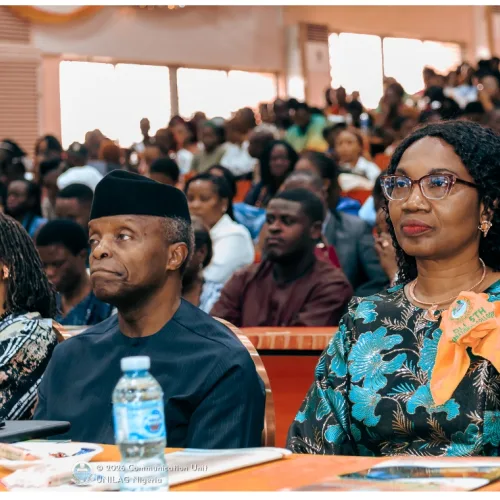
Yemi Osinbajo, former vice-president of Nigeria, said Nigeria must embrace Open and Distance Learning to close the growing demand gap for university education.
“Open and Distance Learning is key to bridging Nigeria’s university enrolment needs; besides, the country must rethink its entire learning experiences,” he said.
Osinbajo said more than 2.2 million young Nigerians seek tertiary education enrolment every year, while about 25 percent of the candidates are admitted; the country’s tertiary education system historically admitted only about 25 percent.
“Nigeria’s population could approach 250 million by 2036, with annual university applicants potentially rising to 2.7 million or exceeding three million.
“The conventional universities can’t provide enough lecture theatres, laboratories, and physical campuses to accommodate the projected demand,” he said.
Stephen Brown, an emeritus professor of learning technologies at De Montfort University, in his keynote address, emphasised the need for an educational systems that provide more, and more flexible and large-scale learning opportunities.
“We know that education can have really powerful transformative effects. It can enable people to overcome limitations of income, gender, and social position.
“It can improve people’s health, sense of well-being, and help to transform society, increasing cohesion and levels of prosperity,” he said.


Charles Ogwo is a proactive journalist, driving education, and business innovations for over 10 years. He leads initiatives leveraging tech to enhance storytelling and build topnotch performing team. Charles is passionate about harnessing technology to inform, engage and empower communities.
Comments
Start the conversation about this story.