





Nigeria’s growing reliance on domestic borrowing to finance government spending has reduced its exposure to foreign-currency risk, but it has also made the government more sensitive to the price of naira liquidity. The Central Bank of Nigeria’s decision to reopen Open Market Operations to individuals, corporates and non-bank financial institutions introduces another high-yield instrument competing for the domestic savings the Treasury relies on.
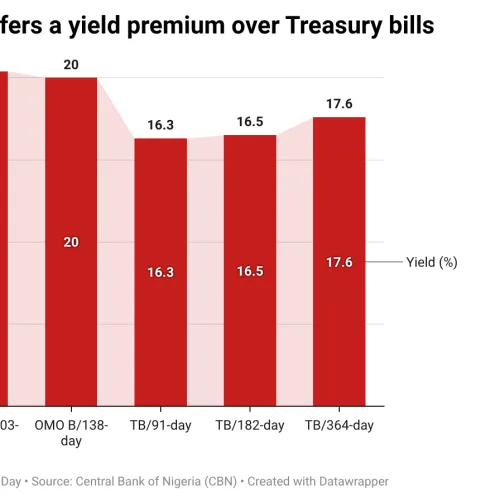
At the first OMO auction after the reopening, investors submitted N4.93 trillion for N600 billion offered. The 103-day instrument cleared at 20.39 percent and the 138-day bill at 20.01 percent, compared with Treasury bill yields of 16.30 percent, 16.50 percent and 17.59 percent for 91-day, 182-day and 364-day bills respectively. The yield gap gives investors a strong incentive to consider OMO over comparable Treasury bills.
The Treasury does not have to lose investors outright for the development to matter. If OMO remains significantly more attractive, it could eventually require the government to offer higher yields to retain demand for its own short-term debt.
That creates a new tension in Nigeria’s domestic borrowing strategy. Foreign borrowing carries exchange-rate risk because a weaker naira increases the domestic cost of servicing external debt. Domestic borrowing avoids that mismatch, but leaves the government exposed to movements in local interest rates and investor demand.
Nigeria has seen the interaction between OMO and government borrowing before. When the CBN restricted domestic non-bank investors from OMO in 2019, liquidity released from maturing OMO holdings flowed into government securities, helping keep government borrowing costs unusually low. The IMF subsequently recommended that OMO maturities remain short to minimise competition with Treasury bills and called for closer coordination between monetary and debt-management operations.
The reopening changes that balance. The CBN can use OMO to absorb liquidity and manage monetary conditions, but the same operation can influence where investors place their money. Still, Idris Oyekan, a capital market analyst at Quantum Zenith, does not expect the reopening to materially increase the government’s borrowing cost.
“I don’t expect OMO yields to have a significant impact on the government’s borrowing cost. Treasury bill subscriptions have remained above the amounts offered, particularly for 364-day bills, and I expect that to continue despite the liberalisation of the OMO market,” Oyekan said.
Read also: OPay plans NGX listing as $4bn US IPO ambitions gather pace
He said OMO serves a different purpose from Treasury bills and is likely to be issued less frequently.
“OMO bills are stabilisation instruments, and their issuance frequency is expected to be lower than Treasury bills. So, I don’t see OMO yields putting pressure on Treasury bill yields. Rather, increased demand for OMO bills should bring their yields down to somewhere close to Treasury bill levels,” he said.
Emeka Ucheaga, head of strategy, research and financial inclusion at Credit Direct Finance Company Ltd, takes a different view, linking the high OMO yields to the CBN’s aggressive liquidity management.
“OMO yields above 20 percent are a reflection of the CBN’s aggressive liquidity sterilisation to keep monetary conditions tight and support inflation and FX stability,” Ucheaga said.
He said the higher returns could eventually increase pressure on the government’s short-term borrowing costs.
“If these elevated OMO rates persist, the DMO will face increasing pressure to pay higher yields, particularly at the short end of the curve,” he said.
The broader pressure could extend beyond government borrowing. Banks could face pressure to raise deposit rates as customers gain access to higher-yielding OMO securities, potentially increasing the cost of lending to households and businesses. Companies seeking to raise capital could also face a higher return threshold from investors.
Abayomi Fashina, lead entrepreneur and risk management specialist at STL Capital, warned that sustained OMO yields above 20 percent could intensify those pressures. “Banks may rationally prefer risk-free returns over business lending, while higher borrowing costs could deepen the government’s debt-service burden,” Fashina said.
He also warned of a potential “fiscal-monetary doom loop”, in which higher borrowing costs widen deficits and force the government to borrow more at increasingly expensive rates. “The risks could arrive together following a single shock, such as an oil-price collapse, naira dislocation or sudden loss of market confidence,” he said.
The immediate auction, however, is not enough to establish a lasting trend. OMO pricing reflects liquidity conditions and investor demand, and future auctions could clear at lower yields. The key test is whether the gap between OMO and Treasury yields persists.
Three numbers will show whether the pressure is becoming structural: OMO yields, Treasury bill yields and the government’s marginal borrowing cost. If OMO remains around 20 percent while Treasury yields continue rising, the competition for domestic liquidity will become harder to dismiss. If OMO yields instead move towards Treasury levels without a sustained increase in government borrowing costs, Oyekan’s assessment will gain support.
For investors, the reopening creates another high-yield option. For the Treasury, it creates another market price to watch. The bigger question is whether Nigeria’s limited pool of domestic savings is being channelled into financing the government’s deficit, supporting private investment or increasingly being absorbed by the CBN’s liquidity-management operations.


Oluwatobi Ojabello, PhD, is a dynamic and multi-dimensional Assistant Editor for Economy and Markets with over two years of professional journalism experience. He delivers authoritative, data-driven coverage of fiscal policy, financial institutions and capital markets, using clear analysis to explain Nigeria’s most complex economic developments. His work focuses on macroeconomic policy, financial stability and corporate performance, turning technical issues into accessible narratives that inform both experts and everyday readers.
Comments
Start the conversation about this story.