





China imported goods worth nearly $2.3 billion from Nigeria in the first half of 2026, representing an almost 80 per cent increase over the corresponding period in 2025, the Chargé d’Affaires of the Chinese Embassy in Nigeria, Zhou Hongyou, has disclosed.
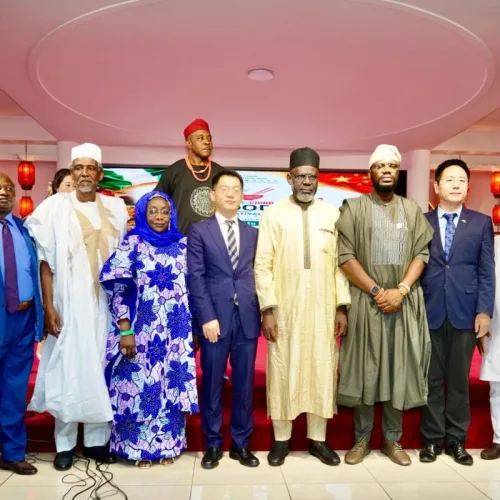
Zhou made the disclosure on Thursday at the Nigeria-China Food Festival held at the China Cultural Centre in Abuja, where he said expanding economic ties, alongside stronger cultural and people-to-people exchanges, would further strengthen relations between both countries.
He said total bilateral trade between Nigeria and China had also risen to $18 billion, representing a 75 per cent year-on-year increase.
According to him, the growth demonstrated the expanding economic relationship between the two countries, while China’s zero-tariff policy for African countries with diplomatic relations with Beijing offered Nigeria an opportunity to further increase its exports.
“This is a great chance for Nigeria to expand exports to China,” Zhou said.
The diplomat said the food festival provided more than an opportunity to taste different cuisines, describing it as a platform for Nigerians and Chinese to understand each other’s history, culture and way of life.
“Today we are bringing Chinese and Nigerian cuisines together. It is not just a feast for our taste buds, but it is also a conversation and a meeting of all cultures,” he said.
Zhou noted that 2026 marked the 55th anniversary of formal diplomatic relations between Nigeria and China, adding that the relationship had expanded over the years to cover trade, education, culture, technology and people-to-people exchanges.
He called for stronger exchanges in education, the arts, schools and youth affairs to consolidate the relationship and ensure that the friendship between both countries was sustained across generations.
“Through deeper exchanges in education, culture, the arts, schools, and youth affairs, China and Nigeria can strengthen people-to-people connections and pass on friendship to the next generation,” Zhou said.
Speaking on behalf of the Minister of Arts, Culture, Tourism and the Creative Economy, Hannatu Musa Musawa, the Permanent Secretary, Abdulkarim Ozi Ibrahim, said the festival highlighted the economic potential of Nigeria’s culinary heritage.
He described food as an important component of cultural identity and a potential driver of tourism and job creation.
“Food does not merely nourish the body. It tells stories, preserves heritage, creates livelihood, and brings people together,” Ibrahim said.
He said the Federal Government had identified food and beverages as the largest subsector of Nigeria’s tourism economy, stressing the growing importance of gastronomy to domestic tourism.
“Gastronomy is tourism. Nigeria’s recent tourism and creative industry market has identified food and beverages as the single largest subsector of Nigeria’s tourism economy,” he said.
Ibrahim said the government was strengthening the creative economy through policy and financing frameworks, stakeholder engagement and institutional reforms designed to promote tourism, attract investment and create opportunities for young Nigerians.
He called for increased Nigeria-China collaboration in gastronomy, tourism, hospitality, culinary education and creative entrepreneurship.
“Let us use food to open new doors of cooperation in gastronomy, tourism, hospitality, cultural exchanges, culinary education, and creative entrepreneurship,” he said.
The Director-General of the National Institute for Hospitality and Tourism (NIHOTOUR), Aare Abisoye Fagade, said the festival was designed to demonstrate the connection between food, culture and economic opportunity.
Fagade said the theme, “From Farm to Feast,” represented the journey from farmers and producers to chefs and consumers, while highlighting the economic value embedded in Nigeria’s culinary traditions.
“Today’s celebration is about food, but it’s also about culture, friendship, and opportunity,” he said.
He said Nigeria possessed a rich culinary heritage capable of supporting a globally competitive food tourism industry if properly developed and commercialised.
“Our task is to package, standardise, promote, and commercialise this heritage while preserving the authenticity,” Fagade said.
Also speaking, the Director-General and Artistic Director/CEO of the National Troupe of Nigeria, Hajia Kaltume Bulama Gana, said cultural collaboration between Nigeria and China could deepen mutual understanding and respect.
She highlighted a joint performance by Nigerian and Chinese artistes, which combined traditional Nigerian drums with Chinese percussion instruments, as an example of how cultural diplomacy could bring the two peoples closer.
“For the first time, the National Troupe has come into this partnership where there is a joint performance of the National Troupe of Nigeria performing with the Chinese percussions and our own indigenous drums,” Gana said.
She expressed hope that the collaboration would expand to reciprocal cultural performances, including opportunities for Nigerian artistes to perform in China.
Former NIHOTOUR Director-General, Alhaji Munzali Dantata, also called for stronger Nigeria-China cooperation, particularly in education and cultural exchanges.
Dantata, who recalled studying in Beijing about four decades ago, said China’s transformation over the years demonstrated the value of sustained investment in education, development and international cooperation.
“See how, within 30 years, the country has changed,” he said.
The festival featured 14 Chinese dishes from seven regions of China alongside traditional Nigerian cuisines representing the country’s six geopolitical zones.
Nigerian dishes on display included jollof rice, pounded yam, tuwon shinkafa, masa, fura da nono, amala, Ofada rice, abacha and ugba, and eba with edikang-ikong soup.
The event also featured cultural performances, music, arts and crafts, with participants highlighting the potential of culinary diplomacy to promote tourism, hospitality, cultural understanding and stronger economic ties between Nigeria and China.
Comments
Start the conversation about this story.