






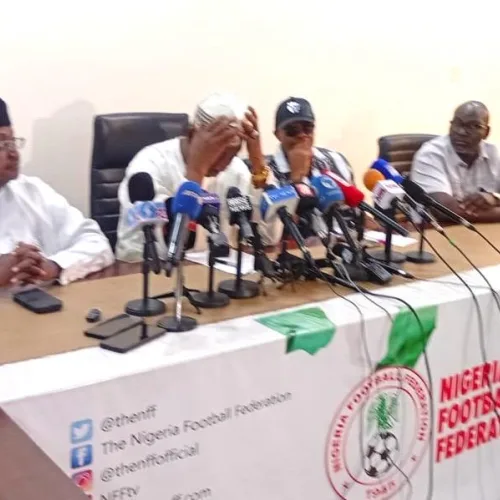
There were emotional scenes at the headquarters of the Nigeria Football Federation (NFF) in Abuja on Thursday August 27, 2026 as Ibrahim Musa Gusau formally addressed members of staff and announced his resignation as president of the federation.
Gusau, who had been at the centre of mounting pressure over the administration of Nigerian football, reportedly informed staff of his decision during a farewell address at the NFF Secretariat.
The development comes hours before an emergency Congress of the NFF is expected to hold in Abuja to deliberate on the unfolding leadership crisis and determine the way forward for the federation.
Emotional farewell at secretariat
The atmosphere at the NFF Secretariat was reportedly emotional as Gusau addressed staff and formally brought his tenure to an end.
The former NFF president was said to have expressed appreciation to members of staff for their support and cooperation during his time in office, with the occasion turning into an emotional farewell.
His resignation brings to a dramatic end a tenure that has become increasingly overshadowed by mounting criticism of the administration of Nigerian football.
The development also confirms earlier reports that Gusau and several members of the NFF Executive Committee had stepped down amid growing pressure over the fortunes of the country’s national teams.
Emergency Congress summoned
The resignation comes as NFF Congress members have been summoned to an emergency meeting in Abuja.
The meeting, scheduled for Thursday, is expected to consider the current developments within the federation, the status and functioning of the Executive Committee and Secretariat, as well as the implications of the crisis for the governance and stability of Nigerian football.
Congress is also expected to consider appropriate measures under the statutes of the NFF, CAF and FIFA before deciding on the way forward. State Football Association chairmen, club representatives, coaches, players and referees’ representatives are among those invited.
The emergency meeting could therefore provide the platform for Congress to formally acknowledge the resignations and determine an interim arrangement for the running of the federation.
Crisis deepens after national team failures
The leadership upheaval follows a prolonged period of disappointment for Nigerian football.
The Super Eagles failed to qualify for the 2026 FIFA World Cup after also missing the 2022 edition, while the Super Falcons suffered an even more historic setback by failing to qualify for the 2027 FIFA Women’s World Cup.
Nigeria had appeared at every edition of the Women’s World Cup since the competition began in 1991, making the failure to qualify a major blow to the country’s football reputation.
The setbacks triggered widespread calls for accountability, with former players, administrators and other stakeholders demanding fundamental changes in the way football is managed in the country.
Former Super Eagles captain John Mikel Obi was among those who called for a change in the NFF leadership structure following the latest setbacks.
Fact-finding committee adds to pressure
The crisis had earlier prompted the NFF to establish a fact-finding committee to investigate the reasons behind Nigeria’s poor performances in international competitions.
The committee was tasked with examining the root causes of the country’s disappointing results and making recommendations aimed at preventing a recurrence.
However, its chairman, former NFF General Secretary Ambassador Fanny Amun, subsequently resigned from the committee after submitting its report.
Amun’s resignation added another layer to the controversy surrounding the process, with the former administrator explaining that he wanted to preserve the integrity and independence of the committee’s work.
The report has since attracted attention as stakeholders await the implementation of its recommendations and the extent to which they could influence reforms within Nigerian football.
N17bn fund under investigation
The leadership crisis has also coincided with scrutiny by security agencies over the management of funds allocated to Nigerian football.
Reports indicate that the Department of State Services is examining the utilisation of a ₦17 billion Federal Government intervention fund approved in 2024 for outstanding wages and bonuses owed to members of Nigeria’s national teams.
NFF officials had been asked to provide documentation relating to the utilisation of the funds, although a source described the exercise as a normal review rather than a witch-hunt.
The financial scrutiny has further increased pressure on the NFF leadership at a time when stakeholders are demanding greater transparency and accountability.
Sanusi, board members also quit
Gusau’s resignation is not an isolated development.
NFF General Secretary, Dr Mohammed Sanusi, has also been reported to have resigned, while several members of the Executive Committee have reportedly left their positions.
Earlier reports indicated that eight of the 13 members of the NFF board had already resigned, effectively leaving the federation facing a serious leadership vacuum.
The scale of the resignations has raised questions about the future of the current Executive Committee and the administrative structure of the federation.
September election now in focus
The unfolding crisis could also have consequences for the NFF electoral timetable.
The federation had scheduled its elective Congress for September 27 in Lafia, Nasarawa state. With the president, General Secretary and several Executive Committee members reportedly out of office, stakeholders are now waiting to see whether the election will proceed as planned or whether Congress will introduce a new arrangement.
For now, attention has shifted to the emergency Congress in Abuja, where delegates are expected to determine the immediate future of the federation.
Gusau’s emotional farewell to NFF staff therefore marks more than the end of one administration. It could signal the beginning of a major restructuring of Nigerian football, with Congress now faced with the task of restoring stability and charting a new direction for the country’s football administration.
Comments
Start the conversation about this story.