





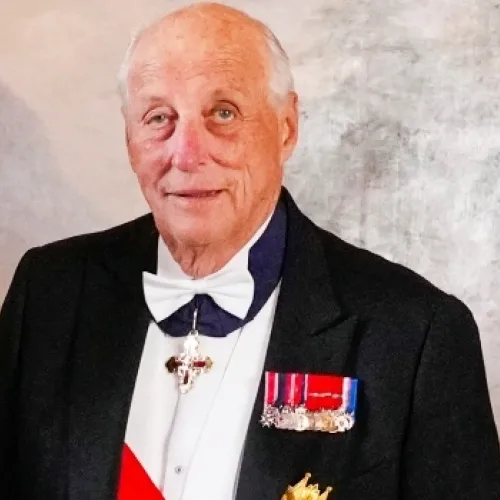
After been taken to a hospital last week for treatment for a rare blood condition, Norway’s King Harald V passed away at age 89.
According to the palace in Oslo, he passed at 06:35 local time (04:35 GMT) peacefully on Friday at the Oslo national hospital. The royal flag at the roof of the palace was lowered to half-mast.
During the hours leading up to the demise of the king, members of the royal family came visiting the king while the crowd laid flowers at the palace.
Since the 14th century, Harald has been the first Norway king to be born in Norway. His 53 years old son Kaakon succeeded him and will later hold an extraordinary council of state on Friday.
Sweden’s King Carl XVI Gustaf remembered him as a good friend to him, his family and Sweden. He wished his godson Haakon a good fortune and success while a heart felt condolence was sent by King Charles III.
In an observation made by the Royals, they referred to him as Dow to earth, respected and beloved. They also described him with a name given to him by his father as the “grandfather” of the nation and the “People’s King”.
Harald 35 years later was remembered as a popular reforming figure who broke the Monarchial tradition by marrying a commoner and served as a unifier at the most difficult moments in Norway.
He appealed to Norwegians to support each other and not let fear take over after the 2011 bomb and gun attacks on Oslo and the Island of Utøya.
Harald and his family recently faced both health challenges and scandals over his daughter-in-law link with late sex offender Jeffrey Episten and her son’s conviction for rape.
The late king is survived by his wife Queen Sonja who is almost 58 years old, his daughter Princess Märtha Louise, the new king Haakon and his six grandchildren.
Harald was born in the Skaugum estate near Oslo on 21 February 1937, more than 30 years after gaining independence from Sweden becoming a constitutional monarchy.
When the dictator Adolf Hitler ordered Norway’s invasion by the Nazi Germany in the early World War II, Harald was only three years old.
On the invitation of President Franklin D Roosevelt of the United States, Harald’s mother fled with her children across the Sweden border.
After the end of the war, Prince Harald returned with his family to Norway and completed his studies and a compulsory military service. In 1957, he became crown prince. From 1960 to 1962, he studied social sciences, history and economics at Balliol College in Oxford.
He met his wife who was the daughter of a businessman at a party but had to wait nine years before he was permitted to get married to her. His father always hoped that he would get married to an European princess but eventually he told his father that he would remain single if he isn’t allowed to marry Sonja.
His father finally gave his approval and on the 29 of August 1968 in Oslo Cathedral, they got married. This choice Harald made, paved way for his children to also marry commoners.
Harald’s father Olaf became sick in 1990 and on the 17 of January 1991, he died and Harald ascended the thrown.
In July 2011, King Harald faced one of the darkest moments of his reign when neo-Nazi Anders Breivik carried out a devastating attack in Norway. Breivik first killed eight people with a car bomb in Oslo before travelling to Utøya island, where he shot and killed 69 people, most of them teenagers.
The following day, Harald addressed the nation on television. Weeks later, he delivered an emotional speech in which he expressed solidarity with the victims and their families, speaking not only as king but also as a father, grandfather and husband. Overcome with emotion, his voice trembled and at times broke as he struggled to hold back tears.
He said that “he could only imagine the depth of their pain”.
In 2016, King Harald once again drew international attention for a powerful speech celebrating Norway’s diversity. He called for acceptance across differences in religion, ethnicity and sexual orientation, emphasising that Norwegian identity is not limited to a single background or belief.
He pointed to the country’s multicultural population, noting that Norwegians come from places including Afghanistan, Pakistan, Poland, Sweden, Somalia and Syria. He also stressed that they hold different religious beliefs or none at all and include people of different sexual orientations. His message was clear: diversity is an important part of what makes Norway Norwegian.
The king was also a good athlete and environmentalist and also, he was one of the initiators of the Norwegian branch of the World Wide Fund for Nature and for 20 years, he served as the president of the Norwegian chapter.
He was an accomplished sailor who decleared his competitive sailing days over in 2022 after he represented Norway three times at the Olympics.
In 2001, Haakon married Mette-Marit and the King and Queen welcomed her four years old son from her previous relationship Marius Borg Høiby. He was treated well as a royal family but along the line, the royal house stressed that he was never royal.
Due to the decline in the king’s health, he permanently reduced his public engagement in April 2024. He was treated with cortisone for a rare blood condition, haemolytic anaemia recently causing the number of red blood cells in his body to reduce. On August 17, he entered into the hospital and his son became regent taking over his activities.
The Norwegian royal family has spent much of the year navigating a difficult mix of personal crises and controversies, putting the monarchy under an unusually intense spotlight.
At the centre of the turmoil has been Marius Borg Høiby, whose criminal case and subsequent four-year prison sentence have kept attention firmly on the royal household. Høiby has appealed the sentence and was reportedly among those who visited King Harald at his bedside before the monarch’s death.
The scrutiny intensified further when revelations emerged about Crown Princess Mette-Marit’s past relationship with convicted sex offender Jeffrey Epstein. The documents, released just days before Høiby’s trial, revived questions about her judgment and associations.
Mette-Marit subsequently apologised to King Harald and Queen Sonja, acknowledging that maintaining a friendship with Epstein had been a serious error in judgment. In a televised interview, she said she regretted ever meeting him.
Together, the controversies have placed the royal family in an uncomfortable position, forcing the institution to confront deeply personal issues in full public view while trying to preserve public confidence in the monarchy.
Just two days after her son’s trial concluded, Mette-Marit underwent a lung transplant, following an eight-year battle with a rare form of pulmonary fibrosis. Her recovery is expected to be closely monitored, with doctors unlikely to consider her condition fully stable until a year after the procedure.
The situation also places added pressure on Crown Prince Haakon, who must balance supporting his wife through a lengthy recovery with the responsibilities that come with being next in line to the throne.
Meanwhile, the succession of controversies and personal difficulties appears to have affected public confidence in the monarchy. An Aftenposten poll showed support falling sharply, from 72 percent in 2024 to 54 percent, highlighting the growing challenge facing the royal institution.
Although Haakon is highly likely to say Mette-Marit will become Queen, other polls suggests otherwise as almost half of Norwegians believed Mette-Marit could no longer become Queen.


Comments
Start the conversation about this story.