





MTN Nigeria has created more than two million direct and indirect jobs through its trade partners and agents over its 25 years of operations, while Nigerians now account for 99.85 percent of its workforce, according to Ije Jidenma, chairman of the Nigeria–South Africa Chamber of Commerce.
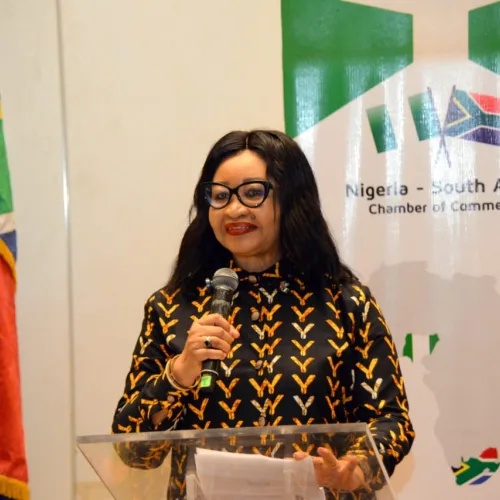
Jidenma disclosed this on Thursday at the Chamber’s August Breakfast Meeting at Eko Hotel, Lagos, held under the theme, “Building Local Content Together: 25 Years of Shared Growth.”
The event brought together business leaders including Modupe Kadiri, Chief Financial Officer of MTN Nigeria; Udeme Ufot, Group Managing Director of SO&U; Yemi Chukwura, Chief Executive Officer of Seams & Stitches; Ayeni Adekunle, Chief Executive Officer of Blockhouse Media; and Afolabi Sobande, Group Chief Operating Officer of Computer Warehouse Group.
Speaking at the event, Jidenma said MTN’s quarter-century presence in Nigeria had extended beyond telecommunications into employment creation, local procurement, entrepreneurship, skills development and technology transfer.
She described the company as “exemplary” in advancing the objectives of Nigeria’s local-content policy, which prioritises Nigerian participation and ownership, indigenous capacity development, local manufacturing and procurement, employment and talent development, technology transfer and the retention of value within the country.
“Today, MTN Nigeria has 99.85 percent of its workforce made up of Nigerians,” Jidenma said.
She said the workforce figure becomes more significant when considered alongside MTN’s statement that it has created more than two million direct and indirect jobs through its trade partners and agents.
According to her, MTN’s local economic footprint also extends to Nigerian small and medium-sized enterprises, suppliers, entrepreneurs involved in procurement and professional services firms supporting the company’s operations.
“If we, therefore, view local content beyond local participation, we can see the footprints of MTN among Nigerian SMEs, be they suppliers, entrepreneurs engaged in procurements and even professional services firms that provide services for its numerous productive activities,” she said.
Jidenma said the ultimate objective of local content should be the development of sustainable Nigerian capacity through talent development, stronger local businesses, knowledge and technology transfer, expanded local supply chains and meaningful employment opportunities.
She urged members of the Chamber and other businesses to adopt a similar approach to commercial activity, arguing that shared prosperity should form part of the foundation for sustainable business.
“As a Chamber, I challenge our numerous members to look at business from the lens with which MTN Nigeria sees it in terms of nation building and the inevitable success that comes from this approach to business,” she said.
MTN Foundation invests N34.4bn
Jidenma also highlighted the contribution of the MTN Foundation, the company’s corporate social investment arm established four years after MTN began operations in Nigeria.
She said the foundation had invested more than N34.4 billion in education, entrepreneurship, digital inclusion, healthcare access and community infrastructure.
The foundation has implemented more than 1,093 project sites and reached 3,610 communities across all 36 states and the Federal Capital Territory, according to Jidenma.
She also cited MTN’s subsidiary, MoMo PSB, which she said was at the forefront of seamless payments across several African countries.
Chamber seeks deeper Nigeria-South Africa partnerships
Jidenma said Nigeria and South Africa, which she described as two of Africa’s leading economies with strong entrepreneurial and commercial capabilities, had an opportunity to deepen their economic relationship.
She called for a shift beyond traditional trade and investment towards deeper partnerships capable of building businesses, skills, technology and value chains across Africa.
She urged business leaders to consider how they could create more opportunities for Nigerian enterprises, strengthen local supply chains, accelerate skills and technology transfer and help the next generation of African entrepreneurs grow.
“These are the conversations that should shape the next 25 years,” she said.
Migration tensions cloud bilateral ties
Jidenma also raised concerns over the current state of relations between Nigeria and South Africa, particularly the migration situation involving Nigerians in South Africa.
She said the migration crisis could have been better handled and disclosed that the Federal Government had brought back 1,490 Nigerians through five arranged commercial flights since June 10, 2026.
She called on business leaders and other stakeholders in both countries to work together to overcome the challenge.
The Chamber, she said, remained committed to facilitating stronger business relationships between Nigeria and South Africa and creating platforms capable of turning partnerships into tangible economic opportunities.
Africa must become a creator of innovation
Looking ahead, Jidenma said the next 25 years would be shaped by digital technology, innovation, artificial intelligence, entrepreneurship and new forms of economic collaboration.
She said Africa should become not only a market for innovation but increasingly a creator and owner of innovation.
She urged participants at the meeting to use the platform to network, identify opportunities, develop partnerships and take practical steps towards strengthening local content and creating shared and sustainable growth.


Comments
Start the conversation about this story.