





By Ifeanyi Igwebike Mbanefo
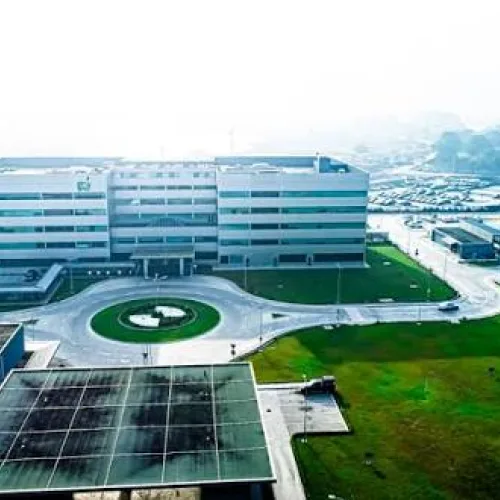
ON Port Harcourt’s eastern edge, where asphalt yields to creeks, mangroves, industrial yards and the humid breath of the Niger Delta, a composed campus rises behind secure gates.
The address is plain: NLNG Road, off the Eastern By-Pass. Yet this is more than an office complex. Here, Nigeria LNG Limited thinks, governs, negotiates, remembers and prepares for the next movement of gas, capital, people and time.
Commissioned by Rivers State Governor Nyesom Ezenwo Wike on May 19, 2021, the facility is officially NLNG’s corporate headquarters. Its deeper identity is more intimate: the House of Gas.
It is a campus rather than a solitary monument; a village of disciplined functions rather than a shrine to one executive or one era. It contains offices, meeting rooms, a boardroom, library, press centre, crèche, gymnasium, banking halls, ATM gallery, fire station, warehouse, landscaped grounds and a transit lounge linking Port Harcourt with Bonny Island.
But buildings are the visible ending of a longer story. Before concrete, glass and landscaped green, there was a corporate problem: NLNG had outgrown its home. Before that problem could be solved, its leaders needed memory, patience, technical discipline, negotiating nerve and the courage to walk away from a bad deal.
Lagos: The First Home
For decades, NLNG’s corporate life was rooted in Lagos. The choice made sense. Lagos was Nigeria’s commercial capital, home to bankers, lawyers, consultants, diplomats, traders and international visitors. Even after the Federal Government and NNPC moved to Abuja in the early 1990s, Lagos remained where contracts were negotiated, financing arranged and commercial relationships maintained.
NLNG stayed.
In 1997, shortly after Steve Ollerearnshaw became Managing Director, the company moved into C&C Towers on Sanusi Fafunwa Street, Victoria Island. The building had been designed as apartments, not offices. Its small rooms gave the company a temporary, almost domestic atmosphere — as though an enterprise of global ambition had been asked to inhabit converted bedrooms.
Yet the building had one blessing: a large ground-floor hall. It became the canteen and the venue for monthly all-staff briefings. Initially, employees listened cautiously while managers spoke. Gradually, staff began asking difficult questions. Managers had to answer. Rumours could be confronted before they hardened into resentment. NLNG was building not only systems, but a shared voice.
The canteen captured the company’s evolving identity. Nigerian staff came for hot meals; expatriates asked for sandwiches. Some Nigerian employees placed sandwiches on plates already filled with jollof rice and stew.
The culinary outcome was uncertain, but the symbolism was clear: NLNG was Nigerian in purpose, international in method and still learning how to bring its worlds together.
The company maintained a small London office near St James’s Park, managed by Elizabeth McGregor. For young Nigerian staff posted there, it became a practical finishing school in international work: navigating cultures, legal systems, time zones and demanding corporate standards.
There was also a bungalow office in Abuja for dealings with NNPC and the Federal Government. In 1999, NLNG opened a logistics base in Port Harcourt.
At first, it was a foothold. In time, it became destiny.
The Sky and the Ground
NLNG’s early memory was formed not only through board papers and commercial milestones, but through the vulnerability of people travelling across Nigeria’s difficult infrastructure.
During one harmattan approach into Port Harcourt, a pilot reportedly mistook a road for the runway before correcting course. The incident ended safely, but carried a larger lesson: in Nigeria, the gravest risks are not always where manuals expect them.
On another occasion, a chartered King Air carrying members of the NLNG community to Abuja developed a landing-gear failure. The gear would not deploy. Emergency support in Abuja was unavailable, so the pilot turned back towards Lagos.
In the cabin, the co-pilot lifted the floor and tried to lower the gear manually. On the Lagos tarmac, fire engines waited beside the runway.
Mrs Victoria Ihonde, one of NLNG’s directors, held a prayer book and began reading aloud. Her voice gave terrified passengers a rhythm. Steve Ollerearnshaw, facing what appeared to be his final minutes, considered writing a farewell message to his wife.
The aircraft landed. A wheel collapsed, then another. The plane skidded onto the grass, its nose struck the ground and the cabin fell into the dreadful silence that follows impact.
Everyone survived.
The story reached the front pages. The aircraft spent six months under repair. Ollerearnshaw flew again the next day, like a rider returning to the saddle after a violent fall.
Such episodes became part of NLNG’s folklore: reminders that corporate history is human first.
A Global Education
NLNG’s board meetings took place across the worlds represented by its shareholders: with NNPC in Abuja; Shell in The Hague or Amsterdam; Elf in Paris; and Agip in Milan or near the Italian Lakes.
There were memorable settings — a Loire Valley château associated with an Elf meeting, a World Cup match in which Nigeria defeated Spain 2–1, and a boat trip on Lake Como. But these were more than executive excursions. They were a global education.
NLNG’s Nigerian personnel observed how mature institutions worked: how board papers were prepared, questions framed, dissent managed, technical advice respected and decisions recorded. Governance was learned through exposure and repetition.
The company also learned how quickly trust can be attacked. At one point, fraudsters used forged NLNG letterheads and a false Ikeja address to target small contractors in a “419” scam. They vanished before the police arrived.
A successful institution attracts partners, but also impostors. Reputation must be defended as carefully as revenue.
When the Base Became Too Small
By 2008, NLNG’s Integrated Support and Operations Base—the ISB/OSB—in Port Harcourt was inadequate. It had been designed for a three-train operation, but NLNG had expanded. Personnel, contractors, visitors, support staff and logistics had multiplied. Temporary structures spread across the site. Accommodation was insufficient. Jetty operations strained. Movement between functions became congested, inefficient and less safe.
Refurbishment could not cure a structural limitation. NLNG needed land.
Next door stood Heliconia Park, owned by Prodeco/Interoil. Its masterplan included an international hotel, school, restaurant, security facilities, helipad and utilities. For NLNG, the attraction was not simply acreage, but shared infrastructure — power, water treatment, helipad services and other facilities that could reduce duplication.
The park offered approximately 46,000 square metres. The opportunity would not remain open indefinitely. Management studies showed that acquisition would permit an optimal ISB/OSB layout, provide room for expansion and prevent NLNG from scattering critical operations across disconnected sites.
The first lesson of the House of Gas is simple: major projects are often won or lost before construction. Site selection governs security, circulation, utility costs, staff welfare, growth and design coherence.
Chima Ibeneche, then Managing Director, saw the strategic truth. He sought Board authority to negotiate. The Board agreed.
Ibeneche: The Strategic Foundation
In 2009, Ibeneche requested approval to acquire the land for US$20.7 million, excluding transfer fees. The arrangement included a right of first refusal for the landowner’s construction company to develop the site.
Questions arose concerning Nigerian Content and Due Process. They were not bureaucratic ornaments; they concerned the legitimacy of the transaction, procurement integrity and NLNG’s long-term protection. Ibeneche provided clarification and carried the project through its most vulnerable stage, when it was still a proposition in boardrooms and a future dependent on judgement.
His contribution deserves high honour because it was not theatrical. He understood that a headquarters would shape institutional identity. Lagos had commercial convenience. Bonny Island was the industrial heart. Port Harcourt stood between them: close to operations, rooted in the region and capable of sustaining a serious corporate centre.
Ibeneche helped establish the logic for moving NLNG’s corporate home towards Port Harcourt. The decision asked whether the company would remain psychologically distant from the Niger Delta or place its centre of authority in the region from which its industrial purpose flowed.
He was also generally credited with helping move Shell’s centre of gravity from Warri to Port Harcourt. Ibeneche did not simply acquire land; he helped reposition a national institution.
Omotowa: The Chessboard Master
When Babs Omotowa succeeded Ibeneche as Managing Director, the project changed in scale and ambition.
By 2011, NLNG was considering moving its head office from Lagos to Port Harcourt. The project now required a genuine corporate home: a place for leadership, governance, communications, corporate services, employee welfare and institutional memory.
But the original land transaction contained a dangerous condition. The seller’s construction subsidiary had effectively been reserved as the single-source builder.
For a less disciplined organisation, that clause could become a trap: one contractor, one design route, one price story and endless opportunity for escalation. Omotowa saw the danger. He recognised the “elephant trap” — a convenient arrangement that could make NLNG captive to its own sunk costs.
His response was strategic, not theatrical.
First, he changed the seller’s advantage. The single-source entitlement would become a right of first refusal. The seller could match the lowest competitive bid, but could no longer dictate price or hold NLNG hostage.
The lesson is fundamental: honour legitimate commitments, but never let an inherited clause extinguish competition, transparency or value.
Second, Omotowa proposed a phased engineering, procurement and construction strategy. The preferred contractor would submit a Phase One proposal. That proposal would be independently benchmarked and negotiated. If it failed the test, management would return to the Board for approval of an open competitive tender.
The Board approved the approach.
By July 2011, Omotowa recommended rejecting award of the EPC contract to the single-source contractor. The Board endorsed a comprehensive review of design, cost and execution strategy.
It approved negotiations for the contractor to relinquish its single-source right, acquisition of additional land for a complete redesign, removal of multi-storey car parks, inclusion of power, water and waste-management infrastructure, design reviews by shareholder subject-matter experts, and fresh assessment of cost, constructability and long-term operational value.
Each move reflected disciplined thinking. More land allowed an efficient layout instead of expensive vertical congestion. Removing multi-storey parking reduced construction and maintenance burdens. Bringing utilities into the scope prevented improvised solutions later.
Independent technical review ensured confidence was tested rather than assumed.
This is Omotowa’s great lesson for private, public and corporate Nigeria: do not confuse speed with progress, paperwork with wisdom, or a contractor’s confidence with value. Major projects need stage gates — moments when enthusiasm submits to evidence.
The seller rejected the strategy and insisted on its single-source rights. A stalemate followed. It came down to who would blink first.
The Chokehold
The negotiations became exhausting. The contractor appeared unwilling to engage meaningfully, believing it possessed too much leverage. NLNG risked becoming captive to its own sunk costs.
Omotowa did not respond with anger. He introduced an alternative.
He applied to the Rivers State Government for land in the Greater Port Harcourt Area, Governor Rotimi Amaechi’s decongestion and smart-city initiative. The project aimed to relieve pressure on old Port Harcourt and create organised residential, commercial and industrial zones.
The message was unmistakable: NLNG was prepared to leave the existing route. The project could move. The presumed monopoly could vanish.
It was a masterstroke. The contractor returned to the table.
Here lies another lesson: never negotiate where the other party knows you have no alternative. A credible second site, supplier, financing structure or design can change the balance of power more effectively than angry meetings.
Omotowa’s tenacity lay not merely in refusing to yield, but in creating the conditions under which refusal became credible.
NLNG subsequently purchased 29,500 square metres of additional land at Amadi Creek for US$16.225 million, equivalent to US$550 per square metre. Omotowa rejected waterlogged areas and preferred hardened ground, sacrificing acreage for buildable quality.
The additional land expanded spatial freedom, improved circulation and permitted a more coherent design.
Good design is often the physical consequence of good negotiation.
In April 2015, the Board directed management to negotiate at least a 10 percent reduction with Bouygues Construction Nigeria Limited, the lowest bidder.
Through value engineering and contract optimisation, management secured US$21.7 million in savings—about 11.5 percent. A further US$1.6 million in VAT savings applied at Final Investment Decision. Refining the scope removed three buildings from the EPC contract, producing another reduction of about US$5 million, or 2.8 percent.
Bouygues also confirmed that performance and advance-payment bonds would be provided at no additional cost.
These figures show what tenacity becomes when translated into governance: interrogate scope, test assumptions, negotiate price, remove waste and preserve protection.
The Board approved the EPC award to Bouygues Construction Nigeria Limited and Final Investment Decision for the Port Harcourt head office project at US$282.4 million.
Port Harcourt as Home
Locating NLNG’s headquarters in Port Harcourt was a declaration about the Niger Delta.
The region would not be merely a resource basin from which gas and oil were extracted and shipped elsewhere. It would also be a place of authority, senior employment, professional development, procurement, visibility and decision-making.
Governor Wike described the headquarters as a sign of NLNG’s regard for Rivers State. In a region where presence and resources are inseparable, the symbolism was powerful.
A company may speak of community partnership in reports. A permanent headquarters speaks in concrete:
We are here.
The building cannot settle every question about extraction, development or responsibility. But it provides a platform from which those questions can be engaged more directly.
The Architecture of Memory
The headquarters’ most important function may be invisible: preserving institutional memory.
Within the House of Gas are the records of contracts, policies, Board decisions, technical reviews, legal opinions, procurement histories, shareholder consultations, stakeholder commitments and project lessons. Such memory is essential in a country where organisations are often disrupted by leadership transitions.
NLNG’s strength rests on accumulated knowledge—gas processing, shipping, finance, law, engineering, safety, construction, contracting, community engagement and international commerce. A headquarters gives that knowledge a physical anchor.
It also gives the institution an environment in which good habits can be repeated. Decisions can be escalated. Records retrieved. Departments can meet. Vendors screened. Emergencies planned. New employees can enter a culture rather than merely receive a job description.
The building is therefore an instrument of memory.
What Nigeria Can Learn
The House of Gas offers Nigeria a practical manual for leadership.
Begin with the real problem. N?LNG did not build merely because a new building looked impressive; it first established that the ISB/OSB was overcrowded, unsafe and incapable of future growth.
Acquire the right site. Land determined security, circulation, utilities, expansion and design quality. Pursue more land when the original arrangement is insufficient.
Do not confuse urgency with permission. Board approval, Nigerian Content, due process, shareholder review and independent benchmarking are protections, not nuisances.
Keep alternatives alive. Omotowa’s Greater Port Harcourt option changed the contractor negotiation because it made withdrawal credible.
Test the price. Review the Bill of Quantities, challenge unexplained gaps and negotiate measurable savings.
Protect independence. Partnership must not erase accountability or identity
Design for people, not only functions. The crèche, gymnasium, library, meeting rooms and green spaces acknowledge that institutions are made of human beings.
Treat procurement as strategy. Vendor management is part of performance, not a clerical afterthought.
Above all, join preparation to courage. Courage without analysis becomes bravado; analysis without courage becomes delay.
Ibeneche provided the strategic foundation. Omotowa — bold, exacting and strategically patient — protected the project from contractual ambush, weak design and avoidable cost. His leadership offers a rare example of how an executive can use negotiation, technical scrutiny, competitive tension and institutional courage to turn a vulnerable project into a national asset.
On Port Harcourt’s eastern flank, the result stands with quiet authority. It is a corporate home, certainly, but also a monument to foresight, negotiation, disciplined governance and Nigerian leadership at its best.
–Ifeanyi Igwebike Mbanefo, CEO Museums & Monuments Academy, lives in Montreal, Canada.
A.I
Aug. 28, 2026
Tags: Ifeanyi Igwebike Mbanefo NLNG Nyesom Ezenwo Wike
Post navigation

By Valentine Obienyem THE simplest way to avoid the distraction of phones during Mass is straightforward: leave them at home...
Comments
Start the conversation about this story.