





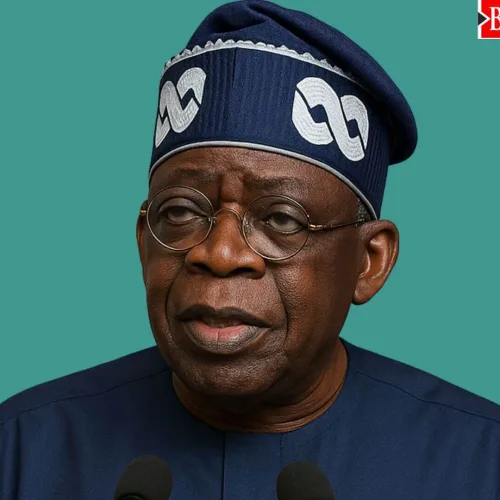
President Bola Tinubu has declared that securing the lives and property of Nigerians remains non-negotiable, stressing that sustained economic growth and national prosperity cannot be achieved without a stable and secure environment.
The President said national security was the fundamental bedrock for achieving his administration’s economic ambitions, noting that businesses would only thrive and investments increase when citizens, investors and communities have confidence in their safety.
Tinubu spoke on Friday in Abuja at the graduation ceremony of participants of the National Defence College (NDC) Course 34.
Represented by Kashim Shettima, the Vice President, Tinubu said that this administration considers the protection of lives and property as the baseline for economic expansion, adding that the government’s broader economic strategy is therefore focused on stabilising macroeconomic fundamentals, strengthening local industries and creating an environment capable of attracting domestic and foreign investment.
He said the government’s economic ambitions must go hand in hand with its responsibility to protect Nigerians, particularly as the country continues to confront terrorism, banditry, kidnapping, piracy and other forms of organised crime.
“Our economic ambitions accompany the duty to secure our people. The Armed Forces and security agencies continue to confront terrorism, banditry, kidnapping, piracy and organised criminality with courage and professionalism.
“Government will provide equipment, training, resources and institutional support for their constitutional duties.
“Peace creates room for enterprise, and enterprise enlarges the citizen’s stake in peace. When communities recover security, opportunity must follow, because stability grows where people can work, trade, learn and hope,” he said.
Tinubu said the government would continue to strengthen the capacity of the Armed Forces and other security agencies to deal with criminal elements threatening national stability.
He linked the security challenge facing Nigeria to the broader question of economic development across Africa, arguing that the continent’s long-term security would increasingly depend on the strength and productivity of its economies.
The President aligned his position with the central argument of a recent graduation lecture delivered by Goodluck Jonathan, the former President, stressing that African countries must build productive economies capable of providing opportunities for their rapidly growing young populations.
“Africa’s security will increasingly depend on productive economies, regional value chains, innovation, and industries capable of employing its young population,” Tinubu said.
He noted that the deepening implementation of the African Continental Free Trade Area presented an opportunity for African countries to strengthen economic integration, expand intra-African trade and build industries capable of competing globally.
The President insisted that industrialisation must remain at the centre of Africa’s development strategy, saying it would help reduce structural vulnerabilities and strengthen the continent’s bargaining power in the global economy.
“Industrialisation must drive inclusive growth, reduce structural vulnerability and enlarge continental bargaining power,” he said.
He reaffirmed Nigeria’s commitment to building “a peaceful, prosperous, integrated Africa,” stressing that the country would continue to support initiatives aimed at strengthening regional cooperation, economic integration and collective security.
The President also outlined some of the reforms and investments being implemented by his administration under the Renewed Hope Agenda, saying the government was working to create a more productive, diversified and competitive Nigerian economy.
He said the administration was improving the operating environment for businesses, encouraging private-sector investment and promoting local value addition across critical sectors.
According to him, the government is also expanding investments in infrastructure, including roads, railways, ports, energy and digital connectivity.
“These investments reduce costs, connect markets and reinforce national integration. We are strengthening capacity in agriculture, solid minerals, manufacturing, technology and defence industry,” he said.
Tinubu argued that economic resilience was also a component of national sovereignty, particularly in an increasingly uncertain global environment.
“Sovereignty acquires substance when a nation can absorb shocks, meet essential needs and defend its interests,” he added.
He said the government would continue to pursue policies designed to reduce the country’s dependence on external vulnerabilities while strengthening domestic productive capacity.
Tinubu described the programme as an important component of strategic leadership development, noting that modern statecraft requires a broad understanding of security, economics, governance and international relations.
He said the composition of the course, which brought together officers from the Armed Forces, the Nigeria Police Force, public institutions and friendly countries, reflected the increasingly interconnected nature of contemporary security challenges.
“The course reflects the breadth required by modern statecraft, drawing participants from the Armed Forces, Police, public institutions and friendly nations,” he said.
The President urged the international participants to use the relationships and networks established during their time at the college to promote greater understanding and cooperation among African countries.
He said the networks created through the programme should transcend the classroom and contribute to peace, development and stronger security partnerships across Africa and beyond.
Tinubu congratulated the graduands on completing what he described as a demanding course, commending them for their discipline, curiosity and resilience.
He charged them to uphold the values of excellence, courage, patriotism and integrity as they return to their various institutions and countries.
The President also commended the Commandant, faculty and staff of the National Defence College for sustaining what he described as Nigeria’s foremost institution for strategic education.
He particularly praised the college for its commitment to education, strategic thinking and policy-oriented research.
Earlier, Abdullahi Ahmed, Commandant of the National Defence College, said the presence of the President, represented by the Vice President, underscored the Federal Government’s commitment to strategic leadership development and national security.
Ahmed said the participants had undergone 47 weeks of intensive training involving research activities, field tours and seminar presentations.
He explained that the programme was designed to expose participants to contemporary security and developmental challenges, as well as the complexities of high-level defence management.
According to him, the training was not limited to military operations but was designed to equip participants with the strategic knowledge required to understand and respond to complex national and international challenges.
The commandant charged the graduates to apply the knowledge and experience acquired during the programme to develop practical solutions to challenges confronting Nigeria’s security and economic sectors.
He said the ultimate value of the training would be measured by the ability of participants to translate their academic and professional experience into tangible outcomes within their respective institutions.
The high point of the ceremony was the presentation of certificates and awards to the 103 participants who successfully completed the NDC Course 34 programme.
The graduating class comprised 33 participants from the Nigerian Army, 20 from the Nigerian Navy, nine from the Nigerian Air Force, four from the Nigeria Police Force, 17 officials from ministries, departments and agencies, and 20 international participants.


Comments
Start the conversation about this story.