






The Minister of Works, David Umahi, has directed the China Civil Engineering Construction Corporation (CCECC) to repair damaged sections of the Benin-Asaba Highway in Delta State within 14 days.
Mr Umahi gave the directive on Thursday during an inspection of the Asaba axis of the Second Niger Bridge access road, where he expressed concern over the condition of sections around Ubulu-Okiti and Onicha-Ugbo and the hardship faced by motorists.
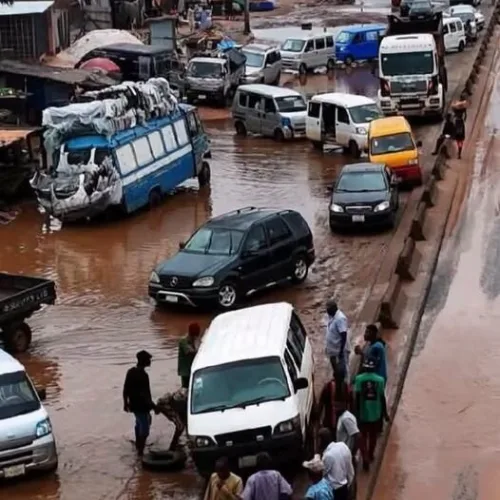
The directive comes amid worsening conditions on the highway, with motorists and passengers reportedly spending days trapped in traffic.
A Vanguard report on Wednesday stated that some motorists spent up to four days on the Benin-Asaba road due to failed sections, gridlock and diversions. One truck driver told the newspaper that although the journey from Lagos to Benin normally takes about four hours, he spent three days after reaching Benin.
Another driver transporting raw materials from Lagos to Asaba said he left Lagos on 20 August and arrived in Asaba on 23 August, stranded for two nights at Agbor.

A passenger travelling with her two-year-old son also told Vanguard that she had spent two nights sleeping in a bus at Agbor because she could not afford hotel accommodation.
‘Fix it immediately’
Mr Umahi directed CCECC to rehabilitate service lanes where asphalt had been removed during construction.
“I am giving you 14 days to fix the access, the service lane you removed the asphalt. You have to fix it immediately, whether you are paid or not. It is my right to insist that you fix it to lessen the problem of the people,” he said.
He also directed the contractor to urgently intervene on sections between Chainage 103 and 105, as well as Chainage 106 and 107, covering about four kilometres of dual carriageway, under an emergency arrangement.
The minister’s directive was contained in a report posted on the official X handle of the Delta State Government and reported by The Nation newspaper.
Mr Umahi said the Federal Ministry of Works had the capacity to repair the affected sections within 14 days but was constrained by the existing concession agreement governing the road.
He said the federal government had written to the concessionaire over its failure to maintain some sections of the road adequately.
The minister had earlier described the concessionaire’s handling of the road as inadequate, according to Vanguard, and apologised to commuters over the hardship caused by the road’s condition.
Second Niger Bridge access project
Mr Umahi reaffirmed the federal government’s commitment to the N148 billion Second Niger Bridge access project being executed by CCECC.
He said the project had achieved 4.47 kilometres of dual carriageway, representing 26.7 per cent completion.
Mr Umahi said the project remained critical because of the importance of the Second Niger Bridge and the vulnerability of the First Niger Bridge, which has been in service for more than six decades.
“The essence is to use that Second Niger Bridge. Because if the First Niger Bridge collapses, the beautiful job on the Second Niger Bridge will be rendered useless,” he said.
The minister said funding under the NNPC tax-credit arrangement had stopped, but President Bola Tinubu had approved an alternative funding arrangement to ensure the project continued.
“I encourage you to please go ahead, you will be paid,” Mr Umahi told the contractor.
READ ALSO: Woman who died at Umahi’s residence buried amid autopsy dispute
Delta government welcomes intervention
Delta Commissioner for Works (Rural Roads) and Public Information, Charles Aniagwu, who represented Governor Sheriff Oborevwori during the inspection, commended the minister’s intervention.
Mr Aniagwu said the condition of the federal road from Benin through Asaba to the Niger Bridge had become a major concern to road users.
He said the intervention would ease movement and support economic activities along the corridor.
The worsening condition of the highway has also raised concerns among residents and business operators, with Vanguard reporting that businesses along the corridor had suffered as movement became increasingly difficult.
Discover more from Premium Times Nigeria
Subscribe to get the latest posts sent to your email.
Comments
Start the conversation about this story.