





The European Union (EU) through its Support to Democratic Governance in Nigeria (EU-SDGN) programme, has backed moves to ensure that internally displaced persons (IDPs) are able to exercise their franchise without being forced to return to unsafe areas where they previously lived.
The EU has expressed worry that millions of Nigerians displaced by insurgency, communal conflicts and other emergencies risk being shut out of the 2027 general elections unless urgent measures are taken to remove the security, mobility and voter-access barriers confronting them.
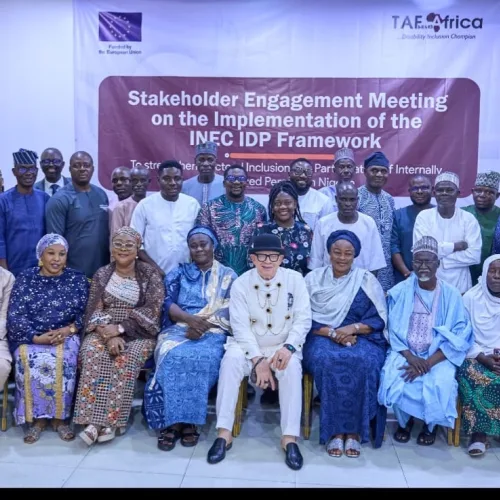
The EU intervention came as stakeholders, including the Independent National Electoral Commission (INEC), the National Emergency Management Agency (NEMA), State Emergency Management Agencies (SEMAs), civil society organisations and IDP community leaders, met in Abuja to work out practical measures for implementing INEC’s IDP Framework ahead of the 2027 elections.
The two-day engagement, organised by TAF Africa for the EU-SDGN programme, focused on the barriers preventing displaced Nigerians from registering to vote, collecting their Permanent Voter Cards (PVCs) and accessing polling units.
Nigeria has an estimated 4.5 million displaced people, many of whom live far from their places of origin and face serious security and logistical challenges if required to return to vote.
The situation is particularly troubling in conflict-affected states such as Borno, where returning to communities of origin could expose displaced voters to renewed attacks.
Speaking at the meeting, Senior Communications Officer at TAF Africa, Jennifer Dafwat, said the engagement was aimed at bringing stakeholders together to develop practical solutions to electoral exclusion.
She said: “Today is about building a nation where no voice is left behind. In this room, we’re here to tackle the issue of electoral exclusion of persons with disabilities.
Dafwat added that the meeting provided an opportunity for stakeholders to collectively develop solutions that would promote a more inclusive democracy ahead of 2027.
“We have the voices necessary to ideate, identify, and produce solutions necessary for promoting an inclusive Nigeria.”
For IDP communities in Borno, the prospect of travelling hundreds of kilometres to vote remains a major concern.
Chairman of an IDP camp in the state, John Gwamma, said insecurity and the distance between displacement locations and places of origin could discourage many displaced persons from participating in the election.
“We have to travel down from Maiduguri to Gaza. But on the way to Gaza to vote, there’s a very big challenge ahead of us,” he said,
recalling an attack by Boko Haram on travellers along the Bama Road during the 2023 election.
He said elderly displaced persons, particularly those aged 70 and above, would struggle to make the journey from Maiduguri to Pulka to cast their votes.
Acting Director-General of the Borno State Emergency Management Agency, Yagana Ali Abadam, consequently urged INEC to establish voting arrangements that would allow displaced residents to vote from their current locations.
“We are appealing: if INEC can create a polling booth for our ward so we can vote here in Maiduguri,” she said.
Director of the Gender and Inclusivity Department at INEC, Lakunuya Bello, welcomed the engagement, saying collaboration with TAF Africa and other stakeholders could strengthen advocacy for the participation of IDPs.
“This initiative is a very wonderful initiative, and we are hoping that with this engagement, things will improve more,” she said.
Bello said the engagement would also help stakeholders understand the arrangements required to facilitate IDP voting while strengthening voter education and sensitisation ahead of the 2027 elections.
The stakeholders are expected to develop a joint roadmap covering voter education, advocacy and practical electoral arrangements for displaced Nigerians.
Please follow and like us:
Comments
Start the conversation about this story.