





A new report has put forward a potentially monumental dimension to Africa’s reparations campaign, claiming that the United Kingdom (UK) and other former colonial powers may be liable for ecological damage worth hundreds of trillions of dollars inflicted on African territories during the colonial era.
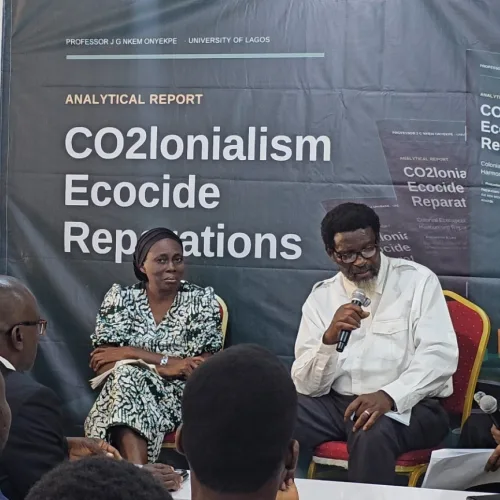
The report, titled: “CO2lonialism-Ecocide-Reparations,” was unveiled on Friday at the University of Lagos, bringing together academics, legal experts and public activists to examine the environmental costs of colonial exploitation.
The lead author of the report, Professor J.G. Nkem Onyekpe, Head of the Department of History and Strategic Studies at the University of Lagos, argued that ecological destruction and the systematic extraction of Africa’s natural resources should be treated as a distinct component of the continent’s reparations claims, separate from the historical harms associated with slavery and the slave trade.
According to Onyekpe, the report documents the large-scale appropriation of resources, land and energy under colonial rule and argues that such exploitation created an ecological debt that can and should be subjected to rigorous monetary valuation.
He said previous research had demonstrated that large-scale and structurally unequal appropriation of resources could be quantified economically.
“The report documents that valuation exercises of comparable ambition and scale have already been attempted successfully,” Onyekpe said, citing a peer-reviewed 2022 estimate which valued resources appropriated from the Global South through unequal exchange at more than $10 trillion annually in 2015 alone.
He argued that applying a similar methodology to the entire period of colonial rule and across affected African countries could produce a figure running into hundreds of trillions of dollars.
Also speaking at the event, a professor of Geography, Professor Oscar, said existing estimates of colonial ecological damage were far below the possible value of the losses.
The report is expected to be submitted to the African Union’s Committee of Experts on Reparations (AUCER) and Legal Reference Group on Reparations (AULER), which are working towards developing a harmonised African framework for evaluating and advancing reparations claims.
The authors contend that incorporating ecological destruction into the reparations framework could significantly expand the scale of Africa’s demands from former colonial powers.
Public activists at the launch consequently argued that the $5 trillion reparations demand previously advocated by Senator Ned Nwoko may be insufficient if ecological damage is comprehensively assessed.
The report also points to recent developments in international law as providing a potentially stronger legal environment for environmental reparations claims.
Among the developments cited are the adoption of a working legal definition of ecocide by an Independent Expert Panel, measures adopted by European institutions, and discussions around the classification of severe environmental destruction as an international crime.
The authors further highlighted a 2025 African Union decision to establish an ad hoc committee to examine the classification of “massive destruction of environmental ecosystems” as a crime.
According to the report, the development strengthens the argument for including environmental destruction in Africa’s reparations agenda.
The authors also referenced the Certain Phosphate Lands in Nauru case before the International Court of Justice as an important precedent.
The case involved Nauru’s claim against Australia over environmental damage resulting from phosphate mining during the period of colonial administration.
A jurisprudence and international law expert, Dr. Karibi-Whyte, said the Nauru case demonstrated that environmental reparations claims were not merely theoretical.
The report comes amid renewed efforts by the African Union to develop a common continental position on reparations. With the AU’s Decade of Justice and Reparations running from 2026 to 2035, the authors believe environmental restoration should form an integral part of Africa’s broader demand for historical justice.
Please follow and like us:
Comments
Start the conversation about this story.