





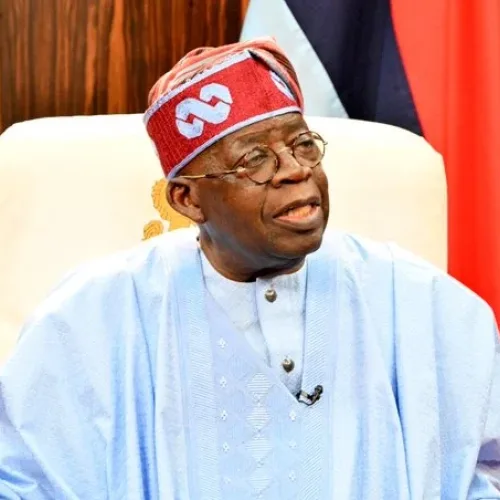
President Bola Tinubu has said the country cannot achieve meaningful economic growth without securing the lives and property of its citizens, stressing that peace and stability are essential for businesses to thrive.
Tinubu stated this on Friday at the graduation ceremony of participants of the National Defence College Course 34 in Abuja.
A total of 103 participants received certificates at the ceremony.
They comprised 33 Nigerian Army officers, 20 Nigerian Navy officers, nine Nigerian Air Force officers, four members of the Nigeria Police Force, 17 officials from ministries, departments and agencies, and 20 international participants.
Awards were also presented to outstanding participants at the ceremony.
The President, who was represented by Vice President Kashim Shettima, said the Federal Government would continue to strengthen the Armed Forces and other security agencies with the equipment, training and resources required to tackle terrorism, banditry, kidnapping, piracy and organised crime.
“Our economic ambitions accompany the duty to secure our people.
The Armed Forces and security agencies continue to confront terrorism, banditry, kidnapping, piracy and organised criminality with courage and professionalism. Government will provide equipment, training, resources and institutional support for their constitutional duties,” he said.
The President, in a statement by the Senior Special Assistant to the President on Media and Communications in the Office of the Vice President, Stanley Nkwocha, said restoring security to communities must be followed by economic opportunities that would enable citizens to work, trade and improve their livelihoods.
“Peace creates room for enterprise, and enterprise enlarges the citizen’s stake in peace. When communities recover security, opportunity must follow, because stability grows where people can work, trade, learn and hope,” Tinubu said.
The President linked the country’s security challenges to the broader economic transformation required to create jobs and improve living standards across Africa.
He said the continent’s long-term security would increasingly depend on productive economies, regional value chains, innovation and industries capable of absorbing its growing youth population.
“Africa’s security will increasingly depend on productive economies, regional value chains, innovation, and industries capable of employing its young population,” he said.
Tinubu also called for industrialisation driven by the African Continental Free Trade Area, saying it would promote inclusive growth, reduce structural vulnerabilities and strengthen Africa’s bargaining power.
He reaffirmed the country’s commitment to building a peaceful, prosperous and economically integrated continent.
On his administration’s domestic economic reforms, the President said the Federal Government was working to improve the business environment, attract private investment and promote local production.
He listed investments in roads, railways, ports, energy and digital connectivity, saying the projects were aimed at reducing the cost of doing business, connecting markets and strengthening national integration.
“We are strengthening capacity in agriculture, solid minerals, manufacturing, technology and defence industry.
“Sovereignty acquires substance when a nation can absorb shocks, meet essential needs and defend its interests,” he said.
Tinubu urged the graduands to deploy the knowledge acquired during their 47-week programme to address Nigeria’s security and developmental challenges.
The President said the course reflected the demands of modern statecraft, with participants drawn from the Armed Forces, Police, public institutions and other countries.
He urged them to use the networks established during the programme to promote cooperation, peace and development across Africa.
Earlier, the Commandant of the National Defence College, Rear Admiral Abdullahi Ahmed, said the President’s representation at the ceremony demonstrated the administration’s commitment to strategic leadership development and national security.
Ahmed said the participants underwent intensive training involving research, field tours and seminars on contemporary security and developmental challenges, as well as defence management.
He urged the graduands to apply the knowledge acquired to solving problems across different sectors of the economy.
Comments
Start the conversation about this story.