





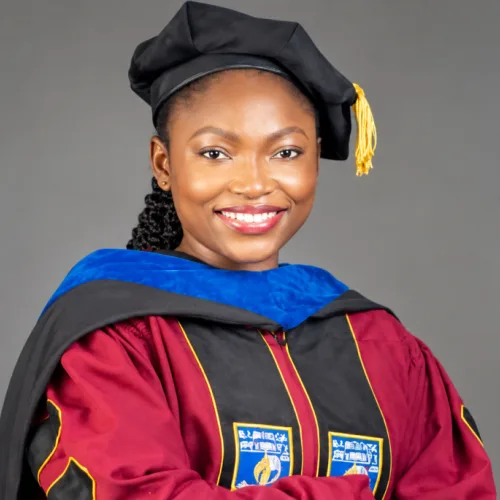
Dr Uzzibi Irmiya recently bagged a PhD in Defence and Strategic Studies from Babcock University, Ogun State, at the age of 26. Her academic journey progressed from international relations for her undergraduate degree to political science for her master’s and PhD degrees. In this interview by KINGSLEY ALUMONA, she discusses her work and research on the deradicalisation of terrorists and human security in northeast Nigeria, among other issues.
You studied international relations for your undergraduate degree, and political science for your master’s and PhD degrees. Why the transition from international relations to political science? How did the former help your postgraduate studies?
While I studied International Studies at Ahmadu Bello University for my first degree, I realised that most of the courses I took were political science, alongside a few international relations courses and some foreign languages, specifically French.
When I was considering postgraduate degrees, I explored both Political Science and International Relations programmes. I happened to find Babcock University, whose programme came highly recommended. They do not offer postgraduate degrees in International Relations, but this was not a significant trade-off for me because I had spent the bulk of my undergraduate years studying political science courses.
I believed this transition would allow me to focus more intently on my area of interest, which was security. Consequently, my specialisations for both my master’s and my PhD are in Defence and Strategic Studies.
Congratulations on bagging a PhD from Babcock University. In your recent LinkedIn post, where you announced your PhD feat, you stated that “At 15, I dreamt it. At 26, I did it.” At 15, still in secondary school, what did you know about a PhD and what it takes to get it? How was the journey, and what did it feel like getting it at 26?
At 15, I already understood what a PhD entailed because I come from a family of academics. My father is a professor, my mother used to lecture at a college of nursing, and we currently have six PhDs in my family with more in view. My initial aspiration was to emulate my father, but I also possessed a deep-seated love for teaching. I used to take tutorials and teach in church. I always wanted to work in an environment that was intellectually stimulating and dynamic.
Lecturing represents such an environment because, although the theoretical course material remains generally consistent, each year presents new developments, particularly in politics, which allow for fresh interpretations of theory for students. This is profoundly fascinating.
Tell us about the area(s) of political science you specialised in for your master’s and PhD programmes. Why did you choose to specialise in this area?
This decision to specialise in Defence and Strategic Studies stemmed from my growing realisation that security permeates every aspect of society. I love understanding society.
The topic of your PhD dissertation is interesting: ‘Deradicalisation and Human Security in Northeast Nigeria’. Why did you choose to work on this topic?
I spend considerable time on social media, and over several years, I observed posts going viral about individuals receiving money and scholarships for deradicalisation. From my understanding of security studies and my previous academic work, this struck me as anomalous. I am aware that Boko Haram remains a threat in the North-East, and I know individuals in that region whose concerns remain unaddressed by the government.
I found myself questioning the veracity of these reports, recognising that not everything on social media or reported in the news is entirely accurate. I was curious about the logistics of deradicalisation in Nigeria. Before this, I had encountered deradicalisation as a concept when examining case studies such as Rwanda, Yemen, or Singapore.
I wanted to investigate Nigeria’s own case study, and this curiosity about whether it was making Nigeria safer or less safe spurred my initial interest.
What are the major findings and significance of your PhD research to Northeast communities and Nigeria generally?
It is difficult to condense these in a nuanced way, given the context of this interview but fundamentally, my study found that deradicalisation is failing both in concept and in practice in Nigeria for several reasons.
First, the programme has been unable to uniformly define what “repentant” means, and this is problematic because it is the main criterion for admittance into the programme. Secondly, gaps in documentation have resulted in a high level of recidivism within the programme because there is minimal monitoring after individuals leave the camp. Consequently, they are more likely to return to Boko Haram, sometimes undergoing deradicalisation multiple times. Most importantly, individuals in the communities, where these people are being reintegrated, feel extremely cheated. They perceive that the government is investing billions in those who destroyed their communities, while they themselves have not received comparable opportunities to improve their lives.
I believe deradicalisation does have a place in countering violent terrorism, but only as part of larger security and developmental reforms. When terrorism has become this pervasive, deradicalisation is almost inevitable owing to complexities of peacebuilding such as involuntary recruits and child soldiers, for example. However, sub-optimal execution has resulted in the programme exacerbating the very problem it seeks to address.
I would recommend reading my two extracted papers to provide more nuance to my findings: ‘Impunity or Progress? A Critical Discussion on Boko Haram Deradicalisation and Justice in Northeast Nigeria’ and ‘Social Identity Theory and Deradicalisation: A Critical Evaluation of the Role Identities Play in the Reintegration of Ex-combatants in Nigeria’s OPSC.’
During the administration of former President Muhammadu Buhari, there were many deradicalisation programmes for terrorists in northern Nigeria, which cost taxpayers billions of naira, and which yielded little or no results. What can you say about this?
Deradicalisation programmes are not inherently negative or positive. My study examines several case studies where they were successfully implemented. In Africa, Rwanda represents one of the best examples of effective deradicalisation, but only as part of a larger suite of reforms.
If there should be another deradicalisation programme, and you were in charge of implementing it, what would you do to make it a success?
I would prioritise an iterative processes that involve speaking to the communities and ensuring they are carried along. Deradicalisation would never be a standalone programme — it would be part of a larger suite of developmental programmes in the North-East. The priority would be to de-incentivise radicalisation and invest a significant portion of resources into developing young people within those communities so they themselves are not incentivised to join Boko Haram or engage in other forms of violence in retaliation for their perceived neglect.
Politics seems to have connections with everything in Nigeria. How would you describe the politics behind security and terrorism in the country? Do you think the security forces are incompetent, or do they see terrorism as a business?
Politics is linked to everything, not just in Nigeria but everywhere in the world, and this extends to security and terrorism. A myriad of factors have contributed to certain inabilities to address specific issues, including corruption, Nigeria’s challenging terrain, and external interference. Ultimately, significant structural challenges exist.
While my study has identified deficiencies in the implementation of deradicalisation programmes in Nigeria, particularly the Operation Safe Corridor (OPSC), I acknowledge the limitations of my understanding. I have no practical military experience; my expertise is predominantly theoretical, as a rather young academic.
As a scholar of international relations and political science, what do you think about United States President Donald Trump’s interest in Nigeria’s national security, especially as it concerns terrorism? Should Nigerians be happy or worried about US involvement in our security problems?
Nigeria should always be wary of external influences because every country operates fundamentally on the principle of national interest. I encourage everyone to adopt critical thinking and consider how much the national interests of other countries truly intersect with Nigeria’s national interests. International relations unfold continually, and we must evaluate matters on a case-by-case basis.
What three political problems would you like to solve with your political science expertise, and how would you go about solving them?
It may be rather conceited to assume I am able to solve any political problems independently. I believe I am capable of being part of teams that can solve, or offer my expertise alongside others with more experience, to address political problems.
I am a very young academic with limited practical experience and expertise. The most significant lesson from obtaining a PhD is recognising how little one knows. You acquire deep knowledge about a very narrow subject while remaining largely ignorant about many other areas.
I believe I can contribute to teams on counterterrorism, deradicalisation, and peacekeeping. After countering terrorism and deradicalising individuals, peacekeeping becomes essential. I have expertise in these three areas and can contribute to developing policies and implementation strategies.
The 2027 elections are around the corner, and the politicking and tension are heating up the polity. What is your advice to Nigerians on how to ensure that they produce the best leaders who would serve them well?
To produce leaders that serve well, we must create a system where our interests and those of politicians align. The fundamental interest of a politician is to gain office, while the fundamental interest of a citizen is to receive better governance. In Nigeria, it would seem these interests have yet to intersect on a larger scale. There is room to create greater awareness among politicians that what we desire is better governance, not necessarily immediate stipends.
ALSO READ: Hausa people are great pillars of Nigeria’s progress — Tinubu
How is your job as an assistant lecturer at Babcock University going? And, if you were to contest any elective office in Nigeria, which office would you run for, and why?
My work at Babcock University is progressing excellently. I have always loved teaching, and I love having the opportunity to do so. My students are performing well, and I particularly enjoy supervising students in their research endeavours.
I do not intend to run for any political office because I am not inclined towards it. I do not necessarily enjoy being at the forefront of the process of politicking, and I believe I would serve better in an advisory capacity rather than as a contestant for political office.
Comments
Start the conversation about this story.