





Lagos State Government has sought stronger collaboration with Japan in mass transportation, technology, human capital development and cultural exchange, with particular emphasis on deploying electric high-capacity buses to improve mobility across the state.
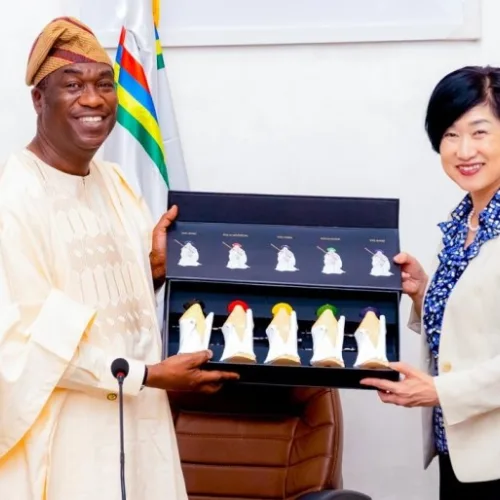
Governor Babajide Olusola Sanwo-Olu, represented by his Deputy, Dr Kadri Obafemi Hamzat, made the call on Friday while receiving Japan’s Assistant Minister and Director-General for African Affairs, Ministry of Foreign Affairs, Ms Takahashi Misako, on a courtesy visit at the Deputy Governor’s official residence in Osborne, Ikoyi, Lagos.
Sanwo-Olu said Lagos’ large population and limited landmass made efficient mass transportation critical to the state’s development and economic sustainability.
He urged Japan and Japanese companies to explore opportunities for collaboration in electric vehicles, particularly high-capacity buses capable of moving large numbers of residents across the metropolis.
“But I think going forward, it will be interesting to know what we can do together in terms of electric vehicles. And when I say vehicle, I mean buses, high-capacity buses. What can we do to get electric buses? How do we get our people to move around freely?” the governor said.
Sanwo-Olu said Lagos has a population of about 30 million, despite having one of the smallest land areas among Nigeria’s states, making mass transit indispensable.
He also sought Japanese support and partnerships in technology and human capital development, particularly in emerging fields such as artificial intelligence, cybersecurity and robotics.
According to the governor, collaboration in these areas could facilitate knowledge transfer and skills development by creating opportunities for Japanese experts, students and Lagos residents to interact and exchange expertise.
Sanwo-Olu further highlighted the importance of cultural cooperation between Lagos and Japan, describing Lagos as Nigeria’s cultural capital with a vibrant creative industry driven by Afrobeats, music and other forms of artistic expression.
He said deeper cultural ties could create additional opportunities for both sides while strengthening people-to-people relations.
The governor also urged Japanese officials and businesses operating in Nigeria to pay greater attention to Lagos, describing the state as the centre of significant economic activity in the country.
He said stronger engagement between the Lagos State Government and the Japanese Consulate in Lagos would help identify areas of mutual interest and translate existing relations into greater impact.
Earlier, Misako said Japan was interested in deepening its partnership with Nigeria, particularly Lagos, citing the state’s expanding business environment, technological development and opportunities for youth-focused collaboration.
She said 57 major Japanese companies had established operations in Lagos, with three of them having manufacturing capabilities.
Misako also pointed to ongoing cultural exchanges and the planned Japan-Nigeria Business Facilitation Council meeting in Lagos in October as indications of the expanding relationship between Japan and Nigeria.
“We see a lot of potential for further collaboration in the future between Japan and Nigeria,” she said.
Misako described the relationship between both countries as potentially complementary, noting that Japanese technology and scientific capabilities could support Nigerian youths seeking to specialise in technology-related fields.
“I am very impressed that there is maybe a mutually complementary collaborative relationship between Japan and Nigeria, because Japanese technology and Japanese science capability can also help facilitate the younger Nigerian students who would like to specialise in that area,” she said.
The engagement underscores Lagos’ efforts to attract international partnerships around sustainable transportation, technological innovation, youth development and the creative economy.
Comments
Start the conversation about this story.