





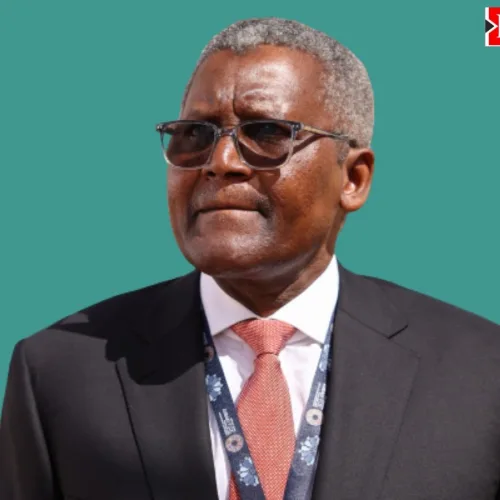
The Dangote Petroleum Refinery will consume roughly 2.5 percent of globally traded crude oil once it reaches full capacity, according to Aliko Dangote, the Nigerian billionaire behind Africa’s largest refining complex, underscoring the plant’s growing weight in world energy markets.
The 700,000-barrel-a-day facility will also match about 10 percent of total US refining capacity when fully ramped up, Dangote said Wednesday, as he hosted John Enoh, Nigeria’s minister of state for industry, on a tour of the refinery, an adjoining petrochemicals complex and Dangote Fertiliser Limited in Lagos.
The visit doubled as a show of government support for the refinery, which Enoh called “one of the most significant investments in Africa” and a template for the industrial growth Nigeria needs to hit President Bola Tinubu’s target of a $1 trillion economy.
“You cannot be Minister in charge of Industry and not visit the Dangote Refinery,” Enoh told reporters. “This facility matters because of what it represents for Nigerian industry, for our people and for the realisation of President Bola Tinubu’s vision of a one trillion-dollar economy.”
The refinery has helped flip Nigeria’s position in global fuel markets, turning Africa’s largest crude producer from a chronic importer of refined products into a supplier to buyers as far afield as the Middle East, Enoh said. He pointed to recent global supply disruptions as a test case.
“When global supply disruptions occurred, Nigeria was able to export petroleum products to markets in the Middle East and beyond,” he said. “That is an extraordinary achievement and one that deserves recognition.”
The minister also addressed lingering investor concern over the refinery’s single-processing-train design, which leaves the plant more exposed to unplanned outages than facilities with multiple parallel units. He said scheduled maintenance had not disrupted output. “The issues surrounding the single-train configuration are much clearer now. Even during scheduled maintenance, operations continued,” Enoh said.
Dangote used the visit to press the government on policy consistency, arguing that stable rules matter more to investors than tax breaks or subsidies. He cited a recent unsecured, unrated bond sale by Dangote Industries that priced below Nigeria’s sovereign benchmark yield as evidence that credible private companies can raise long-term capital domestically.
“There is no way to create jobs and prosperity without industrialisation,” Dangote said. “The greatest attraction for foreign investors is the success of domestic investors. When local investors thrive, they send a powerful signal that the environment is conducive for investment.”
He described the refinery as the biggest financial risk of his career, built through the pandemic, currency volatility and skepticism from lenders who doubted it would ever come online. “What we have achieved here has never been done before on this scale,” he said. “Once one person succeeds, many others will be encouraged to follow.”
Enoh said the Ministry of Industry would keep engaging Dangote Industries through its Industrial Revolution Work Group and ministerial roundtables to tackle obstacles facing manufacturers, chiefly access to affordable, long-term financing. The push ties into Nigeria’s new industrial policy, which targets manufacturing’s share of GDP at roughly 20 percent by 2030 and 25 percent by 2035.
“We want to be judged by the extent to which we implement this policy,” Enoh said. “Achieving these targets will require a strong partnership between government and industry leaders like Aliko Dangote.
Get Newsletter Updates
Enjoying our column?
Subscribe to our specialised **Renewable Energy** feed to receive fresh reports and analyses directly in your inbox.
Dipo Oladehinde is a skilled energy analyst with experience across Nigeria's energy sector alongside relevant know-how about Nigeria’s macro economy. He provides a blend of market intelligence, financial analysis, industry insight, micro and macro-level analysis of a wide range of local and international issues as well as informed technical rudiments for policy-making and private directions.

Comments
Start the conversation about this story.