





In a world where the future belongs to problem-solvers, innovators and compassionate leaders, education can no longer be measured solely by examination scores. Today’s students must leave school equipped with the knowledge, character, resilience and practical skills to thrive in an increasingly interconnected world.
This philosophy is at the heart of Charles Dale Memorial International School, Port Harcourt, where learning extends far beyond the four walls of the classroom.
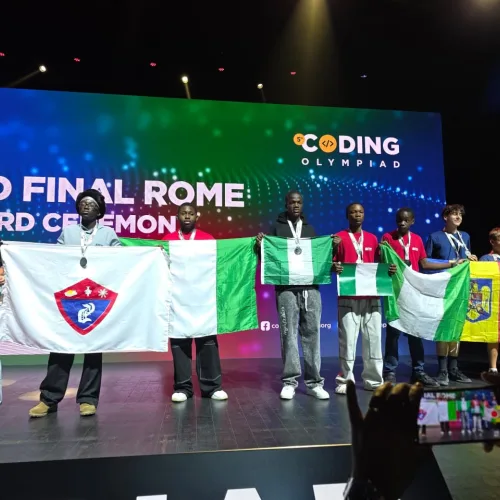
The school’s recent performance at the 2026 International STEM Olympiad in Rome, Italy, held from July 2 to 8, is a testament to this vision. Competing against some of the brightest young minds from around the world, Charles Dale students returned home with an outstanding 41 international medals, comprising 9 Gold, 4 Silver and 15 Bronze Medals, alongside 13 Honourable Mentions. Even more remarkable was the achievement of six students who earned global rankings, with three finishing 2nd Best in the World and another three emerging 3rd Best in the World in the DIY (Do-It-Yourself Plane Challenge).

These achievements reinforce Charles Dale’s growing reputation as one of Nigeria’s leading schools for STEM education. More importantly, they demonstrate what is possible when students are encouraged to think critically, embrace innovation and apply classroom knowledge to solve real-world challenges.
The Rome success is the latest in a growing record of international accomplishments for the institution. In the 2025 INTERNATIONAL STEM Olympiad in Barcelona, Spain, Charles Dale produced Julio Ojiaku, who emerged World Champion (1st in the World) in Coding, while the school recorded 42 international recognitions, including 6 Gold, 11 Silver, and 17 Bronze Medals.
In the 2024 INTERNATIONAL STEM Olympiad in The Hague, Netherlands, the school produced two students ranked 2nd Best in the World, alongside three Gold Medals and other podium finishes. The school’s international journey in STEM began even earlier with participation in the 2023 World Robot Olympiad in Panama City, where students proudly represented Nigeria in robotics, engineering and STEM innovation.
These accomplishments are not simply about medals or rankings. They represent the outcome of an educational environment where students are encouraged to explore beyond textbooks, embrace emerging fields and develop the confidence to compete on a global stage.
Yet, the school’s success story extends beyond international competitions.

Charles Dale believes that while academic excellence opens doors, character, leadership and service determine how far young people go in life. This conviction is reflected in its implementation of The Duke of Edinburgh’s International Award (DOE), one of the world’s most respected youth development programmes.
Through the Award, students embark on adventurous journeys that challenge them to step outside their comfort zones, navigate unfamiliar environments, work collaboratively, solve problems under pressure and develop resilience. These experiences cultivate confidence, independence and leadership; qualities that cannot be taught through textbooks alone.
The heart of the DOE experience is the adventure journey: a period where students are deliberately placed in unfamiliar situations that require them to adapt, collaborate, make decisions and overcome challenges together. Away from the comfort of familiar routines, students learn the importance of perseverance, teamwork, communication and problem-solving. These moments often become defining experiences that shape their confidence and prepare them for the uncertainties of life beyond school.
Community service is another cornerstone of the programme. Charles Dale students regularly organise outreach initiatives that allow them to identify needs within society and contribute meaningful solutions. Whether visiting homes for the elderly, participating in environmental sustainability projects or engaging in charitable activities, they learn that true leadership begins with service.
Perhaps one of the programme’s most transformative aspects is its commitment to impact learning. Students acquire practical skills: from technology and digital literacy to communication and leadership, and then transfer those skills to pupils in public schools and underserved communities. By teaching others, they deepen their own understanding while helping bridge educational gaps and inspiring younger learners to dream beyond their circumstances.
Beyond service and skills development, the DOE programme also introduces students to the principles of entrepreneurship and business development. Students are encouraged to identify opportunities, develop ideas and transform their creativity into practical ventures. Businesses such as 9Jabite and Reverer Scent are examples of student-led initiatives that emerged from this entrepreneurial exposure, demonstrating how young people can move from being consumers of ideas to creators of solutions.
Sports, physical activities and team games are also important components of the experience. Through physical challenges and collaborative activities, students develop discipline, endurance, sportsmanship and the ability to work effectively with others.

This culture of experiential learning fosters empathy, responsibility and a lifelong commitment to growth. It reminds students that success is not defined by personal achievement alone but by their ability to create value, solve problems and make a positive impact in the lives of others.
The combination of global STEM excellence and experiential learning reflects a broader educational philosophy: preparing students not just for examinations or university admission, but for life.
It is therefore unsurprising that Charles Dale graduates continue to excel in leading universities across Nigeria and abroad, while distinguishing themselves in technology, engineering, business, leadership and other professional fields.
As the school approaches its 20th anniversary, its legacy is increasingly defined not merely by impressive academic results or international medals, but by its success in raising young people who can think independently, lead with integrity, innovate with confidence and serve humanity with compassion.
In an era where the demands of the future are changing faster than ever, Charles Dale Memorial International School offers a compelling reminder that the true purpose of education is not simply to prepare children for examinations; it is to prepare them for life beyond the classroom.
Because the future belongs to those who can learn, adapt, lead and make a difference.

Comments
Start the conversation about this story.