





MTN Nigeria closed the first half of 2026 with a profit after tax of N707.5 billion, up 70.6 percent year on year, backed by an interim dividend of N26.00 per share, payable September 7, 2026, to shareholders on the register as at 20 August 2026.
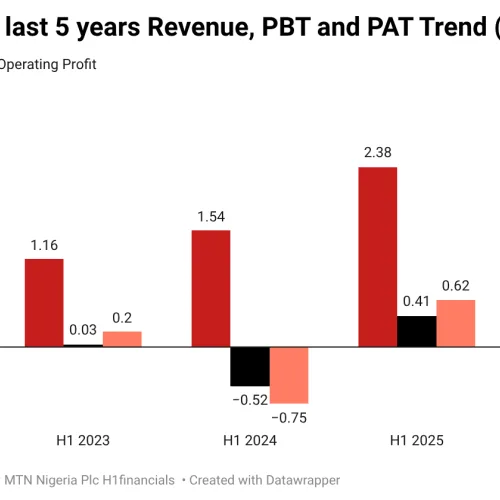
Revenue rose 25.9 percent to N2.99 trillion from N2.38 trillion in H1 2025, with data once again supplying the bulk of the growth as subscribers kept upgrading their usage patterns and MTN pushed further into 5G rollout.
Data revenue advanced to N1.70 trillion from N1.23 trillion, while voice revenue grew more modestly to N897.1 billion from N780.2 billion, underscoring the continuing shift in the revenue mix toward internet-based services.
SMS revenue rose to N112.7 billion from N92.4 billion, and digital revenue, which captures video, music, gaming, and e-commerce activity, climbed to N58.7 billion from N48.4 billion.
Value-added services, covering airtime lending and fintech products, however slipped to N77.1 billion from N82.8 billion, the one soft spot in an otherwise broad-based topline expansion.
Operating profit jumped 41.9 percent to N1.27 trillion from N892.8 billion, even as the company absorbed a sharp rise in employee costs, which more than doubled to N135.6 billion from N54.7 billion on the back of higher share-based compensation and performance-linked incentives tied to the improved results.
Direct networking operating costs actually fell to N629.3 billion from N685.3 billion, helped by diesel savings from the company’s energy transition programme, while depreciation charges rose to N218.9 billion from N140.7 billion as the network expansion of recent years fed through the books.
Below the operating line, the story remained one of a company no longer at the mercy of the naira.
Net foreign exchange movement flipped to a gain of N36.4 billion, from a loss of N5.2 billion a year earlier, as exchange rate volatility stayed contained and the naira firmed through the period.
Finance costs eased slightly to N258.1 billion from N279.7 billion, even with a jump in losses on fair value through profit or loss liabilities, while finance income more than tripled to N46.8 billion from N14.4 billion on the back of higher yields on treasury investments.
Profit before tax rose 75.4 percent to N1.09 trillion, from N622.3 billion. Profit after tax reached N707.5 billion, translating to earnings per share of N33.76, up from N19.80 a year earlier.
Total assets grew 25 percent year on year to N5.97 trillion as at June 2026, from N4.77 trillion in the same period last year, with property and equipment rising to N2.22 trillion from N1.67 trillion on the back of continued capital spending on network infrastructure. Right-of-use assets edged up to N1.75 trillion from N1.62 trillion.
Total liabilities rose to N5.04 trillion from N4.81 trillion, largely on a jump in current tax payable to N640.4 billion from N88 billion and a rise in lease liabilities within current obligations to N328.4 billion from N267.2 billion in H1 2025.
Trade and other payables, however, eased to N1.25 trillion from N1.31 trillion in H1 2025, while non-current liabilities fell to N2.48 trillion from N2.61 trillion as borrowings were paid down.
The bigger shift was on equity, which surged aggressively to N930.6 billion, from a deficit of N42.4 billion in the same period last year, as MTN plc reverted to a retained profit of N793.1 billion from a retained loss of N192.8 billion in H1 2025, despite a N314.6 billion final dividend payout already made during the half for the 2025 financial year. Net assets per share improved to N44.41, from N26.18.
Cash generated from operating activities rose 60.6 percent to N1.53 trillion, from N955.7 billion, as cash generated from operations climbed to N1.87 trillion from N1.24 trillion.
Cash used in investing activities rose to N1.11 trillion, from N642.8 billion, as the company accelerated capital spending. Acquisition of property and equipment nearly doubled to N763.9 billion, from N382.5 billion, while spending on intangible assets fell to N31.2 billion from N59.8 billion.
Financing activities absorbed N597.7 billion in cash, nearly double the N310.9 billion used a year earlier, largely reflecting the N314.6 billion dividend payment, alongside continued debt repayment of N176.3 billion.
Cash and cash equivalents closed the half at N459.3 billion, up from N257.6 billion as at June 2025, even after a net decrease of N170.8 billion during the half itself, a swing attributable to the scale of both the capex programme and the dividend outlay.
In its going concern assessment, the board noted that the company generated strong operating cash flows during the period and that fixed term borrowings approaching maturity are expected to be renewed or repaid as they fall due, alongside tripartite set off arrangements secured with Group entities to reduce intercompany payables, as it affirmed its ability to meet obligations over the next twelve months.
Commenting on the results, Karl Toriola, Chief Executive Officer, said: “We delivered a strong first-half performance, with sustained commercial momentum, improved profitability and robust cash generation. This reflects the resilience of demand for our services, disciplined execution across the business and continued focus on efficiency in a challenging operating environment.”
On the outlook, Toriola added: “We enter the second half with confidence in Nigeria’s long-term structural growth opportunity, underpinned by rising data demand, further headroom for smartphone adoption, underpenetrated home broadband, accelerating enterprise digitalisation and the long-term potential of fintech as execution improves.”
MTN Nigeria’s shares currently trade at N857.10, holding a year-to-date gain of 67.73 percent, lifting the company’s market capitalisation to N15.12 trillion, from N10.73 trillion, as investors continued to reward the sustained earnings recovery.
Chinwe Michael is a financial inclusion advocate and economy journalist who uses compelling storytelling to drive awareness. With a background in Banking and Finance and experience across accounting, media, and education, she applies sharp analysis and attention to detail to every piece. She simplifies complex financial and economy concepts into engaging content for Africa and global audience. Chinwe also doubles as a speaker with global recognition for her expertise.

Comments
Start the conversation about this story.