





By Adeola Badru
Oyo State Governor, Seyi Makinde, on Friday said the decision to constitute a Judicial Commission of Inquiry into the abduction of students and teachers in Esiele and Yawata communities of Oriire Local Government Area was driven by the need to uncover the truth and restore public confidence amid allegations that he orchestrated the incident.
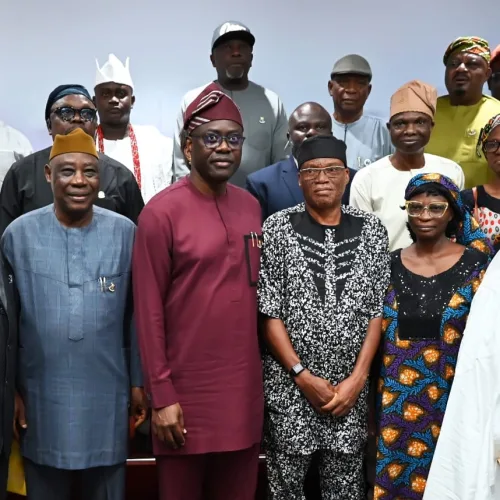
Speaking while inaugurating the commission at the Executive Council Chamber, Governor’s Office, Secretariat, Agodi, Ibadan, Makinde said the panel would independently investigate the circumstances surrounding the May 15, 2026 abduction, identify institutional and operational failures, and recommend measures to prevent a recurrence.
The governor disclosed that the incident was politicised in some quarters, with accusations that his administration masterminded the kidnapping, stressing that such claims made it even more imperative to establish the facts.
“They said I orchestrated the kidnap. The abduction of innocent children and their teachers was not merely an attack on the Ahoro, Esiele and Yawata communities.“
“It was an attack on the right of every Nigerian child to learn in safety and on the confidence of every parent who sends a child to school each day,” Makinde said.
Although the victims were eventually rescued, the governor maintained that the responsibility of government extended beyond securing their freedom.
“We remain grateful for the safe return of the victims, yet our duty did not end with their rescue. Rescue, of course, brings relief. We are all relieved.“
“But truth brings closure. Accountability and reform restore public confidence and help prevent a recurrence. And because justice is not only about punishing wrongdoing, it is about learning enough to ensure that the innocent are never again placed in harm’s way,” he said.
Makinde recounted a personal family experience to explain why he considered it necessary to seek a comprehensive investigation into the incident.
“My own father actually taught in 1959. He was at St. Luke’s and was sent there for teacher training. I was born eight years later.“
“Let’s just assume that he got kidnapped and he was the one beheaded. I would never have been born. So it was for this reason that I called on the international community to support an independent examination of the circumstances surrounding this incident,” he stated.
He emphasised that the call for international support was not intended to undermine the efforts of security agencies but to ensure that every question surrounding the incident was answered.
“That call was never about diminishing the efforts of our security agencies, whose sacrifices we acknowledge and appreciate.“
“It was about ensuring that every lesson is learned and every question that deserves an answer is answered. So this Judicial Commission of Inquiry represents our commitment to that responsibility,” the governor added.
According to him, the commission has been mandated to establish the facts surrounding the abduction, identify any institutional or operational lapses, recommend measures to strengthen the protection of schools and communities, and ensure that such a tragedy never occurs again.
“The assignment of this commission is clear: to establish the facts, identify any institutional or operational lapses, recommend measures that will strengthen the protection of our schools and communities, and help ensure that such a tragedy never happens again,” Makinde said.
He praised members of the commission for accepting the assignment despite the prevailing political climate, noting, “This is also a season of politics. You have agreed to serve knowing well that this assignment may come back to you in such a way that people may think you are being used for political purposes.“
“But because of your love for our state and country, this has never happened. I called everybody one after the other and no one said no to me. So I thank you,” he said.
The governor charged the panel to conduct its work with impartiality, professionalism and strict adherence to the law.
“Each of you brings decades of experience, integrity and public service. Your work must be guided only by the evidence, the law and the public interest. The people of our state, and indeed Nigerians, expect nothing less than an impartial, thorough and credible process,” he said.
Makinde gave the commission four weeks to submit its report but assured members that additional time would be granted if required to ensure a thorough investigation.
“I have given one month, four weeks, but feel free to come back to us if you require additional time to ensure that we do not leave any stone unturned.
“As a government, we will provide every support required for this commission to carry out its assignment independently and professionally. We also call on individuals, institutions and relevant agencies to cooperate fully by making available any information that will assist the commission in arriving at its goals,” he added.
He noted that confronting difficult events honestly was essential for building stronger institutions and safeguarding the future.
“History teaches us that societies become stronger not by pretending that difficult events never happen, but by confronting them honestly, learning from them and building stronger institutions afterwards.“
“May this commission help strengthen public confidence, honour the resilience of the victims and their families, and contribute meaningfully to improving the security of our schools and communities,” Makinde said before formally inaugurating the panel.
Responding on behalf of the commission, its chairman, retired Justice of the Court of Appeal, Professor Mojeed Owoade, assured Nigerians that the inquiry would be guided solely by facts and evidence.
“Nigerians should expect truth and nothing but the truth. That is all I can say. When I was called, I was assured that those who will work with me are people of great experience and the highest integrity.“
“I have met them and I believe that. So, in unravelling the truth, Nigerians should be assured that there will be no disappointments,” Owoade said.
He also indicated that the commission would seek additional time if necessary, adding, “Will the one month be enough? It may not be. If it is not, we will ask for an extension.“
Comments
Start the conversation about this story.