





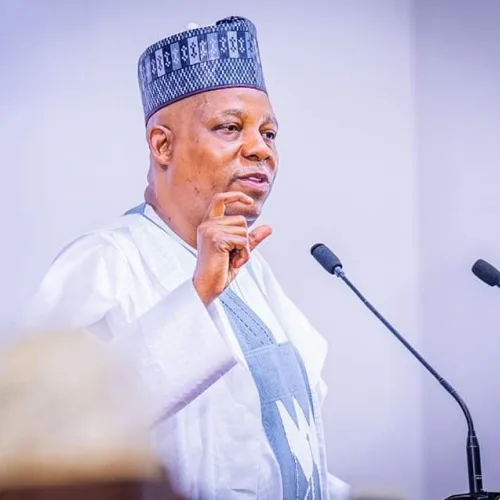
Vice President Kashim Shettima has urged Nigerians to reject ethnic profiling, religious hatred, misinformation and retaliatory violence in order to build a secure, inclusive and prosperous federation.
He made the call on Saturday in Jos, the Plateau State capital, during the 80th birthday anniversary and public presentation of the autobiography of former Plateau State Governor, Senator Jonah David Jang.
According to a release by his spokesman, Stanley Nkwocha, Shettima also called for a renewed national covenant on peace, observing that peace was a shared responsibility between government, community leaders and the citizens.
“A people at peace is the highest achievement of any government, because peace is the soil in which every other blessing grows,” he declared.
The Vice President, who conveyed the goodwill and prayers of the President to the celebrant, reaffirmed the Tinubu’s administration’s commitment to a Nigeria where security supports economic opportunity and every citizen feels at home in every part of the country.
He stressed that sustainable development could not take root in an atmosphere of fear, insecurity and distrust, noting that the economic fortunes of communities and states in Nigeria were closely connected.
“No community flourishes in isolation. Prosperity cannot survive where fear reigns. A farmer in Riyom depends upon peace beyond his village. A trader in Jos depends upon roads that run through the towns of other men. The confidence of one state is the security of another,” he said.
Describing Plateau State as “Nigeria in miniature,” Shettima said the state’s diversity, aspirations, difficulties and recovery reflect the wider national experience.
According to him, whatever strengthens peace and development in Plateau contributes to the stability of the entire federation, while any setback in the state points to the unfinished work of national reconciliation.
“Plateau State is Nigeria in miniature. Its dreams are the dreams of Nigeria. Its struggles are the struggles of Nigeria. Its complexity is the complexity of Nigeria. Its fears are the fears of Nigeria. Its grief is the grief of Nigeria. Its recovery is the recovery of Nigeria,” he stated.
Shettima condemned attempts to associate individual criminal conduct with entire ethnic, religious or regional communities, warning that collective blame enables criminals to deepen divisions beyond the immediate harm caused by their actions.
“No criminal represents his origin, his ethnic group, his religion, his language, his ancestry, his village or the innocent people who bear his surname. Crime has no tribe. Violence has no religion. Murder carries no mandate from any community,” he maintained.
He averred that when innocent people were condemned for crimes committed by others, the perpetrator succeeds twice by taking a life and destroying the trust among those left behind.
“He destroys a life, and then he poisons the fellowship of those left behind. This is the lesson the rest of Nigeria must learn,” he added.
The Vice President acknowledged that Plateau had endured years of violence perpetrated by criminals who invested in chaos, disrupted farming, weakened commercial activities and attempted to replace neighbourliness with suspicion.
He praised the people of the state for refusing to abandon their belief in peaceful coexistence, describing their resilience as a quiet form of heroism that had earned the gratitude of the nation.
The Vice President assured that the Federal Government would continue to discharge its constitutional responsibility for security, emphasising that lasting peace also required citizens to reject rumours, resist inflammatory rhetoric and choose reconciliation over revenge.
Paying tribute to Jang, Shettima described the former military officer, governor and Senator as a father figure whose influence extends beyond the Berom people and Plateau State.
Please follow and like us:
Comments
Start the conversation about this story.