






There are writers who merely tell stories, and there are writers who force a society to confront the truths it has learnt to bury beneath ritual, respectability and silence. Onyeka Nwelue belongs to the latter tradition. Over the years, he has established himself as one of the most restless voices in contemporary African literature, moving effortlessly across genres, geographies and artistic forms.
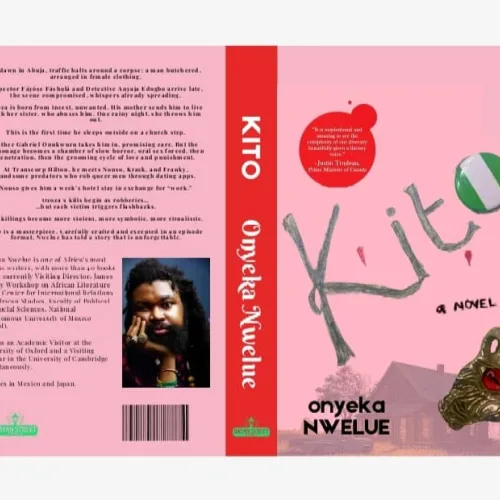
Fresh from the international acclaim that greeted Tokyo Spies, a novel whose historical sweep announced the breadth of his imagination, Nwelue returns home in Kito, a darker, more intimate work that exchanges the vast theatre of history for the bruised interior of modern Nigeria.
Yet Kito is more than a crime thriller. It is an anatomy of trauma. It is a meditation on institutional failure. It is an unsettling exploration of what becomes of a society that repeatedly abandons its most vulnerable citizens and then recoils when they return wearing the face of violence.
Set across Abuja, Kaduna and Owerri, the novel follows a chain of ritualistic murders investigated by Detective Anyaja and Inspector Fashola. The victims are discovered in carefully staged circumstances, each body carrying the same disturbing signature.
From its opening pages, the novel establishes that the murders are not random acts of brutality. They belong to a deliberate moral architecture, one built on memory, humiliation and revenge.
Running beneath the police investigation is the story that gives the novel its emotional gravity. Ozoza, abandoned as a child and raised within the supposed sanctuary of St. Jude’s Catholic Mission, grows up under the authority of Father Gabriel Onukwuru. What should have been a place of refuge becomes the geography of his destruction.
The recurring image of the white petticoat, together with the haunting refrain that rain always arrives before the beating, transforms childhood memory into something almost liturgical. Trauma acquires its own rituals. Violence develops its own calendar.
Nwelue is not interested in sensationalising abuse. His concern lies elsewhere. He asks what institutions become when they value their own reputations above the lives entrusted to them. In Kito, the church does not merely fail a child. It manufactures the conditions that will later produce a killer. Faith itself is not placed on trial. Rather, it is the machinery that cloaks itself in faith while feeding on innocence.
The novel’s greatest achievement lies in its refusal to isolate violence from its origins. Ozoza’s journey from Owerri to Kaduna and eventually Abuja is not simply geographical. It is the slow migration of an injured soul through landscapes that offer survival without healing. Every city teaches him a different grammar of violence.
Kaduna hardens him. Abuja recruits him into organised criminality. By the time he enters the syndicate that specialises in “kito”, he is no longer searching for redemption. He is merely adapting to a country where brutality has become a practical language.
Here, Nwelue demonstrates a sharp understanding of contemporary Nigeria. The criminal practice from which the novel takes its title becomes far more than a plot device. It exposes the intersection of prejudice, technology and organised crime.
Digital platforms designed for intimacy become instruments of entrapment, while fear itself becomes a profitable commodity. Those targeted cannot easily seek justice because society has already condemned them before any crime is committed against them.
One of the novel’s quiet strengths is its refusal to reduce its characters to moral categories. Ozoza is neither monster nor martyr. He inhabits the uneasy territory between victimhood and culpability. His choices remain his own, yet they emerge from wounds that society consistently refused to acknowledge.
This moral complexity rescues the novel from becoming either a sentimental tale of suffering or a conventional detective story. Instead, it asks readers to confront the uncomfortable possibility that violence often survives by reproducing itself across generations.
The novel reaches its emotional summit when Ozoza returns to confront Father Gabriel. The scene is disturbing not because of its physical brutality but because of its symbolic inversion. The rituals once used to humiliate a powerless child are returned to their author with devastating precision.
The altar, traditionally associated with forgiveness and redemption, becomes the stage upon which accumulated pain finally demands recognition. Justice and vengeance collapse into one another, leaving neither the characters nor the reader with the comfort of easy moral certainty.
Meanwhile, Detectives Anyaja and Fashola pursue the investigation with patient determination. Their work is refreshingly grounded in the realities of Nigerian policing. There are no miraculous forensic breakthroughs or cinematic displays of technological sophistication. Progress emerges instead through persistence, local intelligence and painstaking fieldwork. In doing so, Nwelue offers a portrait of law enforcement that feels recognisable rather than romanticised.
Perhaps the most remarkable quality of Kito is its restraint. The novel could easily have surrendered to melodrama, given the gravity of its themes. Instead, Nwelue writes with controlled intensity. His prose is direct without being simplistic, economical without losing emotional force.
The pace rarely falters, and each revelation deepens rather than merely extends the narrative. The result is a thriller whose greatest tension lies not in discovering the killer but in understanding the conditions that made the killings possible.
If there is a weakness, it lies in the occasional haste with which certain supporting characters pass through the narrative. Some relationships invite greater psychological depth than they ultimately receive. Yet this scarcely diminishes the novel’s overall achievement. The emotional architecture remains firm, and its central concerns continue to resonate long after the final page.
Ultimately, Kito refuses consolation. It offers neither uncomplicated justice nor sentimental redemption. Instead, it compels readers to confront a society where institutions repeatedly fail, where silence protects the powerful, and where neglected wounds eventually return as public catastrophe. Nwelue understands that violence rarely appears without ancestry. Every act carries an earlier echo. Every monster has a history.
That is why Kito lingers. It is not simply because it tells the story of murder, but because it reveals the quieter murders committed long before blood is spilled. By the time vengeance arrives, the real crime has already happened.
The novel leaves us with a question that extends beyond its pages: what future awaits a nation that continues to mistake silence for peace and denial for justice? Nwelue offers no comforting answer. He simply holds the mirror steady until we recognise ourselves among its fractures.
Comments
Start the conversation about this story.