






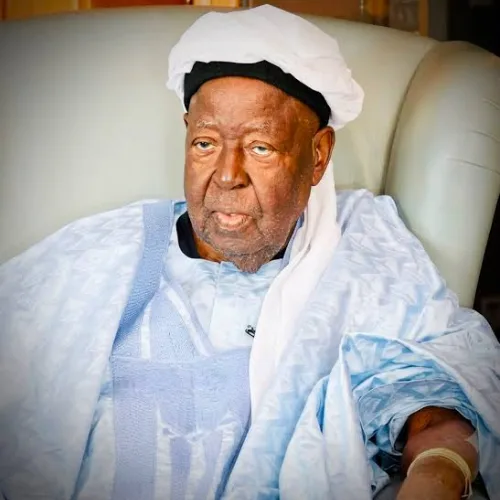
As Nigerians continue to mourn the former Minister of Finance, Alhaji Abubakar Alhaji, widely known as “Triple A”, who died on Thursday July 30, 2026 at the National Hospital, Abuja, it becomes imperative to retrospect on his life and times.
Alhaji Abubakar Alhaji was one of Nigeria’s most distinguished civil servants, economic administrators, diplomats, and traditional title holders, who stepped into the shoes of the revered Sir Ahmadu Bello as the Sadauna of Sokoto in 1990 after the seat remained vacant for a long time following the demise of is holder .
His career, spanning several decades, reflected the evolution of Nigeria’s public service from the post-independence era through military administrations, and into the country’s modern democratic period.
Early life and education
Born on 22 November 1938 in Sokoto, Abubakar Alhaji grew up in a family with deep roots in the Sokoto Caliphate. His unusual name became a subject of public curiosity.
He once explained that “Alhaji” was inherited from his father’s name rather than from pilgrimage, although he was also born during the Eid festivities, adding to the association.
The nickname “Triple A” gained popularity after Queen Elizabeth II reportedly found his full name difficult to pronounce.
He attended secondary school in Kano and Katsina before studying political economy in the United Kingdom.
His further training at international institutions, including the IMF Institute and in The Hague, exposed him to modern public finance and development planning.
This education mattered because Nigeria in the 1960s desperately needed administrators capable of building institutions after independence.
Alhaji belonged to the first generation of technocrats who combined Nigerian administrative experience with international economic training.
Positions held
A distinguished public servant, the Prince of Sokoto Caliphate joined the Federal Ministry of Finance in 1964, beginning a remarkable civil service career.
Over the next three decades, he held several influential positions: Assistant Secretary, Federal Ministry of Finance
Senior official in the Ministries of Trade, Industries, and Finance, Permanent Secretary in key economic ministries, Executive Secretary of the FESTAC Secretariat, Director at the African Development Bank, Minister of State for Budget and Planning, Minister of Finance and Economic Development (1990–1992) and Nigeria’s High Commissioner to the United Kingdom (1992–1996).
Throughout these appointments, he became known as a quiet but highly influential technocrat whose expertise was sought on national budgeting, economic planning, debt negotiations, and international financial diplomacy.
Role in Nigeria’s economic development
As Permanent Secretary and later Minister of Finance, Alhaji played an important role in shaping Nigeria’s economic policies during a challenging period marked by fluctuating oil revenues, structural economic reforms, and negotiations with international creditors.
He participated in negotiations concerning Nigeria’s external debt, International financial institutions, economic planning and budgeting,
The Lomé Convention negotiations involving African, Caribbean, and Pacific countries.
Although many of the economic policies of the era remain debated by historians and economists, Alhaji earned a reputation for technical competence, professionalism, and administrative discipline.
Diplomatic service
Following his ministerial role, he served as Nigeria’s High Commissioner to the United Kingdom. His diplomatic posting strengthened Nigeria’s bilateral relations with Britain and reflected the confidence successive governments placed in his experience.
Traditional leadership
In 1990, Alhaji was installed as the Sardauna of Sokoto, one of the most respected traditional titles in northern Nigeria. The title had previously been held by Sir Ahmadu Bello before his assassination in 1966.
As Sardauna, Alhaji became an important elder statesman within the Sokoto Caliphate, contributing to community development, education, and public discourse while generally avoiding day-to-day palace politics.
He held the revered traditional title of Sardaunan Sokoto until his death.
He was first appointed by the late Sultan Abubakar III as Sarkin Shanun Sokoto, a traditional title previously held by his father.
Leadership style
Observers frequently describe Alhaji as calm and measured, highly disciplined, intellectually rigorous, non-confrontational and
deeply committed to public service
Unlike many politicians, his reputation rested largely on his administrative achievements rather than electoral politics. Several tributes portrayed him as a technocrat whose influence came through expertise and institutional leadership rather than public campaigning.
Alhaji’s legacy can be viewed through several lenses: As an institution builder, he helped to shape Nigeria’s finance and planning institutions during formative decades. And in the area of economic management, he contributed to national budgeting, development planning, and international financial negotiations.
At the level of diplomacy, he represented Nigeria abroad during an important period in its foreign relations, while as Sardauna of Sokoto, he linked modern governance with northern Nigeria’s traditional institutions.
More than any other thing, hiis long experience made him a respected voice on governance and public administration.
Role during the Babangida era
His greatest political importance came under the Ibrahim Babangida regime. He first became Minister of State for Budget and Planning in 1988 and later Minister of Finance and Economic Development.
This period coincided with the Structural Adjustment Programme (SAP), debt rescheduling, declining oil revenues, exchange-rate reforms, privatisation, liberalisation of trade. As finance minister, he was one of the principal administrators of these reforms.
Assessments of his economic legacy depend largely on one’s view of SAP. Supporters argued that Nigeria faced unsustainable debt, oil revenues collapsed even as economic reforms were unavoidable. He demonstrated professionalism in difficult negotiations with creditors.
As finance minister, Nigeria maintained credibility with international financial institutions. Critics, however, argue that SAP deepened poverty, as currency devaluation reduced purchasing power, liberalization hurt domestic manufacturing, while international lenders exercised excessive influence over Nigerian policy.
Many of these criticisms were directed more broadly at the Babangida government’s economic direction than at Alhaji personally, though he was one of its principal implementers.
Diplomatic career
After leaving the finance ministry, he served as Nigeria’s High Commissioner to the United Kingdom. This appointment reflected government’s confidence in him, his international reputation, his experience dealing with foreign governments and financial institutions.
His diplomatic work continued his pattern of representing Nigeria in international economic and political circles.
Traditional leadership
In 1990, he became the Sardauna of Sokoto, succeeding to one of northern Nigeria’s most prestigious traditional titles after it had remained vacant since the death of Ahmadu Bello in 1966.
The title carried enormous symbolic weight. Although Alhaji did not inherit Ahmadu Bello’s political role, receiving the title recognised his stature within the Sokoto establishment and among northern elites.
Administrative style
Without doubt, Alhaji’s influential across multiple administrations. This continuity illustrates how Nigeria’s senior civil service often functioned as the institutional memory of the state despite frequent political upheaval.
Criticisms
No balanced assessment would ignore criticisms associated with his period in office. Among them was his association with unpopular SAP reforms, participation in military governments rather than democratic administrations, policies that coincided with increasing inequality, limited public accountability characteristic of military rule.
However, there is comparatively little or no evidence that he became personally associated with the corruption scandals that overshadowed many prominent Nigerian officials of the same era. Most historical accounts portray him primarily as an administrator rather than a political patron.
Historical significance
Alhaji belonged to an important but often overlooked generation of Nigerian nation-builders, not founding politicians,
not military rulers, but elite administrators who translated political decisions into government policy.
His career reflected broader themes in Nigerian history – the dominance of the civil service after independence, the growing influence of international financial institutions, the transition from oil-boom optimism to debt management, the fusion of traditional authority with modern state administration, the enduring influence of northern bureaucratic elites.
Overall assessment
From a historical perspective, his legacy is best understood as that of a technocratic statesman. His greatest strengths were administrative competence, continuity of service, and international economic diplomacy rather than electoral politics or charismatic leadership.
His career also illustrated a central paradox of Nigerian governance: Highly capable administrators can play pivotal roles in implementing policies that remain deeply contested.
Whether one views the economic reforms of the late 1980s and early 1990s as necessary modernisation or as harmful austerity, Alhaji stood out as one of the principal architects and executors of that era’s economic management.
As such, his life offers a window into the evolution of Nigeria’s bureaucracy, economic policy, and statecraft over more than three decades.
Conclusion
The late technocrat stood among Nigeria’s most accomplished career public servants. His journey—from a young civil servant in 1964 to Permanent Secretary, Finance Minister, diplomat, and Sardauna of Sokoto—illustrated the impact that dedicated administrative leadership can have on national development.
While public attention often focuses on elected leaders, his career highlights the enduring influence of experienced technocrats in shaping economic policy, public institutions, and national governance.
As the light dimmed on the diplomatic giant, he is survived by his wife, five children, grandchildren and other relatives.
The elder statesman was laid to rest on Thursday at Hubbaren Shehu, the historic royal cemetery in Sokoto, with both the high and the low in attendance.
Comments
Start the conversation about this story.