





For those who follow Nigeria’s visual arts circuit closely, the annual regional exhibition of the Life in My City Art Festival (LIMCAF) has become a familiar ritual. The Lagos outing, which held on July 25, 2026 at Thought Pyramid Art Centre in Ikoyi, drew the usual mix of emerging artists, curators, collectors and enthusiasts, reaffirming the festival’s place as one of the country’s most dependable platforms for young creative talent.
The Lagos exhibition forms part of LIMCAF’s nationwide selection process after entries closed on May 31, 2026. This year’s exercise spans 18 centres across the country and features 830 submissions. From that pool, 100 works will be shortlisted for the grand finale in Enugu, holding from October 24 to 31, 2026, with the winners to be announced on October 31, 2026 at the International Conference Centre of the Institute of Management and Technology.
The timing is significant. With its 20th anniversary due next year, LIMCAF enters its 19th edition under the theme ‘Open Letter’, backed by a prize purse exceeding N50 million. Since its launch in 2007, the festival has grown into one of Nigeria’s most influential incubators of emerging artists, interrupted only once, in 2020, when the COVID-19 pandemic forced the suspension of public events.
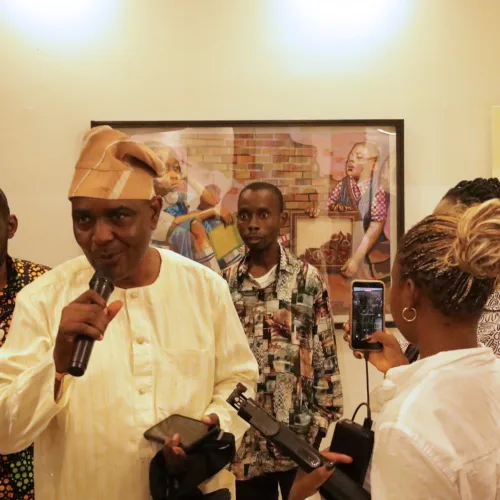
Officially declared open by Ayo Adewunmi, artistic director, LIMCAF and coordinated in Lagos by Okechukwu Eze, the exhibition began with remarks from Ovie Omatshola, director, Thought Pyramid Art Centre and Adetiloye Jekami, curator. Paintings dominated the display, complemented by a modest number of sculptures and photographs. Eight works from the Lagos showing eventually advanced to Enugu.
As in previous editions, some artists engaged the theme more convincingly than others. Some artists interpreted the theme rather literally, while others only touched on it in passing. The issue is hardly new. Over the years, some members of the festival’s organising committee have questioned whether LIMCAF should abandon thematic framing altogether. Yet removing the conceptual anchor would risk reducing the competition to little more than a broad survey of contemporary practice, depriving it of the intellectual thread that has long distinguished it.
This year’s theme asks artists to reflect on existential choice, personal agency and the capacity of communities to shape social change. That engagement extends beyond the exhibition spaces. Alongside the competition, LIMCAF continues to invest in public programmes, including creative workshops for schoolchildren and young people living with disabilities. A six-week residency and mentorship programme for a coterie of artists also commenced on July 1, reinforcing the festival’s emphasis on professional development rather than prize-winning alone.
The competition’s highest prize award remains the Elder K. U. Kalu Grand Prize for Young Artist of the Year, worth the naira equivalent of $2,000. New category prizes have broadened the awards structure, including the Capt. Everest Odengene Nnaji Prize of N1 million for painting and the Tayo Adenaike Prize of N500,000 for watercolour, alongside other specialised awards.
LIMCAF’s longevity owes much to an unusually broad coalition of supporters. Alongside its longstanding partnership with the Alliance Française network, the Institut Français and the French Embassy, the festival has received sustained backing from organisations including the Ford Foundation, Thought Pyramid Art Centre, Clam Lab, Rocana Nigeria Limited, Honeywell Group, FBN Holdings, the Pan African Circle of Artists, the Enugu State Council for Art and Culture and the Centre for Contemporary Art, Lagos. Prize endowments and philanthropic support from distinguished individuals and families have further strengthened its foundations.
The festival’s wider significance is reflected in the careers it has helped to launch. Since 2007, participation has expanded steadily, while many former winners have progressed to national prominence and international opportunities. Their trajectories offer perhaps the clearest measure of LIMCAF’s contribution to Nigeria’s visual arts ecosystem.
Established through the initiative of Robert Orji, founder of Rocana Nigeria Limited, LIMCAF now stands on the threshold of its third decade. Few cultural initiatives in Nigeria have matched its consistency, and fewer still have remained so firmly committed to creating opportunities for the country’s next generation of artists.

Comments
Start the conversation about this story.