





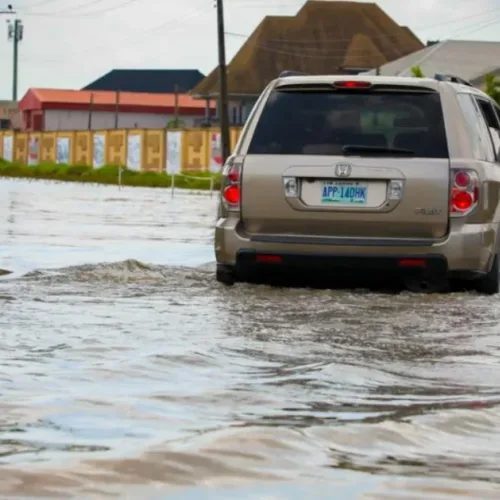
Persistent rainfall across Lagos is forcing residents to change their daily routines as they battle flooding, traffic congestion, rising transport costs and threats to property.
From commuters leaving home before dawn to traders protecting their goods, residents are finding different ways to cope with the prolonged rains.
The News Agency of Nigeria on Sunday reported that umbrellas, raincoats, waterproof sheets and weather forecasts have become essential for many residents.
The experiences align with the Nigerian Meteorological Agency’s 2026 Seasonal Climate Prediction, which projects a longer-than-normal rainy season and delayed cessation of rainfall in Lagos.
For Mrs Shola Opeyemi, an Aguda resident, coping with the rains means leaving home much earlier to avoid being trapped in traffic.
She said carrying a backpack had become essential because it contained her rain boots and raincoat in case of an unexpected downpour.
Opeyemi added that getting caught in the rain often meant spending almost twice her daily transport budget because fares usually increased.
“I leave home early to avoid getting stuck in traffic. I always carry a backpack containing my rain boots and raincoat because you can never predict the weather.
“Whenever I am caught in the rain, I spend almost double my transport budget for the day because fares usually increase,” she said.
Mrs Cecilia Uwadi, who lives in Ogba, said she had also adjusted her routine, noting that surviving the rainy season required careful planning and personal sacrifice.
She said she leaves home by 4:00 a.m., uses Google Maps after work or remains in the office until 9:00 p.m. to avoid gridlock.
Uwadi lamented that prolonged traffic during rainfall increased her fuel consumption and reduced the number of days a full tank of fuel could last.
“A full tank lasts me about 10 days during normal weather, but when it rains continuously, it doesn’t even last up to seven days because of traffic,” she said.
“It is a daily struggle that I have to live with because I never get enough sleep.
“Thank God my children are not toddlers that I need to clean up after. But I don’t wish this level of stress on anybody,” she added.
For Mr Timothy, who lives in Mafoluku and works in Surulere, the rainy season means spending beyond his already stretched monthly budget.
“I hate it when it rains. Instead of paying my usual N2,000 transport fare, I spend N3,000 or more,” he said.
“My salary is already accounted for, which means it is never enough. Spending extra will deprive me of one essential thing or another,” Timothy added.
While commuters worry about movement and expenses, traders say the rainy season brings both opportunities and losses.
Mrs Adewunmi Yusuf, an umbrella seller at Ojota, said sales usually increased whenever unexpected rainfall sent commuters searching for protection.
“On sunny days, I may sell only one or no umbrella. Once the rainy season starts, people rush to buy them. Some days, I sell more than 20,” she said.
Yusuf said demand was highest during the morning and evening rush hours when commuters were caught in sudden downpours.
Mrs Nkiru Adedeji, a raincoat trader at Oshodi, said the rainy season had become her busiest period of the year.
She said many customers preferred disposable emergency raincoats because they were cheaper than reusable ones.
“Many people who never planned to buy a raincoat end up buying an emergency raincoat because it is cheaper.
“Some even buy extra ones for their children, spouses or to keep for later use. Emergency raincoats cost between N500 and N700, and they sell very fast during this season,” she said.
Adedeji, however, said frequent rainfall could also reduce sales when heavy flooding discouraged customers from visiting the market.
At Mile 12 Market, trader Temitope Alakija said the rains had made leaving children in charge of shops increasingly risky.
She said sudden downpours could destroy goods before children had time to react, resulting in avoidable losses.
Alakija added that prolonged rainfall also discouraged customers, leaving traders with little or no sales.
“You can’t ask your children to stay in your shop because rain usually comes unannounced and will destroy your goods.
“It is better not to open your shop at all than to leave your children in charge. Trading during the rainy season is not for the faint-hearted.
“We hardly see buyers when it rains. If it rains throughout the day, you may not record any sales at all,” she said.
Students are also adjusting to the realities of the prolonged rains, with protecting books and important documents becoming a daily concern.
Miss Chikaodinaka Agbo, a student at the University of Lagos, said she had adopted measures to protect her books and certificates from water damage.
“There is no space on the table for reading. It is strictly for storing my textbooks to keep water away from them,” she said.
“My credentials are tied up in several nylon bags for protection from water. If you are not careful, you will lose all your certificates,” Agbo said.
Despite the different challenges they face, the residents agreed that adapting to Lagos’ rainy season had become a necessity rather than a choice.
For many, surviving the rains now means leaving home earlier, spending more, protecting their livelihoods and constantly adjusting their plans whenever the skies darken.
(NAN)
Comments
Start the conversation about this story.