





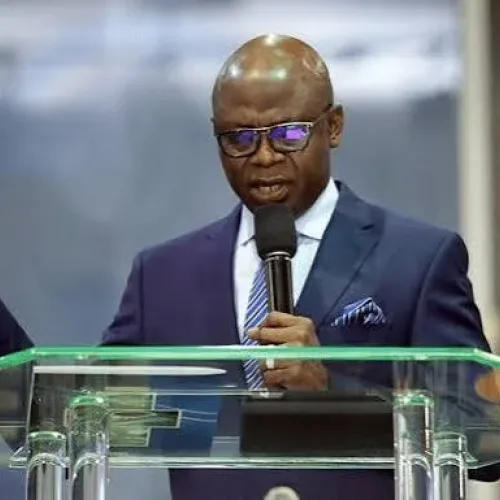
The Serving Overseer of the Citadel Global Community Church, Pastor Tunde Bakare, has warned that Nigeria’s development will remain elusive unless its leaders address the country’s institutional weaknesses, ensure continuity in governance and accept responsibility for building systems that can outlive individual office holders.
Bakare spoke in Lagos on Sunday at the public presentation of his three-volume work, Strategic Intervention in Governance, which documents his interventions in Nigeria’s political and governance affairs over nearly two decades.
The former presidential candidate said the country’s recurring crises could not be resolved merely by changing individuals in government, arguing that sustainable nation-building required leaders capable of confronting difficult problems and creating institutions that could preserve progress beyond their tenure.
“Nation-building is impossible without leadership continuity. Vision without succession eventually dies,” Bakare said.
The three-volume publication brings together 104 speeches delivered between 2008 and 2025 across five presidential administrations, covering Bakare’s interventions on governance, constitutional reform, corruption, leadership, public accountability and national development.
The event drew prominent figures from politics, academia, law, religion and civil society, including former Akwa Ibom State Governor, Victor Attah; former Ekiti State Governor, Dr Kayode Fayemi; former Ogun State Governor, Segun Osoba; former Minister of Health, Olorunnimbe Mamora; Pastor Jimi Odukoya of Fountain of Life Church; human rights activist, Dr Joe Okei-Odumakin; Prof Akin Oyebode; and Vice-Chancellor of the University of Lagos, Prof Folasade Ogunshola.
The work, according to its reviewer, Elder Olabode Adekanye, captures an 18-year progression in Bakare’s public engagement, from confronting governments over their failures to advocating the creation of institutions capable of addressing some of the problems he had consistently identified.
Adekanye described the collection as “the voice that challenged a nation,” arguing that it should be read not merely as an archive of Bakare’s speeches but as a sustained argument about the responsibilities of leadership and citizenship.
He said the books challenged Nigerians to move beyond diagnosing the country’s problems to taking responsibility for solving them.
The three volumes trace Bakare’s interventions from 2008 to 2025, with the first volume containing 36 speeches delivered between 2008 and 2015, the second 31 speeches from 2015 to 2018, and the third 37 speeches from 2019 to 2025.
The review noted that the speeches were delivered across a range of platforms, including churches, universities, press conferences, civic gatherings, protest grounds, business forums and political engagements, rather than being confined to Bakare’s role as a pastor.
For Adekanye, that breadth was significant because it demonstrated the central argument running through the books: that the responsibility to intervene in public affairs should not be confined to politicians.
“Strategic Intervention in Governance is not a book about politics. It is a book about the cost of silence, and the price a nation pays when its conscience stays in the church and never enters the chambers of power,” he said in his assessment of the work.
The book traces Bakare’s public interventions from his student years at the University of Lagos, where he studied law, and records a trajectory that included opposition to military rule, the annulment of the June 12, 1993 presidential election, the detention of Bakare during the Abacha regime and his involvement in protests during the 2010 constitutional crisis over the prolonged absence of President Umaru Yar’Adua.
The review described him as a participant rather than a detached commentator on Nigeria’s political history, noting that his interventions repeatedly placed him in confrontation with those in power.
It cited his opposition to the annulment of the June 12 election under Gen Ibrahim Babangida and his subsequent detention in 1997 under the regime of Gen Sani Abacha.
Under civilian rule, Bakare’s criticism of the administration of former President Olusegun Obasanjo also resulted in his detention and passport confiscation in 2002, according to the review.
His involvement in the Save Nigeria Group protests during the Yar’Adua constitutional crisis similarly reflected the approach that runs through the books: that citizens and institutions must intervene when governance fails.
The first volume, covering 2008 to 2015, centres substantially on the question of where political authority derives its legitimacy.
One of the arguments highlighted in the review is Bakare’s comparison of government to a bank holding power deposited by citizens through their consent, an analogy used to argue that political authority is borrowed rather than permanently owned by those in office.
The volume also examines the 2012 fuel subsidy crisis and Nigeria’s 2014 National Conference, with Bakare contrasting the conference with the 1787 Philadelphia Convention that produced the United States Constitution.
His criticism, according to the review, was that Nigeria had repeatedly produced conference communiqués without resolving the constitutional questions underlying its political structure.
The second volume, covering 2015 to 2018, shifts more directly into questions of institutional failure and the relationship between leadership and citizenship.
It argues that institutions cannot be stronger than the people who operate them and that constitutional reform alone cannot transform a country without corresponding changes in the character and conduct of its citizens.
Bakare also turns his criticism towards the Christian church, questioning whether religious institutions had themselves become complicit in some of the dysfunction they condemned in the wider society.
That willingness to interrogate his own constituency, Adekanye argued, strengthened the moral basis of Bakare’s broader criticism of Nigeria’s political leadership.
The third volume, which covers 2019 to 2025, represents a further shift from criticism towards institution-building.
The review identified this as a significant development in Bakare’s thinking, tracing a movement from what it described as “prophetic protest” towards “institutional renewal.”
It points to the establishment of the Citadel School of Government and a strategic partnership with the University of Lagos Business School as examples of Bakare attempting to move beyond identifying Nigeria’s governance problems towards building structures that could contribute to their solution.
According to Adekanye, the evolution is important because the trilogy ultimately asks a question beyond whether Nigeria’s problems have been properly diagnosed.
The more difficult question, he argued, is whether Nigerians are willing to build the institutions necessary to address them.
“The diagnosis alone is not enough; one must become part of the remedy,” Adekanye said in the review.
The reviewer said the books retained a consistent argument despite being written across changing administrations and different political circumstances.
He identified three characteristics of the work — Bakare’s ability to move between religious and empirical arguments, his intellectual willingness to interrogate his own positions and his sustained willingness to challenge political and institutional failures.
The review also argued that the work was distinguished by its refusal to allow criticism to become cynicism.
Rather than simply catalogue Nigeria’s failures, it said the trilogy continued to ask whether the country could be reclaimed and what citizens themselves could do to make that possible.
Bakare, who was the running mate to the late President Muhammadu Buhari in the 2011 presidential election on the platform of the Congress for Progressive Change, said the book was intended to provide ideas for addressing Nigeria’s problems rather than merely attacking those responsible for them.
He called for greater compassion among leaders and urged young Nigerians to take responsibility for creating opportunities and contributing to national development even when institutions failed to provide adequate pathways.
The cleric also said the future of Nigeria depended on citizens willing to make sacrifices for the country.
His position received support from Osoba, who chaired the book presentation.
Osoba described Bakare as a “tough character” who had demonstrated loyalty and commitment to the country, saying his interventions were motivated by concern for Nigeria rather than personal interest.
“When you see Bakare fighting for the nation, it is not for self,” Osoba said.
The former governor said the significance of Bakare’s interventions was not simply in his willingness to criticise those in power but in his effort to propose alternatives.
He said Nigerians who criticised President Bola Tinubu and other political leaders should similarly be prepared to offer solutions to the problems they identified.
“Bakare’s book is not just to criticise but to proffer solutions to the nation’s challenges,” Osoba said.
Presenting the books, the senator representing Ogun West and All Progressives Congress governorship candidate for Ogun State, Solomon Adeola, called on Nigerian leaders to do more for citizens and urged Nigerians to develop a stronger sense of patriotism and nationhood.
Bakare said copies of the publication would be donated to universities across the country, including the University of Lagos, where he studied law.
Comments
Start the conversation about this story.