





Nigeria’s premium crude grades are facing their stiffest competitive test in years as a flood of cheaper oil from Brazil and Guyana reshapes buying patterns in Europe, threatening to erode the country’s position in one of its most lucrative export markets despite the superior quality of its barrels.
Fresh Argus Media price data showed that the delivered discount on Brazilian crude to Europe has swung from a virtual dead heat in April to nearly $9.20 a barrel by late July, indicating that a flood of cheaper Latin American oil is reshaping buying patterns, even as the quality case for Nigerian barrels continues to strengthen on paper.
For decades, European refiners have leaned on Nigerian crude for its high yields of premium transport fuels, particularly diesel.
However, that equation is being tested as rapidly rising output from Brazil and Guyana hands refiners a cheaper alternative, one that produces a less valuable slate of refined products but slashes the upfront cost of feedstock at a time when margins are under pressure.
The shift is a strategic problem for Nigeria, whose economy remains heavily dependent on crude oil exports for foreign exchange earnings and government revenue.
European refiners are increasingly weighing whether the higher refining value of Nigerian grades such as Forcados justifies paying up over Brazilian alternatives such as Buzios, and the numbers, obtained by BusinessDay from Argus Media’s delivered price assessments, show that calculation shifting from month to month.
A gap that briefly vanished, then reopened sharply
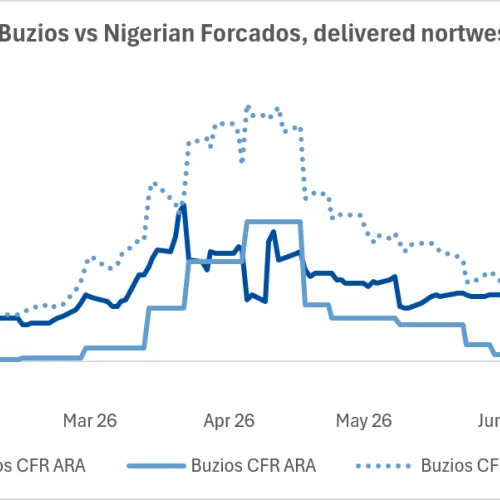
Data compiled from daily Argus assessments on a cost and freight (CFR) Amsterdam-Rotterdam-Antwerp (ARA) basis showed that medium-sweet Buzios has averaged roughly $5.50 a barrel cheaper than Forcados on a delivered northwest Europe basis since the start of the year, a figure that matches Argus’s own full-period estimate.
However, the monthly pattern beneath that average has been far from steady. The gap held near $5.30-6.90 per barrel of oil through the first quarter, collapsed to effectively zero in April as Forcados briefly traded at a discount to Buzios on a delivered basis, then rebuilt sharply through the second quarter to reach an average of $9.20 per barrel of oil in July, with daily readings touching as high as $22 per barrel of oil in late March.
Brazilian Buzios vs Nigerian Forcados delivered northwest Europe. Source: Argus Media.
“The price gap is material, with medium sweet Buzios from Brazil averaging about $5.50/bl cheaper than Nigerian Forcados on a delivered-northwest Europe basis over the past year,” said Lina Bulyk, deputy head of crude pricing at Argus Media.
She said refiners are weighing lower upfront feedstock costs against the better product slate that Nigerian grades can offer once processed.
The refining-value cushion is growing, not shrinking
Where Nigeria’s position looks structurally stronger is in refinery gate value (RGV), a measure of how much a barrel is worth once converted into finished products at a typical northwest European refinery.
Argus’s RGV series showed Forcados’ advantage over Buzios widening from about $6.60 per barrel of oil in January to a peak above $15 per barrel of oil in April, before easing back to roughly $11.80 per barrel of oil in July, still more than double the average acquisition-cost saving refiners get from choosing Buzios.
In other words, even as Brazilian crude has become measurably cheaper to buy, Nigerian crude has, on Argus’s numbers, become more valuable to run.
Refinery Gate Value indicates the value of a barrel of crude is worth in the products a refinery can make from it, based on the crude’s assay, a typical regional refinery configuration and prevailing product prices.
A widening RGV gap signals that Forcados is pulling further ahead on pure refining economics even as its price premium over Buzios also increases, a tension that is forcing refiners away from simple purchase-price comparisons and toward post-processing margin analysis.
Brazilian volumes surged, then pulled back
The competitive pressure has been amplified by sheer volume.
Combined crude exports from Brazil and Guyana have risen by roughly 500,000 barrels per day since 2025 to reach about 3.28 million barrels per day this year, giving European buyers far greater flexibility to diversify away from West African grades.
However, deal-tracking data reviewed by BusinessDay suggest the pace of Brazilian crude committed specifically to Europe has not risen in a straight line, volumes climbed from roughly 20,000 barrels per day in January to a high of 36,000 barrels per day in May, before falling back sharply to about 14,000 barrels per day by October.
This showed that Latin American supply to Europe, while structurally larger than a year ago, still moves in bursts tied to arbitrage economics rather than as a steady base-load flow.

China purchases of Brazilaion crude
From base-load supplier to arbitrage barrel?
Analysts warned that the swings evident in both the price gap and the volume data point to a bigger structural risk for Nigeria, some West African grades could shift from being dependable base-load supplies, purchased regardless of market conditions, to arbitrage barrels that refiners buy only when temporary price differentials make them attractive.
That would mark more than a change in trading patterns; it would represent a structural shift in one of Nigeria’s key export markets, intensifying competition for cargo placements and putting downward pressure on official selling premiums over time.
With production from Brazil and Guyana expected to keep rising over the next few years, European refiners will have even greater access to cheaper Atlantic Basin barrels, intensifying competition for traditional West African suppliers.
“Nigeria’s crude quality, reliability and product value remain strong selling points, but European buyers are increasingly testing whether cheaper Latin American barrels can meet their needs,” Bulyk said. “Latin American production is forecast to rise over the coming years, further increasing competition.”
However, Nigeria retains a genuine advantage as its crude continues to command stronger refining economics, offer reliable quality, and produce a more valuable slate of refined products than many competing barrels, characteristics that remain powerful selling points for complex European refiners chasing diesel margins.

Comments
Start the conversation about this story.