





 Team Nigeria
Team Nigeria brought the curtain down on an impressive outing at the 2026 Commonwealth Games in Glasgow with a total haul of 24 medals, comprising 10 gold, seven silver and seven bronze, finishing as the highest-ranked African nation and seventh overall on the medals table.
The remarkable performance saw Nigerian athletes excel across five sporting disciplines—para powerlifting, weightlifting, athletics, para athletics and judo—underscoring the country’s growing depth in elite sports and the impact of renewed investment in athlete preparation. Blueprint reports
Details of the medal-winning performances were contained in a statement signed by the Special Assistant on Media to the Director General of the National Sports Commission (NSC), Kola Daniel, who described the athletes’ achievements as another milestone in Nigeria’s sporting history.
The Glasgow campaign produced 10 Commonwealth champions, while several athletes also delivered historic performances that reaffirmed Nigeria’s status as one of the Commonwealth’s leading sporting nations.
Para powerlifting leads medal charge
Nigeria’s para powerlifters once again justified their reputation as one of the country’s most reliable medal-winning teams.
The contingent delivered six medals, comprising three gold and three silver, accounting for a quarter of Team Nigeria’s total medals.
In the women’s lightweight event (61kg), Esther Nworgu claimed the gold medal with a commanding performance, while compatriot Esther Oyema secured silver to complete a Nigerian one-two finish.
The women’s heavyweight category also belonged to Nigeria as world record holder Folashade Oluwafemiayosuccessfully defended her Commonwealth title by winning gold, while Rita Ferdinand added another silver medal to the country’s tally.
The men’s events equally produced podium finishes, with Riluwan Idris winning gold in the heavyweight division (above 72kg) and Roland Ezuruike claiming silver in the lightweight category (72kg).
The performances further reinforced Nigeria’s dominance in para powerlifting, a sport in which the country has consistently excelled at the Paralympic Games, World Championships and Commonwealth Games.
Weightlifters continue golden tradition
Weightlifting also lived up to expectations by contributing four medals, including three gold and one silver.
The competition began with Ruth Nyong, who claimed silver in the women’s 48kg event after an impressive display.
Nigeria’s first weightlifting gold came through Edidiong Joseph Umoafia, who emerged Commonwealth champion in the men’s 71kg category.
The golden run continued when Onome Didih secured victory in the women’s 53kg event before Rofiat Lawal added another title in the women’s 58kg division.
The performances highlighted Nigeria’s enduring strength in weightlifting, which has remained one of the country’s most successful sports at major international competitions.
Athletics delivers biggest medal haul
Athletics emerged as Team Nigeria’s biggest medal-producing sport, contributing 12 medals made up of three gold, three silver and six bronze.
The track and field events produced several memorable performances.
Jessica Oji opened Nigeria’s medal account in the field events by winning silver in the women’s shot put.
Sprinter Kanyinsola Ajayi followed with bronze in the men’s 100 metres, while Temitope Adeshina also secured bronze in the women’s high jump.
Nigeria celebrated another Commonwealth champion when Chukwuebuka Enekwechi dominated the men’s shot put to win gold.
World record holder Tobi Amusan added bronze in the women’s 100 metres hurdles before Nathaniel Ezekiel stormed to victory in the men’s 400 metres hurdles to secure another gold medal for Team Nigeria.
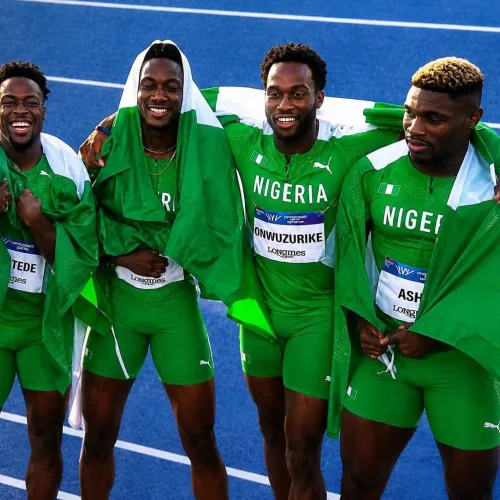
Sprint sensation Udodi Onwuzurike claimed silver in the men’s 200 metres, while Samuel Ogazi produced one of Nigeria’s most memorable performances by winning gold in the men’s 400 metres, becoming one of the country’s standout athletes at the Games.
In the women’s 400 metres, Ella Onojuvwevwo claimed bronze, while Ruth Usoro added silver in the women’s long jump after an impressive leap of 6.87 metres.
Nigeria also demonstrated its strength in relay events, earning medals in both the men’s 4×100 metres relay and the mixed 4×400 metres relay to cap another successful athletics campaign.
Para athletics and judo make history
Nigeria’s para athletics team also contributed to the country’s success.
Goodness Nwachukwu won gold in the women’s F42-44/F61-64 discus throw to secure another Commonwealth title and reinforce Nigeria’s growing reputation in para athletics.
The achievement added to the country’s impressive record in disability sports, where Nigerian athletes have consistently competed among the world’s best.
In judo, Enku Ekuta ended a 24-year Commonwealth Games medal drought by winning bronze in the women’s 63kg category.
After losing in the quarter-finals, Ekuta fought back through the repechage before defeating Zambia’s Rita Kabinda by ippon in the bronze medal contest.
Her achievement marked Nigeria’s first Commonwealth Games judo medal since the 2002 edition and was widely celebrated as a major breakthrough for the sport.
Nigeria remains Africa’s number one
The final medal distribution reflected Nigeria’s impressive all-round performance across multiple sports.
Para powerlifting accounted for six medals, athletics produced 12, weightlifting delivered four, while para athletics and judo contributed one medal each.
The overall tally of 10 gold, seven silver and seven bronze medals earned Team Nigeria seventh position on the final medals table behind Australia, England, Canada and other leading Commonwealth nations.
More significantly, Nigeria finished as Africa’s highest-ranked nation, ahead of South Africa, Kenya, Mauritius, Cameroon and every other African country that participated in the Games.
Although the overall medal haul was lower than the 35 medals won at the Birmingham 2022 Commonwealth Games, sports administrators described the Glasgow campaign as another encouraging step in Nigeria’s sports development journey.
The performances across para sports, athletics, weightlifting and judo highlighted the country’s growing pool of talented athletes capable of competing successfully on the global stage.
The National Sports Commission noted that the achievements reflected the effectiveness of its high-performance programme, improved athlete preparation and sustained investment in elite sports.
With attention now turning to future international competitions, including the World Championships, African Games and the 2028 Olympic Games in Los Angeles, Team Nigeria leaves Glasgow with renewed confidence, having once again established itself as Africa’s leading sporting nation at the Commonwealth Games while producing 10 new Commonwealth champions and inspiring a new generation of athletes across the country.
Comments
Start the conversation about this story.