







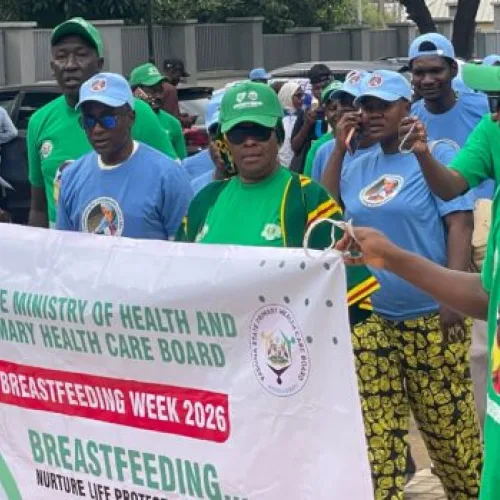
The Kaduna state government, in partnership with the United Nations Children’s Fund (UNICEF), has launched the First 1,000 Days Social and Behaviour Change Initiative for Nutrition as part of activities marking the 2026 World Breastfeeding Week.
The initiative is aimed at promoting optimal nutrition from conception until a child reaches two years of age, while encouraging exclusive breastfeeding and improved maternal and child health across the state.
Speaking at a press briefing in Kaduna on Tuesday, the Commissioner for Health, Hon. Umma K. Ahmed, said this year’s World Breastfeeding Week, themed “Breastfeeding for a Sustainable Start in Life: Strengthen What Works,” underscores the need to reinforce proven interventions that improve child survival and development.
She described breastfeeding as one of the most effective and affordable strategies for ensuring healthy childhood development, saying exclusive breastfeeding for the first six months provides all the nutrients an infant needs, protects against diseases, strengthens immunity and supports brain development.
“Breastfeeding is not only the first and best food for every child, but it is also a foundation for lifelong health. Continued breastfeeding alongside appropriate complementary feeding until two years of age and beyond further enhances a child’s growth and development,” she said.
Ahmed said the state government remained committed to strengthening maternal, newborn, child and adolescent health and nutrition services across the 23 local government areas through programmes promoting infant and young child feeding, baby-friendly health facilities, maternal nutrition and community nutrition services.
She also called on fathers, families, employers, healthcare providers, traditional and religious institutions, civil society organisations and development partners to support nursing mothers.
“I encourage all mothers to initiate breastfeeding within one hour of birth, exclusively breastfeed for the first six months of life, and continue breastfeeding with appropriate complementary foods up to two years of age or beyond,” she said.
Also speaking, UNICEF Nutrition Specialist, Kaduna Field Office, Mrs Chinwe Ezeife, said the global campaign was being used to strengthen the First 1,000 Days Initiative because the period from conception until a child turns two is critical to survival, growth and development.
She described breastfeeding as more than a health intervention, saying it is also a major investment in human capital development.
“Breastfeeding is one of the strongest foundations we can give a child for survival, growth and development. It is not just a health intervention; it is also a critical investment in human capital development,” she said.
Ezeife explained that this year’s theme focuses on reinforcing interventions that have already delivered positive results.
“‘Strengthen What Works’ means that we are moving beyond awareness campaigns to reinforcing proven interventions. Kaduna State has consistently remained at the forefront of implementing strategies that work,” she said.
She commended the Kaduna State Government for adopting six months’ paid maternity leave for eligible women, describing the policy as one that enables mothers to practise exclusive breastfeeding for the recommended period.
The UNICEF official also praised the establishment of breastfeeding-friendly workplaces, noting that the Kaduna State Planning and Budget Commission had established a crèche and deployed caregivers to support working mothers.
“When mothers return to work after maternity leave, we are advocating for the establishment of crèches and breastfeeding-friendly workplaces. Kaduna State has already demonstrated commendable leadership in this regard,” she said.
She said UNICEF was promoting three key breastfeeding practices: initiation of breastfeeding within one hour after birth, exclusive breastfeeding for the first six months without water or any other food, and continued breastfeeding with complementary feeding until the child is at least two years old.
Ezeife also stressed the importance of maternal nutrition, noting that what a woman eats before conception, during pregnancy and while breastfeeding has a direct impact on the health and nutrition of her child.
According to her, Kaduna State, with UNICEF’s support, has trained healthcare workers on Maternal, Infant and Young Child Nutrition to strengthen counselling and support for mothers.
She expressed optimism that the state would record improved breastfeeding indicators beyond those reported in the 2023/2024 Nigeria Demographic and Health Survey.
“We are also tracking mothers who deliver between August 1 and August 7 to monitor how they practise early initiation of breastfeeding,” she said.
Ezeife urged communities, traditional rulers, religious leaders and local government authorities to support mothers in adopting recommended breastfeeding practices, while commending Governor Uba Sani’s administration for its continued commitment to improving maternal and child nutrition in Kaduna State.
Comments
Start the conversation about this story.