





The Presidency on Tuesday lauded the National Agency for Science and Engineering Infrastructure’s growing investment in locally assembled drones, agricultural technologies and indigenous manufacturing, describing the agency as a key driver of the Federal Government’s innovation, technology transfer and industrialisation agenda.
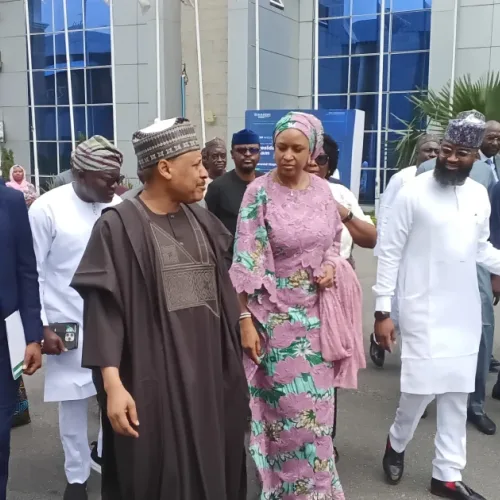
Senior presidential aides gave the commendation during a tour of six factories, production facilities and the NASENI showroom at the agency’s headquarters in Abuja, where they inspected locally assembled unmanned aerial vehicles, agricultural equipment, diagnostic test kits and other technologies developed through partnerships with private firms.
The Presidential Communications Team included the Special Adviser to the President on Information and Strategy, Bayo Onanuga; the Special Adviser on Media and Public Communication, Sunday Dare; the Special Adviser on Policy and Coordination, Hadiza Bala-Usman; and the Minister of Information and National Orientation, Mohammed Idris.
The visit comes amid the Federal Government’s renewed emphasis on local content development, import substitution and technology-driven industrial growth under President Bola Tinubu’s Renewed Hope Agenda.
In recent years, NASENI has expanded collaborations with local and international firms to promote manufacturing, engineering innovation and skills development across critical sectors of the economy.
Speaking during the inspection, Onanuga praised the transformation of the agency under its Executive Vice Chairman and Chief Executive Officer, Khalil Halilu.
He said, “NASENI has done really well. I was not surprised that when it came to selecting the presiding positions, the agency’s EVC was appointed. This agency was created in 1992. Yet, in three years, you can see how Halilu has turned it around.
“I was here last year and found some of his innovations remarkable. I can see the Renewed Hope Transformation in this agency. We must commend you and also encourage you to continue to justify the confidence the President has in the youth of this country to continue to apply their skills to develop this country.”
 Some of the locally made drones in Abuja on Tuesday…Photo Credit: Adebayo Folorunsho-Francis
Dare said the agency’s innovations reflected the Tinubu administration’s eight-point agenda, particularly in technology transfer, artificial intelligence and agricultural mechanisation.
“Obviously, from the technology transfer and AI precision on display, we are beginning to see the results. NASENI is bringing technology that was once seen as utopian to the level of ordinary people.
“I saw how you developed modern agricultural equipment to replace the small hoes of our farmers. And when you develop this big equipment for agriculture, affordability and understanding of how to use it come in. I also saw the factory that you partnered with for test kits. And interestingly, when you look at the data about test kits, almost 80% of our test kits come from outside this country.
“For me, that’s great. I think it’s important that we ensure that the work you’re doing here is put out there. Also, we need to develop a model that makes it almost mandatory for MDAs, before they go outside or import, to take clearance to find out if the products are not done here before they can proceed,” he stated.
Bala-Usman also commended the agency’s management, saying Halilu had demonstrated vision and commitment in repositioning NASENI.
“I’m totally impressed by what has been done here in the last few years. We all know Khalil. He has really shown what it means to be committed, dedicated and very intentional. His coming to NASENI was not an accident. Khalil was very clear on the path we wanted.
“I’ve known Khalil since the 2014 elections. He has been one of our experts and IT titans from 2014 to date. Throughout the journey, he has been very clear on what he wanted. I knew this because he came to me to discuss NASENI after the election, and I wondered what he saw in the agency.
“We talked through that. He explained what it was and I guided him. And here we are, seeing what he’s been able to do to transform it. I’m beyond excited. I feel like a proud mom today, seeing what he’s been able to do.
“Our President has been very clear that he wants people who are bold and capable of turning the tide; people who have the capacity to look beyond the typical mandate that has been given to them. Again, Khalil has exemplified that. We’re proud of what has been done by NASENI, and we look forward to seeing many more such clear interventions within the scope of his mandate.”
During the tour, the Project Coordinator for Caverton Drones, Ese Obukonise, showcased technologies developed through the partnership between Caverton and NASENI, including surveillance drones, agricultural drones, pressure pumps and a locally assembled helicopter.
Responding, Halilu dismissed the notion that every product must be entirely locally produced, arguing that global competitiveness depends on strategic collaboration and identifying national strengths.
The NASENI boss said there was a misconception that products developed by the agency must be 100 per cent locally made, arguing that such an approach was unrealistic in today’s global economy.
Drawing a comparison with global technology companies such as Apple, he said countries should focus on their comparative strengths, including design, innovation and strategic partnerships, rather than insisting on complete local production.
“If you attempt to make everything 100% local, you’re pushing yourself out of civilisation. Today, one of the biggest technology companies in the whole world, Apple Inc. doesn’t even have operations in the United States for assembly. It’s designed in California but assembled in China and India.
“So it is very important that nations understand our strength. That’s what will make our business sustainable, grow and expand into other territories. So simply, we start by design because if you’re asking them to visit the country, you have to also show them the growth of the market,” he said.
Halilu explained that NASENI prioritises projects capable of creating jobs, reducing production time and adding value to the economy, in line with the Federal Government’s Nigeria First policy.
He added that the agency remained agile in pursuing innovations that could be scaled commercially and expanded into new markets.
Comments
Start the conversation about this story.