





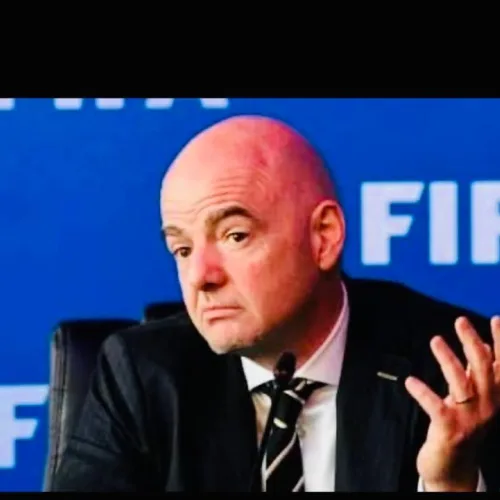
 Gianni Infantino
FIFA President Gianni Infantino has convened an emergency meeting of the world football governing body’s senior management in Rabat, Morocco, as pressure continues to mount over the controversial proposal to introduce private investment into a company that would oversee FIFA’s tournaments.
The emergency meeting on Wednesday, scheduled in the wake of growing opposition from major football confederations, will bring together FIFA Secretary General Mattias Grafstrom and members of the organisation’s management board to address the fallout from the now-abandoned FIFA Forward Enterprise (FFE) proposal. Blueprint reports
The latest development comes amid an escalating governance crisis that has seen European football’s governing body, UEFA, publicly declare that it has lost confidence in Infantino’s leadership.
FIFA abandons controversial investment plan
The controversy began after reports emerged that FIFA was considering establishing a commercial entity known as FIFA Forward Enterprise (FFE) to manage the commercial and operational aspects of its tournaments.
Under the proposal, FIFA intended to sell a 20 per cent stake in the new company to private investors in a move designed to attract fresh investment into world football.
However, the proposal immediately sparked widespread opposition from several continental football confederations, who argued that the plan could undermine FIFA’s independence and commercial control over its flagship competitions.
Faced with mounting resistance, FIFA officially abandoned the proposal over the weekend.
Wenger backs decision
Former Arsenal manager and FIFA’s Chief of Global Football Development, Arsène Wenger, has now publicly distanced himself from the controversial project.
Breaking his silence on the matter, Wenger said he had no involvement in the proposed investment initiative and described FIFA’s decision to abandon it as the only acceptable course of action.
He reiterated his belief in an independent FIFA, stressing that the organisation must continue to serve global football with commitment, transparency and integrity.
His comments have added further weight to growing calls for greater accountability within football’s world governing body.
UEFA withdraws confidence
Despite FIFA’s decision to withdraw the proposal, the controversy has continued to deepen.
UEFA announced that it had lost confidence in Infantino, while reports indicate that several national football associations, including those of England and Wales, have also withdrawn their support for the FIFA president.
The Scottish Football Association is also understood to have aligned itself with UEFA’s position.
Earlier reports suggested that UEFA had even considered boycotting FIFA competitions, including the FIFA World Cup, if the investment proposal had not been abandoned.
Other continental bodies, including the Confederation of North, Central America and Caribbean Association Football (CONCACAF) and the Asian Football Confederation (AFC), also expressed opposition to the initiative.
Council members seek accountability
The crisis has also intensified within FIFA itself, with reports indicating that members of the FIFA Council are attempting to secure the required 19 votes needed to convene a formal meeting to hold Infantino accountable over both the FFE proposal and his handling of other governance matters.
According to reports, if sufficient support cannot be secured or if Infantino declines any request for such a meeting, some member associations are considering a “governance boycott” that could significantly disrupt FIFA’s administrative activities.
The possibility of such action reflects the growing dissatisfaction among sections of world football over the organisation’s recent direction.
Staff reassured amid uncertainty
Amid the unfolding crisis, FIFA Secretary General Mattias Grafstrom has sought to reassure staff members affected by the controversy.
In an internal communication, Grafstrom described the events of the past week as “a sad and reproachable series of events” while expressing relief that the controversial project had been permanently abandoned.
He acknowledged the uncertainty experienced by FIFA employees and assured them that they would be protected from the political tensions currently affecting the organisation.
Grafstrom also reminded staff that while individuals and difficult moments may pass, FIFA’s responsibility to global football remains unchanged.
Leadership under increasing scrutiny
The latest developments follow the recent resignation of Infantino’s senior adviser, Carlos Cordeiro, further fuelling speculation over growing tensions within FIFA’s leadership structure.
Although Infantino is still believed to enjoy considerable support from football associations across Africa, South America and Oceania, observers say the position of several Asian football federations could ultimately prove decisive should any leadership challenge emerge.
While countries such as Qatar, the United Arab Emirates, Sri Lanka and Lebanon are reported to have maintained their backing for the FIFA president, Jordan has taken a sharply different stance.
Jordan Football Association president Prince Ali bin Al Hussein accused FIFA of attempting to influence his support by allegedly linking financial payments owed to his federation to his vote in favour of Infantino.
FIFA has acknowledged awareness of the allegation but has yet to issue an official response.
Legal action looms
Adding to the pressure, UEFA is reportedly considering legal action against FIFA over the abandoned investment proposal.
Lawyers representing the European governing body have reportedly instructed FIFA officials to preserve all documents and records relating to the FFE project as part of preparations for possible legal proceedings.
The emergency meeting in Rabat is therefore expected to focus not only on restoring confidence within FIFA but also on addressing the growing political and legal challenges confronting the organisation.
With divisions widening among football’s governing bodies and questions continuing to surround FIFA’s governance, the coming weeks are expected to be crucial in determining both the future of the organisation’s leadership and the direction of global football administration.
Comments
Start the conversation about this story.