





While the broader equities market frequently celebrates record-breaking rallies and high-flying sector leaders, a very different story often unfolds in the shadows of the banking sector.
As the Nigerian Exchange market closed trading on August 4, the benchmark NGX All-Share Index (ASI) settled at 244,802.83 points, reflecting a marginal daily pullback of 0.38percent.
Even with this slight dip, the index boasts an impressive year-to-date (YtD) return of 57.32 percent, underscoring an otherwise fiercely bullish multi-month rally driven by aggressive institutional capital and banking sector recapitalisation milestones.
Despite broad market optimism, certain legacy lenders and financial institutions are failing to keep pace with their peers and the broader index. While tier-1 financial giants push the broader index to historic heights, a distinct group of lenders continues to lag behind.
Interestingly, the NGX Banking Index (NGX Banking) recorded a year-to-date (YtD) gain of approximately 65.86 percent, surpassing the market’s benchmark index.
This impressive performance was bolstered by a strong July-August surge where the banking sector index emerged as one of the market’s leading sectoral performers – driven by high-cap rallies, robust corporate earnings disclosures, and intense investor positioning.
As the market digested the trading session on August 4, the gap between the broader market’s stellar 57.32 percent YtD return and its weakest financial counters became impossible to ignore.
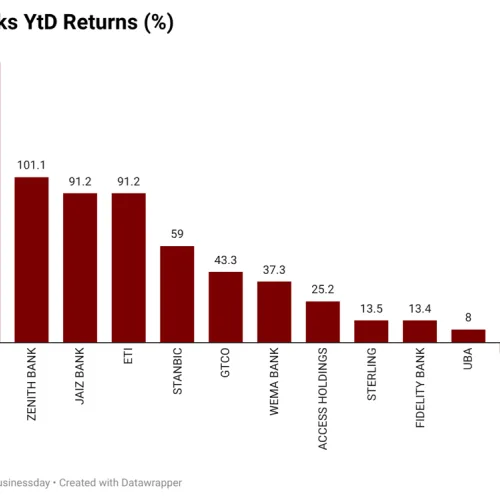
As at that date, the five banking stocks trailing the pack and their year-to-date returns are: FCMB Group (-6.64 percent), United Bank for Africa Plc (+8.04percent), Fidelity Bank Plc (+13.42 percent), Sterling Financial (+13.48 percent), and Access Holdings (+25.24percent).
These banks varying performance figures emphasise a selective market where investors are heavily rewarding aggressive capitalisation strategies, digital footprint scale, and balance sheet expansion, while taking profits on institutions after industry-wide banking recapitalisation. Some banks had to aggressively tap the capital markets through massive public offers, rights issues, private placements, or minority divestments to meet the towering thresholds.
The exercise fundamentally reshaped trading patterns on the Nigerian Exchange Limited. Lenders that efficiently mobilised capital and successfully secured their new status drew strong investor confidence. Conversely, other institutions see profit-taking from investors reallocating their portfolios following heavy share dilutions.
FCMB (-6.64 percent YtD)
FCMB Group Plc was the sole negative performer in this group. The contraction reflects localised profit-taking in the stock, tighter competitive pressures within retail banking, and capital rotation by stock investors toward higher-momentum banking tickers.
United Bank for Africa (+8.04 percent YtD)
UBA posts positive return but far underperforms the market’s benchmark index. As a dominant pan-African player, its strong geographic diversification and consistent dividend expectations continued to attract steady buying interest, despite occasional market-wide profit-taking.
Fidelity Bank Plc (+13.42 percent YtD)
Though Fidelity Bank records double digit return YtD, but it is below the NGX-ASI which printed higher this year at +57.32 percent. Fidelity Bank which has benefited from active internal share allocations is firmly among the low performers in the banking sub-sector.
Sterling Financial Holdings Plc (+13.48 percent YtD)
Sterling recorded double-digit gains this year, but it is still below the NGX-ASI which is up by +57.32 percent this year. Like Fidelity Bank, the NGX-ASI return YtD is more than four times higher than that of Sterling Financial Holdings.
Access Holdings Plc (+25.24 percent YtD)
Though still underperforming the market’s benchmark index, Access Holdings led the pack of top five underperformers in the banking sector with a stellar surge. Strong institutional demand, aggressive digital ecosystem adoption, and broad investor confidence following major corporate expansions propels its stock upward.
Get Newsletter Updates
Enjoying our column?
Subscribe to our specialised **Tax 360** feed to receive fresh reports and analyses directly in your inbox.
Iheanyi Nwachukwu, is a creative content writer with almost two decades journalism experience writing on banking, finance, capital markets, and tax. The multiple awards winning journalist is Assistant Editor, BusinessDay. Iheanyi holds BSc Degree in Economics from Imo State University; Master of Science (MSc) Degree in Management from University of Lagos. Iheanyi has attended several work-related trainings including (i) Advanced Writing and Reporting Skills (Pan African University, Lagos); (ii) News Agency Journalism (Indian Institute of Mass Communication {IIMC}, New Delhi, India); and (iii) Capital Markets Development and Regulations (International Law Institute {ILI} of Georgetown University, Washington DC, USA). Other trainings Iheanyi attended include: Economic/Political Risk Analysis (By Thomson Reuters Foundation); International Financial Journalism (IFJ) (By PMA Media Training, UK); Effective Business Writing Skills (By Phillips Consulting); Reporting on Corporate Governance (By International Finance Corporation (IFC) & Thomson Reuters Foundation UK); etc. In addition, he has participated in high-level economy & markets events in Dubai, South Africa, Morocco, and other African countries like Zambia, Ghana and Gambia.

Comments
Start the conversation about this story.