





- Advertisement -
The Health of Mother Earth Foundation (HOMEF) has raised alarm over what it described as the prolonged environmental disaster unfolding in Uzere Kingdom, Delta State, accusing Heritage Energy Operational Services Limited of failing to contain and clean up an oil well blowout more than five weeks after the incident occurred.
In a field report released on August 3, 2026, following a visit to the community on July 25, the environmental advocacy organisation warned that the continuing discharge of crude oil and associated petroleum substances from Well 14 in Oil Mining Lease (OML) 30 poses grave threats to livelihoods, public health and the fragile ecosystem of the oil-producing community.
The blowout occurred on the night of June 26, 2026, at the Heritage Energy-operated facility in Uzere Kingdom, Isoko South Local Government Area of Delta State.
According to HOMEF, Uzere – one of Nigeria’s oldest oil-producing communities where commercial oil exploration began in 1957 – hosts more than 43 producing wells with a combined output of about 53,000 barrels of crude oil per day. The community’s economy depends largely on farming and fishing, making it particularly vulnerable to environmental pollution.
The organisation said community leaders who visited the site shortly after the incident were informed by company engineers that the blowout resulted from equipment failure caused by excessive pressure.
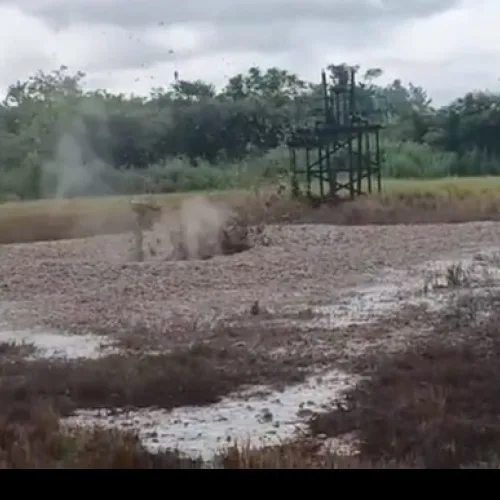
Despite demands by residents for immediate intervention, HOMEF said the company was unable to halt the uncontrolled release of crude oil, gas and associated petroleum fluids. More than one month later, the damaged wellhead, commonly referred to as the “Christmas Tree,” had reportedly collapsed and continued to leak petroleum products into the surrounding environment.
HOMEF warned that the location of the damaged facility – close to farmlands, fish ponds and a gas flare stack – could trigger a much larger ecological disaster as the annual flood season approaches.
“The damaged wellhead is located dangerously close to agricultural land, fish ponds and a gas flare facility,” the report stated. “With the flood season imminent, there is a significant risk that crude oil and associated pollutants could spread into rivers, wetlands and farmlands, worsening ecological damage and threatening food security.”
The report said residents remain haunted by the devastating floods of 2012 and 2022, which destroyed livelihoods and caused extensive environmental damage. Community members fear a repeat scenario, this time compounded by widespread oil contamination.
Chairman of the Uzere Oil and Gas Committee, Mr. Sylvanus Evroro, said the community had experienced a smaller oil spill in the same field about a decade ago, but it was successfully contained.
He expressed concern that the current blowout remains unchecked as the rainy season intensifies.
“August is approaching, and without intervention from the authorities responsible for salvaging the well blowout, the coming flood will worsen the situation by spreading the spill across the community and beyond,” Evroro said.
He warned that the community’s economic survival is at stake if urgent action is not taken.
“About 90 per cent of our people are farmers and fishers. If this blowout is not contained immediately, our farms, fish ponds, lakes and swamps will be seriously affected, with grave consequences for livelihoods and food production,” he added.
According to the report, community leaders said Heritage Energy notified the National Oil Spill Detection and Response Agency (NOSDRA) almost two weeks after the incident.
Residents told HOMEF that officials of the agency later visited the site and reportedly attributed the blowout to poor maintenance of the operator’s equipment. However, they lamented that no meaningful containment or environmental remediation had commenced as of the organisation’s assessment.
HOMEF also disclosed that its delegation, accompanied by community leaders, was denied access to the affected site by security personnel, who insisted that authorisation must first be obtained from Heritage Energy’s office in Warri.
As a result, the organisation based its assessment on photographs, video recordings and eyewitness accounts provided by community representatives. It also noted that no Joint Investigation Visit (JIV) report was made available during the assessment.
The environmental group said the inability to directly inspect the site did not diminish the seriousness of the evidence gathered.
“Evidence gathered from community testimonies, photographs and videos indicates that the blowout presents serious environmental, economic and public health risks,” the report stated.
HOMEF further argued that the prolonged failure to contain the blowout raises broader concerns about emergency preparedness, regulatory oversight and accountability within Nigeria’s oil industry.
The organisation urged Heritage Energy to immediately deploy internationally accepted emergency response measures to stop the ongoing discharge of crude oil and associated pollutants, undertake comprehensive environmental cleanup and remediation, replace ageing infrastructure and decommission obsolete wellheads and pipelines.
It also called on the company to grant unrestricted access to affected communities, regulators and independent observers to ensure transparency throughout the response process.
HOMEF further urged NOSDRA to immediately conduct and publicly release the findings of a transparent Joint Investigation Visit, enforce regulatory compliance and supervise the full restoration of affected ecosystems.
The organisation also called on the Delta State Ministry of Environment and other environmental authorities to undertake independent environmental, ecological and public health assessments to determine the full extent of contamination.
Criticising existing regulatory practices, HOMEF said environmental agencies should no longer wait for invitations from oil companies before inspecting pollution sites, describing the approach as outdated and ineffective in delivering environmental justice.
Finally, the organisation called on the Federal Government and the Delta State Government to protect the rights and livelihoods of the people of Uzere by ensuring fair compensation, livelihood restoration and long-term environmental monitoring until the affected ecosystem has fully recovered.
HOMEF said timely intervention is essential to prevent the disaster from escalating into a wider humanitarian and environmental crisis, particularly as floodwaters threaten to spread oil pollution across rivers, wetlands, farms and fishing grounds in one of the Niger Delta’s historic oil-producing communities.
Comments
Start the conversation about this story.