





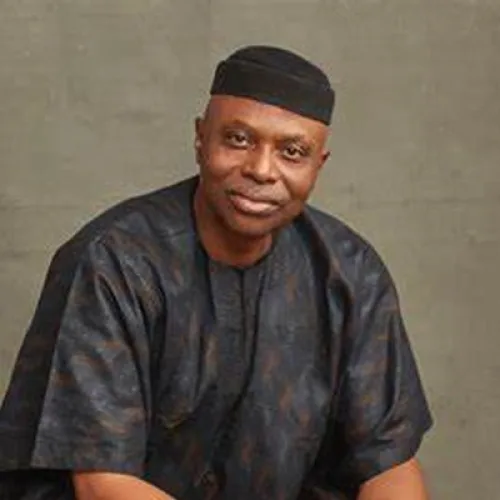
Former Governor of Ondo State, Dr Olusegun Mimiko, has called for the urgent adoption of what he called the “Jethro Principle” as a structural solution to Nigeria’s governance challenges, saying devolution of authority and resources is key to efficiency and accountability.
Speaking at the Pastor’s Seed Event of the 74th Annual Convention of the Redeemed Christian Church of God (RCCG), on the topic “The Government and Politics Mountain” under the convention theme, “Mountain Movers,” Mimiko said Nigeria must learn from Exodus 18 to dismantle centralised failure further.
Mimiko noted that Moses suffered burnout and administrative gridlock when he attempted to govern millions from the centre alone, until his father-in-law, Jethro, advised him to delegate authority to capable leaders over thousands, hundreds, fifties and tens.
According to him, “The Jethro Principle teaches us that effective governance must be built on merit, capacity and capability. Power and responsibility must be pushed closer to the people so local issues can be handled locally, while only national matters rise to the centre. That is the template for true federalism.”
While acknowledging the ongoing efforts of the Tinubu presidency to decentralise policing, resource management, and decision-making to sub-national governments to address peculiar community challenges, he recommended the Jethro model, which he says is “a vital structural tool for dismantling systemic governance failure.”
Linking the biblical model to present realities, Mimiko said excessive concentration of power at the centre has been the root cause of Nigeria’s five major political mountains: ethnocentrism, corruption, insecurity, poverty and poor leadership.
His words: “Centralised government cannot manage a multi-ethnic, multi-cultural and multi-religious nation like Nigeria effectively,” he said. “We need subsidiarity. Leaders closest to the people must be empowered to solve problems closest to the people.”
Addressing a gathering that included many youths, Mimiko urged Nigerian Christians and people of all faiths to actively participate in politics, arguing that government and politics are strategic “spheres of influence” that shape the nation’s future.
He said, “Politics should not be viewed merely as a contest for power, but as the process through which authority is exercised for the common good. “Government is the institution that deploys such authority to organise society.”
Mimiko said Christians have a biblical responsibility to engage governance because government policies directly affect citizens’ welfare in areas of security, education, employment and religious freedom.
Citing Scripture, he added that God’s mandate for government revolves around dominion and justice, with rulers called to act as faithful stewards by protecting the poor and vulnerable.
He cited biblical and historical examples of leaders who applied the principle of delegated, merit-based governance. These include the Good Samaritan as a model of compassionate, borderless leadership; Nehemiah, who fought corruption as governor; and Joseph and Daniel, who used integrity and competence to influence governance in foreign kingdoms.
He also referenced British statesman William Wilberforce and South African cleric Desmond Tutu as examples of faith-driven leaders who transformed society. He said they demonstrated that faith should redeem power rather than retreat from it.
He challenged young professionals, accountants, lawyers, teachers, technologists, and pastors to see politics as a calling.
His words: “Joseph, Daniel, and Nehemiah did not run from the secular mountain. They climbed it. They didn’t wait for governance to become Christian; they brought divine wisdom into the halls of power to transform their society.
“We cannot pray for God to bless our nation on Sunday, and then abandon the seats of power on Monday. When responsible citizens avoid public service, less competent individuals take over.
“The goal is not power for power’s sake. The goal is a nation where righteousness exalts the people.”
He called on Nigerians to combine prayer with responsible civic engagement in pursuit of national renewal.
Please follow and like us:
Comments
Start the conversation about this story.