





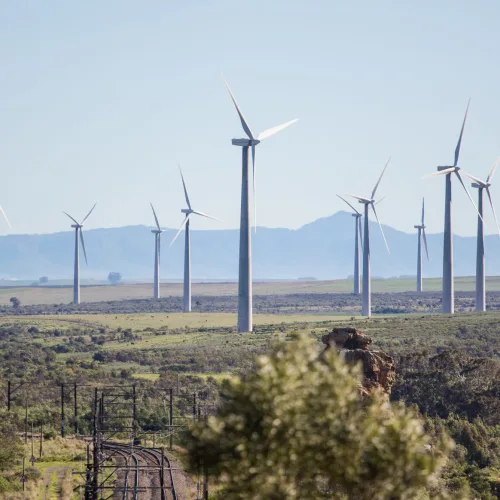
Close up image of a wind farm in south africa, supplying eco friendly electricity actual, power, electrical, modern, prairie, field, windfarm, environment, production, development, electric, turbine, sustainable, energy, windmills, electricity, mill, blue, generator, windfarms, sustainability, clear, industrial, innovation, wind, windmill, meadow, spain, innovative, green, equipment, environmental, grassland, white, windturbine, grass, generation, turbines, ecology, farm, alternative, landscape, nature, sky, ecological, renewable, renewable energy, renewable resource, wind energy, wind turbine, Engine, Machine, Motor, Outdoors, Turbine, Wind Turbine, Windmill BII's innovative funding approach is supporting independent sustainable energy trading via Etana Energy while giving South Africa more reliable electricity. 500MW of clean energy will be added to South Africa's grid.
Nigeria is moving to position itself as a manufacturing and investment hub for renewable energy, as officials warn that Africa’s most populous nation is capturing only a fraction of a global clean-power market now drawing more than $2 trillion a year in investment.
Speaking at the Global Initiative for Food Security and Environmental Protection (GIFSEP) Solar Forum in Lagos on Tuesday, Olamide Fagbuji, senior special assistant to the president on climate technology and operations, said Nigeria’s energy strategy must go beyond simply installing solar panels and instead build a domestic industrial base spanning manufacturing, financing, maintenance and recycling.
“Nigeria must position itself as a producer, assembler and exporter of renewable energy technologies, not just a consumer of them,” Fagbuji told delegates, citing China, India and Vietnam as examples of countries that built long-term prosperity from manufacturing clean-energy hardware rather than importing it.
According to the International Energy Agency, annual clean-energy investment needs to climb toward $4.5 trillion by 2030 to meet global net-zero targets, with solar photovoltaic technology commanding the single largest share.
Yet Africa, home to roughly a fifth of the world’s population and some of its richest solar resources, still attracts only 2 percent to 3 percent of that capital, Fagbuji said, even as the continent needs more than $200 billion a year in energy investment through the end of the decade.
Nigeria’s own numbers illustrate both the opportunity and the shortfall. Daniel Awolaja, co-founder of the Africa Energy Tracker, told the forum that Nigeria drew roughly $100 billion in disclosed energy investment over the past decade across 422 projects, the second-highest total in Africa after South Africa.
But he said about 92 percent of that capital went to oil and gas, leaving renewables, transmission and storage chronically underfunded.
The mismatch between installed capacity and delivered power remains stark. Nigeria has roughly 14 gigawatts of installed generation capacity, Awolaja said, but the national grid typically delivers only about 5 gigawatts, while close to 90 million Nigerians still lack reliable electricity access. He described a parallel, unofficial power market sustained by millions of privately owned diesel and petrol generators — a system he said now supplies several times more electricity than the grid itself.
“These generators have effectively become an unofficial component of Nigeria’s electricity system,” Awolaja said, cautioning against any near-term ban on generator or solar-panel imports before the country’s underlying supply gap is addressed.
That warning was echoed by David Michael Terungwa, executive director of GIFSEP, who said Nigeria cannot yet wean itself off imported solar equipment even as it pushes local manufacturing. Lithium battery plants have been commissioned in Zamfara and Nasarawa states, and the National Agency for Science and Engineering Infrastructure (NASENI) is working on locally produced solar panels, he noted.
“Banning solar imports now would be like removing lifelines in a crisis,” Terungwa said, calling instead for incentives for local production, support for assembly and manufacturing, and cheaper financing for clean-energy systems.
Policy architecture, officials argued, is largely already in place. The Electricity Act 2023 decentralised Nigeria’s power sector, allowing states to establish their own electricity markets and regulatory bodies for the first time.
Fagbuji said the law has helped unlock more than $1.3 billion in investment commitments through programs including the Nigeria Electrification Project and the Distributed Access through Renewable Energy Scale-up program, which together aim to power millions of households and support hundreds of thousands of small businesses.
Awolaja said Nigeria’s regulatory framework for decentralised mini-grids, first introduced in 2015, is, in some respects, more advanced than that of peer emerging markets.
He recounted that Nigerian officials who travelled to Brazil to study its mini-grid rules found Brazilian regulators still building systems Nigeria had established years earlier.
“Nigeria’s primary challenge lies not in policy design but in implementation,” he said.
Officials also linked energy access directly to food security. Fagbuji cited Food and Agriculture Organisation estimates that Nigeria loses 30 million to 40 million metric tons of food annually to post-harvest losses — worth roughly N3.5 trillion to N5 trillion, much of it tied to a lack of reliable power for cold storage, irrigation and processing.
Chris Kiff, senior director at the Secure Energy Project, urged the more than 100 government officials, investors and civil-society representatives in the room to coordinate rather than duplicate efforts.
“The objective isn’t to launch a new campaign,” Kiff said, but to align existing initiatives “under a common framework” that strengthens Nigeria’s collective bargaining power with investors and policymakers alike.


Dipo Oladehinde is a skilled energy analyst with experience across Nigeria's energy sector alongside relevant know-how about Nigeria’s macro economy. He provides a blend of market intelligence, financial analysis, industry insight, micro and macro-level analysis of a wide range of local and international issues as well as informed technical rudiments for policy-making and private directions.
Comments
Start the conversation about this story.