





By Femi Falana SAN
Former military head of state, General Abdulsalami Abubakar has belatedly joined the dubious campaign to sanitise the ignominous Abacha era. In his interview published by the Sun newspaper on June 26, 2026, the retired general attempted to rewrite history in a rather untidy manner when he claimed that the much talked about Abacha loot is a hoax, saying that the former military head of state, the late General Sani Abacha, never stole money belonging to the country.
According to General Abubakar, what is usually referred to as Abacha loot was money the former head of state had saved for the country, following advice from former Libyan Leader, Muammar Gaddafi; former Benin Republic President, Mathieu Kérékou and others, in order for the country not to be financially handicapped in case of freezing of the nation’s accounts arising from sanctions from the international community. Even though Presidents Gaddafi and Kerekou are no longer alive to confirm or deny the monstrous allegation, they could not have advised General Abacha to engage in the reckless looting of the nation’s treasury.
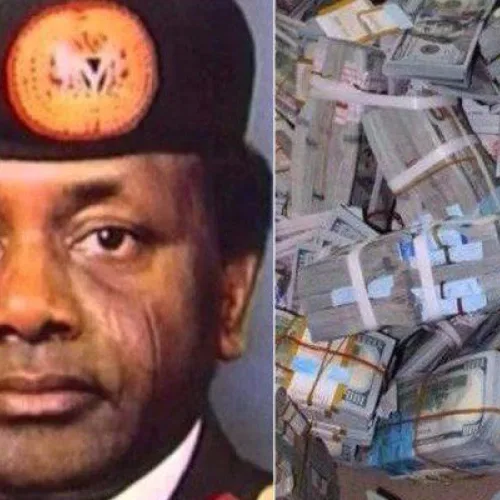
In fact, General Abubakar did not believe the cock and bull story that General Abacha had saved any money for the country. Hence, on the 23rd day of July 1998, his regime instituted a Special Investigation Panel (SIP) with the sole mandate to investigate the looting and corruption that characterised the Abacha era. In the course of the investigation, the SIP headed by Mr. Peter Gana, a Deputy Commissioner of Police unravelled the gargantuan Abacha loot with the connivance of the management of the Central Bank of Nigeria. A large quantity of the cash and properties were recovered by the SIP.
In its report published in November 1998, the SIP revealed that General Abacha approved several fake funding requests for security operations or purchase of equipment by his National Security Adviser (NSA). Upon approval of the fraudulent funding requests, General Abacha directed the Central Bank to release cash in dollars and pounds. The cash was then handed over to the NSA who ensured that the cash was transferred to family members and business associates of General Abacha. It was also confirmed that many properties in many cities were bought with the stolen funds.
General Abubakar accepted the report in toto and promptly acted on it. In particular, he promulgated and signed the Forfeiture of Assets, Etc. (Certain Persons) Decree No. 53 of 1999, which legitimised the forfeiture and return of the Abacha loot located in Nigeria and Sierra Leone. Pursuant to the decree, General Abacha, family members, political associates and political allies were made to forfeit the total sum of $636, 263,187,19, £75, 306 886.93, DM 30m and N547 million as well as 30 percent shares in 2 refineries in Sierra Leone worth $380,000. Also forfeited were several properties in the choice areas in Lagos, Abuja, Kano, Zaria and very expensive official vehicles that had been converted to illegal use by Abacha’s aides.
For the avoidance of doubt, section 1 of the Forfeiture Decree stipulates that the various sums of money and properties listed in parts 1 and 2 of the Schedule were “acquired corruptly and illegally” by General Abacha and his cronies and were forfeited to the Federal Government of Nigeria “free from all encumbrances without any further assurance other than this Decree.” The jurisdiction of the Court was ousted from entertaining any suit in respect of anything done or purported to be done under the Decree.
In a desperate bid to justify the Abacha loot, General Abubakar further stated that, “And I believe, if you will remember, there was a certain time Abacha bought vehicles for the security agencies. He bought some Tata vehicles. It was from that money he was able to do that. Unfortunately, as I said, he did not bring us into confidence of what he was doing.” Contrary to General Abubakar’s false narrative, Mr. Raj Bhojwani, a business associate of the former dictator, General Sani Abacha, was convicted and jailed in the high court of Jersey for money laundering. He was ordered to forfeit $45 million to the Nigerian Government.
No doubt, General Abubakar must have forgotten that he was the first ruler to indict, name and shame General Abacha for the large scale looting of the treasury. To that extent, the former military ruler deliberately set out to mislead Nigerians to believe that the Abacha loot is a hoax. But having recovered funds and assets worth over $750 million from the estate of the late dictator, his family members and associates, General Abubakar cannot be permitted to cover up the grand larceny of his predecessor.
It is on record that President Olusegun Obasanjo who succeeded General Abubakar engaged the services of a private prosecutor, Enrico Monfrini, a Swiss lawyer known for international asset recovery, to trace the Abacha loot outside Nigeria. Monfrini relied on the report of the SIP in tracing the Abacha loot located in many financial institutions of western countries. Not less than US$1.2 billion was recovered by the Obasanjo administration.
The Goodluck Jonathan administration equally relied on the SIP report and recovered a large chunk of the Abacha loot. Notwithstanding that General Mohammmadu Buhari had said that he did not believe that Abacha plundered the treasury, the country recovered a substantial part of the Abacha loot under his watch when he later became the President of Nigeria. To avoid the Abacha loot from being re-looted by local corrupt officials, the Buhari administration agreed with the Swiss Government to invest the recovered loot in development projects monitored by credible NGOs.
It is pertinent to note that in all the court cases that were instituted in Nigeria, Switzerland, France, United States, United Kingdom, Jersey etc, no person or institution ever pleaded that the Abacha loot was kept for the Federal Government of Nigeria. Indeed, family members of the late dictator and his business allies attempted but failed to claim that the funds belong to them. One of the cases is currently pending in the United States where a serving minister in Nigeria is laying claim to the sum of $130 million recovered from the Abacha loot.
It is interesting to note that the recovery of the Abacha loot remains an unfinishedb business. In fact, sometime in November 2023, France’s Minister of Europe and Foreign Affairs, Mrs Catherine Colonna, said $150 million found to have been looted by Abacha would be repatriated to Nigeria. She said: “I also informed President (Bola) Tinubu that, in response to the request submitted by the Nigerian Federal Ministry of Justice and in agreement with the US Administration, France will return to Nigeria the assets stolen from the Nigerian people by General Sani Abacha and his family that have been frozen in France since 2021.” France however stated that the $150 million on the condition that it will be earmarked for “development projects benefiting the population, according to the priorities of the Nigerian government.”
It is crystal clear that General Abubakar, out of sheer class solidarity, has turned round to claim, rather falsely that the Abacha loot was money saved for the Government of Nigeria. But having promulgated and signed the Forfeiture Decree No 53 of 1999 which legalised the forfeiture of the Abacha loot, General Abubakar should apologise to Nigerians and withdraw the statement that the Abacha loot is a hoax. In addition, the retired military ruler should step down as the Chairman of the National Peace Committee set up to mediate political tensions and organise peace accords for Nigerian elections.
Finally, we are compelled to attach a copy of the Forfeiture Decree No 53 of 1999 promulgated and signed by General Abdulsalami Abubakar on May 26, 1999 which listed the funds and properties “acquired corruptly and illegally” by General Abacha, his family members and business associates. In addition, the decree has exposed the barefaced lie that the Abacha loot was money saved for the Government of Nigeria.
Comments
Start the conversation about this story.